
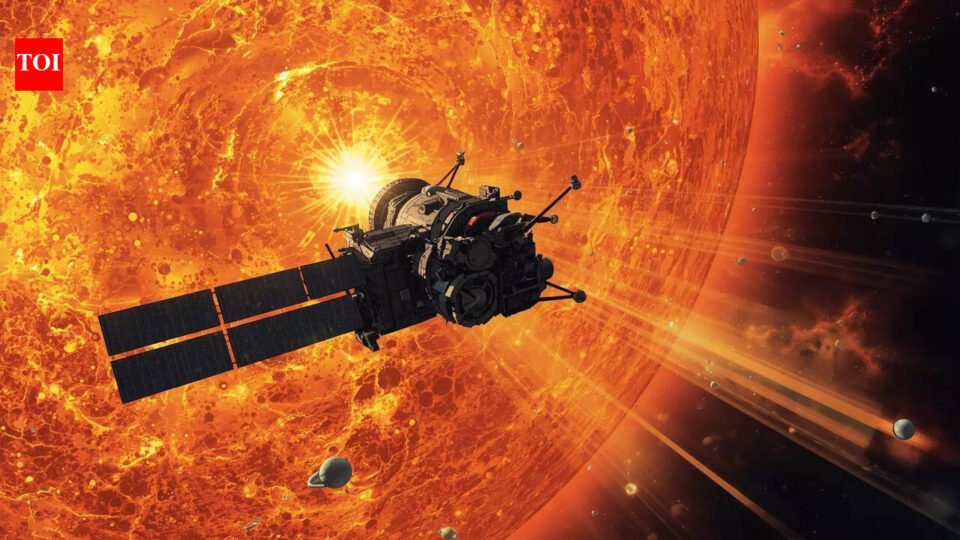
A spacecraft now moves through a region once thought unreachable, sampling the thin outer atmosphere of the Sun at distances no mission had managed before. Data returned by Parker Solar Probe is offering a closer look at how the solar wind is heated and pushed outward into space. The findings, published in Geophysical Research Letters, focus on how energy flows through the Sun’s corona and into the wider heliosphere. Researchers are using direct particle measurements rather than relying only on simplified models. The work is technical, but its implications are practical. Better knowledge of solar wind behaviour feeds into space weather forecasts, which affect satellites, radio systems, and power grids on Earth.
Direct particle data improves space weather forecasting models
Since its launch in 2018, the probe has moved progressively closer to the Sun, using repeated flybys of Venus to tighten its orbit. During recent encounters it travelled within a few million miles of the solar surface. At those distances, instruments measured the detailed motion of charged particles in the solar wind.The solar wind is a steady stream of plasma flowing away from the Sun. For years, scientists assumed the particles followed tidy mathematical patterns known as Maxwellian distributions. The new measurements show something less orderly. The velocity patterns are uneven, shaped by waves and magnetic forces that shift as the plasma expands.
New modelling tool changes how wave heating is calculated
To analyse these irregular particle patterns, researchers developed a numerical system called the Arbitrary Linear Plasma Solver. Instead of forcing observations into neat theoretical shapes, the tool calculates how real distributions respond to electromagnetic waves.The results suggest that some ion scale waves behave differently than earlier models predicted. In certain cases, damping rates increase or decrease by as much as a factor of three. That affects how much energy is transferred between waves and particles in the corona. It also alters estimates of how quickly the solar wind cools as it travels outward. Observations indicate the plasma retains heat longer than simple expansion would suggest. The reason is still being examined.
Findings reshape understanding of space weather and plasma physics
Understanding how the solar wind gains and keeps energy matters beyond solar physics. Disturbances such as coronal mass ejections travel through this same medium. Their speed and intensity depend partly on background plasma conditions. By measuring real particle behaviour close to the Sun, the mission is narrowing gaps that have persisted for decades. The data does not overturn earlier theory outright, but it adjusts it. Heating processes in the inner heliosphere appear more varied than once thought.Researchers note that the conclusions come from selected intervals and specific wave types. Further encounters may reveal additional patterns. For now, the probe continues its orbit, returning measurements from a region that had long remained theoretical.
