
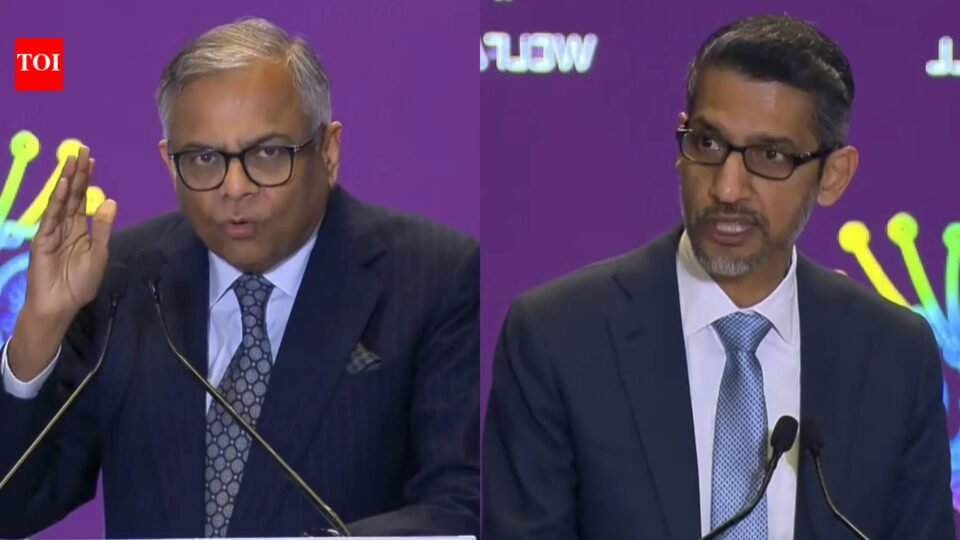
India’s AI ambitions took centre stage at the India-AI Impact Summit 2026 in New Delhi, where national and global leaders, policymakers, and top technology executives discussed how artificial intelligence is reshaping economies, governance, and society.From Union Minister Ashwini Vaishnaw’s emphasis on democratising AI and building sovereign capabilities, to Tata Sons Chairman N Chandrasekaran’s description of AI as the next major infrastructure shift, speakers framed the technology as both transformative and foundational. Additionally, industry leaders including Google CEO Sundar Pichai and Anthropic CEO Dario Amodei highlighted India’s growing role in the global AI ecosystem, while also flagging the scale of opportunities and emerging risks.
On day 4 of the summit, speakers emphasised themes of accessibility, sovereignty, infrastructure, and inclusive growth, reflecting India’s push to position itself as a trusted AI hub in the Global South.
‘AI must be democratised and scaled’: Union minister Ashwini Vaishnaw
Union Minister Ashwini Vaishnaw described AI as a foundational technology transforming work and decision-making, highlighting India’s integrated five-layer AI strategy spanning applications, models, compute, infrastructure, and energy.“Welcome to the first AI summit in the Global South and the biggest AI summit so far… The true value of technology lies in ensuring that its benefits reach the masses,” Vaishnaw said.“AI is a foundational technology transforming work and decision-making, and the Prime Minister’s vision is to democratise and scale it so its benefits reach the masses. India is working across all five layers of the AI stack, focusing on real-world solutions in sectors like healthcare, agriculture, education, and finance. At the model layer, emphasis is placed on sovereignty, with the belief that over 90 per cent of use cases can be addressed through smaller, specialised models that deliver value at lower cost,” he added, addressing heads of state, delegates, industry leaders, students and members of the media.He stressed the importance of sovereign AI capabilities at the model layer, arguing that most use cases can be addressed through smaller, specialised models delivering value at lower cost.Vaishnaw also announced what he called a key outcome of the summit, the “New Delhi Frontier AI Commitments”, a voluntary framework adopted by leading global and Indian AI companies. He said the initiative focuses on two priorities: advancing real-world AI usage through anonymised, aggregated insights to support evidence-based policymaking on jobs and skills, and strengthening multilingual, use-case evaluations to ensure AI systems work effectively across languages and cultures.
AI is the next major infrastructure: Tata Sons Chairman N Chandrasekaran
Chandrasekaran framed AI as a transformative infrastructure shift comparable to steam engines, electricity, and the internet. “AI, in my mind, is the next big infrastructure. It is the infrastructure of intelligence,” he said.Chandrasekaran argued that AI tools must reach the “last person,” highlighting how accessibility will define the technology’s societal impact. He cited examples of rapid AI adoption, including rural participants learning and deploying AI tools within hours, to illustrate the technology’s lowering barriers.He also positioned India as a nation of “AI optimists,” linking the country’s confidence to its track record in building large-scale digital public infrastructure, from digital identity systems to payments platforms. He emphasised the need to build capabilities across the full technology stack — from chips and systems to energy and applications — to ensure long-term competitiveness.
Energy to build together here is palpable: Anthropic CEO Dario Amodei
Anthropic CEO Dario Amodei hailed India’s AI ecosystem, praising what he described as the country’s unique drive and ambition. “The energy and ambition in this room and across India are incredible… the energy to build together here is palpable, unlike anywhere else,” Amodei said during his address.Highlighting Anthropic’s expanding footprint, he added, “As a sign of our commitment, we just this week opened an office in Bengaluru… We’ve also announced partnerships with major Indian enterprises, including Infosys.”Amodei stressed AI’s transformative potential, saying the technology could “cure diseases that have been incurable for thousands of years” and “lift billions out of poverty.” At the same time, he cautioned about risks, adding, “I’m concerned about the autonomous behaviour of AI models, their potential for misuse… and their potential for economic displacement.”
‘Biggest platform shift of our lifetimes’: Google CEO Sundar Pichai
Google CEO Sundar Pichai highlighted artificial intelligence as a defining technological transformation, describing it as “the biggest platform shift of our lifetimes.” Speaking at the summit, he emphasised that AI demonstrates how “nothing is impossible when humanity dreams big,” while cautioning that its benefits are “neither guaranteed nor automatic.”Further mentioning India’s expanding role in the global AI landscape, Pichai pointed to the rapid evolution of Visakhapatnam. “I remember it being a quiet and modest coastal city brimming with potential. Now… Google is establishing a full-stack AI hub, part of our USD 15 billion infrastructure investment in India,” he said, adding that the facility will bring “gigawatt-scale compute and a new international subsea cable gateway.”Explaining the grounds for optimism around AI, Pichai cited breakthroughs in scientific research. “AI can improve billions of lives and solve some of the hardest problems in science,” he noted, referencing AlphaFold’s impact on drug discovery. He added that the Nobel Prize-winning innovation “compressed decades of research into a database that is now open to the world,” now used by “over 3 million researchers in more than 190 countries.”Pichai also stressed the need for bold and responsible deployment of AI, saying, “We must be equally bold in tackling problems in regions that have lacked access to technology,” while reiterating the importance of inclusive and responsible development to ensure AI’s benefits are widely shared.
‘AI must belong to everyone’: UN chief Antonio Guterres
UN Secretary-General Antonio Guterres delivered one of the summit’s most direct cautions, warning that the trajectory of artificial intelligence cannot be left to “the whims of a few billionaires” or shaped by only a handful of countries. Stressing that “AI must belong to everyone,” he pushed for the creation of global guardrails to ensure oversight, accountability, and fairness as the technology rapidly advances.Guterres called on governments and technology leaders to back a proposed $3 billion Global Fund on AI aimed at building basic capacity and ensuring open, equitable access. Framing the figure as modest, he added that the target represents less than one per cent of the annual revenue of a single large tech company, calling it “a small price for AI diffusion that benefits all”.While talking about AI’s transformative promise, from accelerating medical breakthroughs to strengthening food security and climate resilience, he warned of the parallel risks. Without coordinated safeguards, AI could deepen inequality, amplify bias, and expose vulnerable populations to harm. He also emphasised the need to protect individuals from exploitation, stating that “no child should be a test subject for unregulated AI”.Beyond ethics and governance, Guterres flagged the growing environmental strain linked to AI infrastructure. As energy and water demands from data centres surge, he urged companies to prioritise clean power rather than “shift costs to vulnerable communities”.
‘India’s digital model sets global benchmark’: French president Emmanuel Macron
French President Emmanuel Macron talked about Europe’s role in shaping the future of artificial intelligence, describing the region as a “space for innovation and investment” amid rapid technological change. Addressing the summit, he also praised India’s digital public infrastructure as a global benchmark.“India built something that no other country in the world has built. A digital identity for 1.4 billion people. A payment system that now processes 20 billion transactions every month… They call it the India Stack — open, interoperable, sovereign. That is what this summit is about,” Macron said, pointing to the scale and impact of India’s digital systems.Reflecting on past collaboration, he recalled the AI Action Summit co-hosted by France and India in Paris. “We set a global guiding principle… Artificial Intelligence will be an enabler for our humanity to innovate faster… for the good of mankind. Both of us do believe in this revolution,” he said.Macron also acknowledged the competitive dynamics surrounding AI. “AI has become a major field of strategic competition, and big tech got even bigger,” he noted, underlining the need for balanced, responsible, and investment-driven innovation.
‘AI a global common good, must be trusted and safeguarded’: PM Modi
Prime Minister Narendra Modi positioned artificial intelligence as a shared global responsibility, urging leaders to “develop AI as a global common good.” Emphasising inclusion, he said AI must be democratised to become “a tool for inclusion and empowerment, particularly for the Global South.” PM Modi also unveiled the ‘MANAV Vision’ for AI, centred on moral and ethical systems, accountable governance, and national sovereignty.Flagging risks, he stressed that the AI ecosystem must remain “child safe and family guided,” while warning that deepfakes and fabricated content are destabilising open societies. Calling for global standards, he advocated authenticity labels, watermarking, and clear-source norms to embed trust in AI technologies “from the start,” noting that AI is not only making machines intelligent but amplifying human potential at an unprecedented speed and scale.
