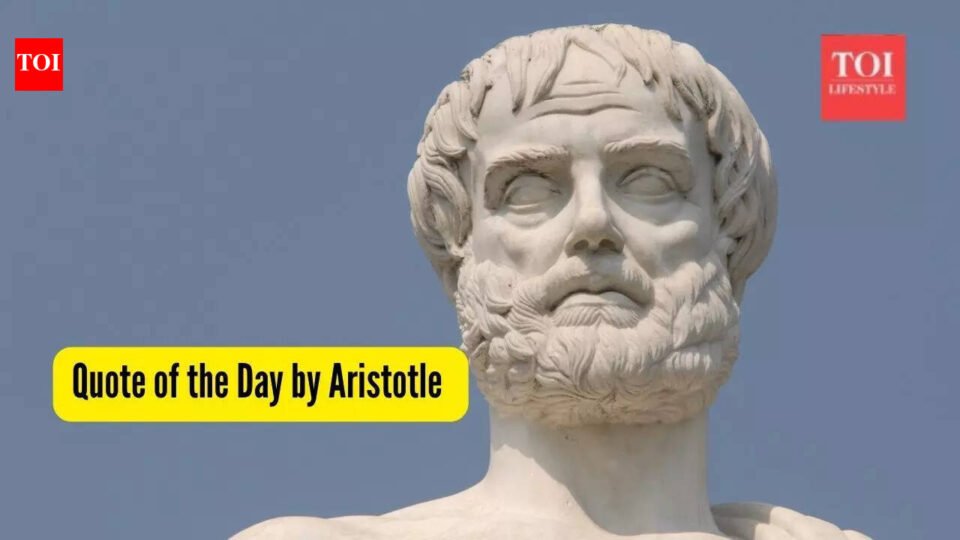
Aristotle, who is often called the father of Western philosophy, was more than just a thinker. He was a constant observer of the world, a teacher to kings, and a walking encyclopedia who influenced everything from science to ethics. He was born in Stagira, a small town in northern Greece, in 384 BCE. His father was the doctor to the Macedonian king, so he grew up in a family that was very interested in medicine. When he was 17, Aristotle moved to Athens to attend Plato’s Academy. There, he spent 20 years learning new things and eventually questioning his teacher’s beliefs. Plato thought that the world was made up of perfect Forms, which were eternal blueprints that were better than our messy reality. Aristotle? He rolled up his sleeves and said, “No, let’s look at the real world.”After Plato died in 347 BCE, Aristotle traveled around a lot. He went to Asia Minor for a short time, then to Lesbos to study biology, and finally to Macedonia to teach 13-year-old Alexander the Great. Think about how Aristotle shaped the mind of a future conqueror: he taught him to love Homer, ethics, and nature. Alexander later sent him strange things he had found during his campaigns, which helped Aristotle’s research. In 335 BCE, Aristotle went back to Athens and started the Lyceum, his own school. There, students “perambulated” while debating, which is why the philosophy is called “peripatetic.” He taught there until 323 BCE, when feelings against the Macedonians grew stronger after Alexander’s death. He had to leave with the quip, “I won’t let Athens sin twice against philosophy.” A year later, at the age of 62, he died in Chalcis.Aristotle wrote a lot, more than 200 works, but only about 30 of them are still around. Most of them are lecture notes from students. He wrote about a wide range of topics, including logic, metaphysics, biology, politics, poetry, rhetoric, and ethics. Aristotle’s writing was thick and systematic, like blueprints for reality, which was different from Plato’s dialogues. He divided knowledge into three categories: theoretical (what is?), practical (how to live?), and productive (how to make?). This framework lasts; modern universities still use it.Aristotle’s philosophyHis theory of causation was at the center of Aristotle’s worldview. There are four reasons why something exists: material (what it’s made of), formal (its structure), efficient (what makes it), and final (its purpose). A statue made of bronze? The sculptor’s design is formal, the chisel is effective, and the final product is a tribute to a hero. This teleology—purpose driving existence—pervades his thought. Nature isn’t random; acorns want to grow into oaks.Aristotle wrestled with “being qua being” in metaphysics. He rejected Plato’s separate Forms and instead suggested that substance is the most important thing. For example, “this horse” is a combination of form (horsiness) and matter (flesh and bone). His “prime mover,” which is an eternal, unchanging mind thinking itself, is pure actuality that starts motion without moving. It’s God as a cosmic battery, affecting theology from Aquinas to Einstein’s “Spinoza’s God.“Aristotle was the first person to come up with logic. In the Organon, he made syllogisms official: All men are mortal (major premise), Socrates is a man (minor premise), and Socrates is mortal (conclusion). This deductive tool gave rise to formal logic, which is the basis of science and law.Biology demonstrated his empirical approach. He cut up sea animals on Lesbos and made a list of 500 species, noting how embryos grew, which was the start of embryology. He wrote, “Nature does nothing in vain,” and he saw purpose in everything, from fish gills to human thumbs.Ethics The Nicomachean Ethics, which is named after his son Nicomachus, is where Aristotle’s ethics really shine. Happiness (eudaimonia) is not transient pleasure but thriving through virtue. There are two types of virtues: moral (courage, temperance) and intellectual (wisdom, understanding). Moral virtues develop through habitual practice, akin to muscle development. The “doctrine of the mean” is very important: virtue is the middle ground between two extremes. Courage is in the middle of being cowardly and being too brave. Generosity is in the middle of being too stingy and too generous. It’s not strict math; it’s calibrated judgment that comes from phronesis (practical wisdom).Ethics led to politics. People are “political animals” who do well in the polis (city-state). The best government? A mixed constitution that combines monarchy, aristocracy, and democracy, which is similar to how modern republics work. Justice requires that equals be treated equally and unequals be treated unequally based on merit. Slavery? He defended it as natural for “barbarians,” which is a flaw by today’s standards, but it came from his hierarchical view of the universe. He was well-rounded because of rhetoric and poetics. Logos (logic), pathos (emotion), and ethos (character) all work together in good speech. In the Poetics, tragedy cleanses pity and fear through catharsis, enhancing art. What did Aristotle have to do with it? Very big. Medieval scholastics, such as Aquinas, Christianized him; Renaissance humanists revived him; and scientists from Galileo to Darwin expanded upon his methodologies. Today, his ethics guide business schools, his logic guides computers, and his biology guides ecology.Quote of the dayOne of the most popular quotes of Aristotle is, “Just as at the Olympic games it is not the handsomest or strongest men who are crowned with victory but the successful competitors, so in life it is those who act rightly who carry off all the prizes and rewards.” This quote has a deep, abiding meaning. Imagine the old Olympics, when athletes from all over Greece came together every four years at Olympia. People scream as wrestlers fight, chariots race, and runners run. People in the crowd might swoon over the handsome Adonis lookalike or the strong man with shoulders like an ox. But winners get olive wreaths. These are the people who trained hard, made plans, and put up with cramps and dust. Just beauty or just strength? Not useful unless you do something.Aristotle applies this to life. Looks (kalos, handsome) and strength (ischuros) are not the end of innate gifts; they are the beginning. To win, you need praxis, which means doing good things on purpose.Successful competitors (nikaiousin hoi agonizontes) aren’t just good at wandering around; they compete (agonizomai, struggle). In the polis, the true rewards of life are prizes (stephanoi, crowns) like honor, wealth, and friendship.This quote sums up Aristotle’s ideas about morality: eudaimonia crowns the active soul. Potential (dunamis) becomes real through habit (hexis). The strongman who skips training loses, but the virtuous actor, even if he isn’t very good at acting, wins by being consistent. It’s against Plato: don’t wait for divine Forms; just jump in and practice.A deep, lasting meaning? A meritocracy based on character. In a world that loves the glamor of influencers and the luck of billionaires, Aristotle reminds us that good deeds bring good things. Success isn’t a lottery; it’s the result of hard work. During Athens’ golden age, when there were wars and plagues, this made people think carefully and fight bravely.Aristotle’s legacy lives on because he made philosophy more accessible to people. It wasn’t just abstract ideas; it was practical advice for how to live well. In a time when we are all so busy, his call to do the right thing feels very important. Crown yourself with good deeds.
