This is a parliamentary by-election result for the ages, one that sets the tone for its time.
It is the first by-election gain by the Greens at the 87th time of asking.
Only once before has the party polled above a tenth of the vote let alone gained a seat.
Follow live – politics latest
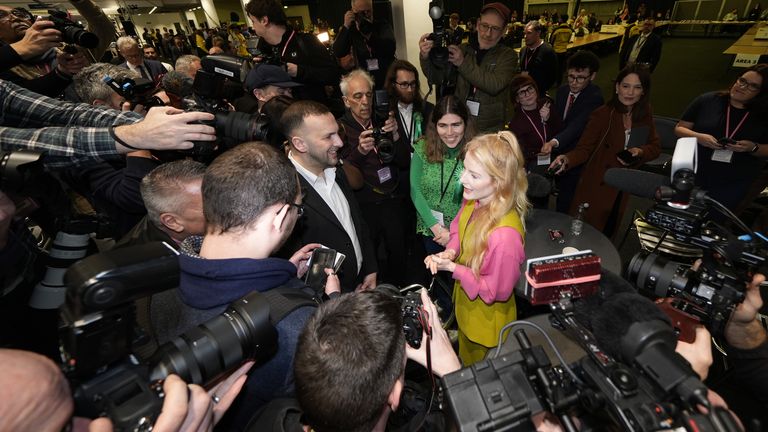
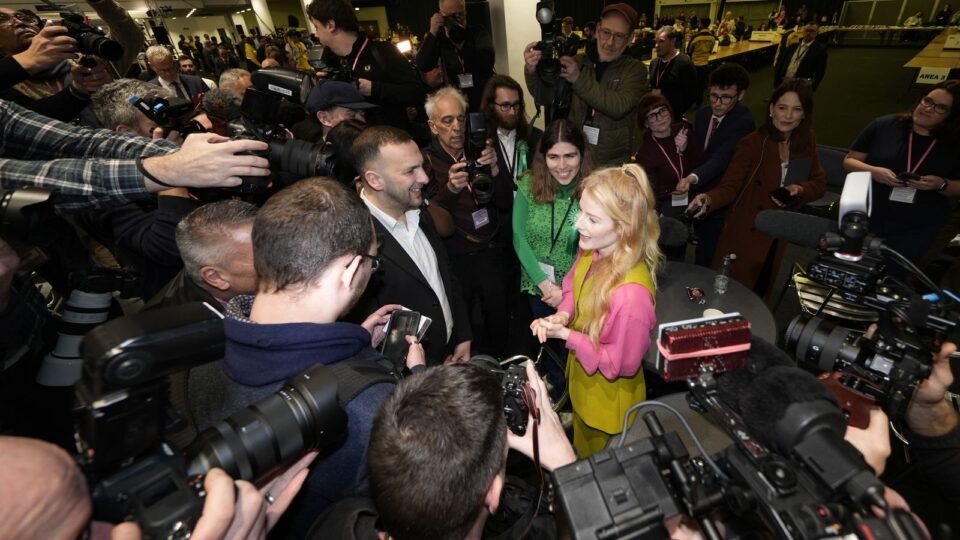
The Green Party’s Hannah Spencer celebrates winning the Gorton and Denton by-election with party leader Zack Polanski. Pic: PA
Hannah Spencer’s 40.7% share of the vote is 27.5 percentage points higher than the party polled at the last general election.
She becomes only the 18th candidate over the last 100 years to take her party from third at the general election to first place at a parliamentary by-election.
Under its new leader Zack Polanski, the party has moved further to the left of British politics, the clearest competitor to Labour in large parts of the country.
For the second successive by-election, following Reform UK’s gain in Runcorn and Helsby in May 2025, a party outside the three parties of Labour, Conservative and Liberal Democrats has gained a seat.
We are in a new era of multi-party politics.
Crucially, the decision of Workers Party leader George Galloway not to add his party to the eleven-strong ballot, made an impact. At the 2024 contest the Workers Party candidate finished fourth with 10.3%.
Galloway, himself a winner of two by-elections in Bradford West (2012) and Rochdale (2024), instead gave free passage to the Greens to fight a campaign that directly addressed the conflict in the Middle East.
There is no disguising the fact that the result in Gorton and Denton is dreadful for the Labour government as the party fell from first to third place.
In what was Labour’s 38th safest seat – its 36.7% general election majority evaporated.
It becomes the seventh largest Labour majority to be overturned.
The party’s vote share suffered a drop of 25.3 percentage points – becoming the 17th worst result on this measure.
The swing from Labour to the Greens, a massive 26.4%, has only been higher in 10 other Labour defeats.
It becomes only the second time that a party elected with a landslide Commons majority has then proceeded to lose its first two by-election defences.
It was Harold Wilson’s ill-fated administration following its 1966 election victory that previously held that distinction.
Much of Labour’s campaign was targeted at the threat posed by Matt Goodwin, Reform UK’s candidate.
He finished second with 28.7% of the vote, a 14.7 percentage point increase on the general election.
Nick Buckley became the first candidate to stand in a parliamentary by-election for Advance UK, a party seen as a potential rival to Reform, attracting just 154 votes.
In what was always seen as a three-way fight between the Greens, Labour and Reform, it was inevitable that the Conservatives would be squeezed. The party polled only 1.9%, lower than the 2.3% it polled in Monklands West in 1994.
The turnout was 47.5%, just 0.3% below the 47.8% recorded at the general election.
It is rare for a by-election to be this close to the previous level; the last time that a greater proportion of the electorate voted than had done so before was in 1987 when Rosie Barnes took the Labour seat of Greenwich for David Owen’s SDP.
But the large turnout probably reflects the intense interest surrounding this contest, from Labour’s choice of candidate to defend a safe seat, Reform’s previous success in Runcorn and Helsby, and the Green’s political movement to the left.
