

AI image (Picture credit: OpenAI via ChatGPT)
The Strait of Hormuz – a narrow water passageway in the Middle East – is back in focus. The US and Israel strikes on Iran and its retaliation on Saturday have sent ripples globally, and the growing tensions in the Middle East spell trouble for crude oil prices.US President Donald Trump ordered strikes against Iran , following through on earlier warnings. The United States and Israel carried out military strikes on Iran, with the initial reported attack taking place close to the offices of Supreme Leader Ayatollah Ali Khamenei.Iranian media said that attacks occurred across various parts of the country. In a video shared on social media, President Donald Trump announced that the United States had initiated “major combat operations in Iran.” He alleged that Iran had continued advancing its nuclear programme and was pursuing the development of missiles capable of reaching the United States.In response, Iran could consider retaliatory steps such as restricting or shutting down traffic through the Strait of Hormuz.What do these fresh tensions mean for global crude oil prices? Why is the Strait of Hormuz important and how real is the threat of it being closed? We explain:
What is the Strait of Hormuz?
The Strait of Hormuz is a narrow maritime corridor that is situated at the entrance to the Persian Gulf. Situated between Iran to the north and the United Arab Emirates and Oman to the south, the Strait of Hormuz serves as the main link between the Persian Gulf and the Indian Ocean.The Strait of Hormuz stretches roughly 100 miles (161 kilometres) in length and narrows to about 21 miles at its tightest point.
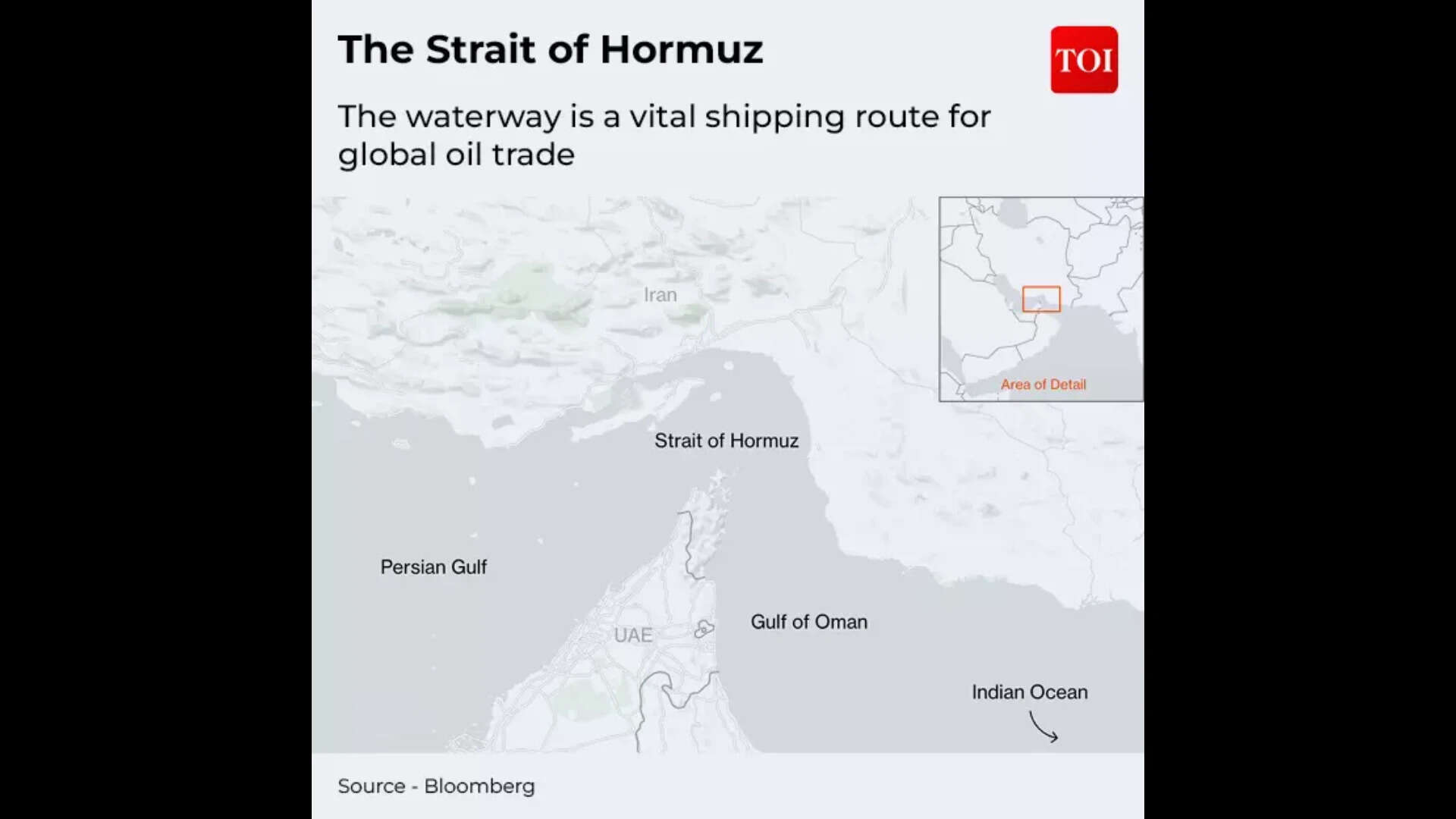
Navigation lanes in each direction are only two miles wide. Because of its relatively shallow waters, vessels are susceptible to naval mines, and the close proximity of surrounding coastlines – particularly that of Iran – exposes ships to risks from shore-launched missiles, patrol craft and helicopters.
Why is the Strait of Hormuz important?
The reason why the Strait of Hormuz is important is also straight: It carries roughly one-fourth of global seaborne oil shipments. Fundamentally, the Strait of Hormuz is a critical artery for international energy trade, as most Persian Gulf exporters do not have alternative sea routes for shipments. Data from analytics firm Vortexa quoted in a Reuters report indicates that, on average, more than 20 million barrels per day of crude oil, condensates and refined fuels moved through the Strait of Hormuz last year.Members of OPEC – which includes Saudi Arabia, Iran, the United Arab Emirates, Kuwait and Iraq – currently rely heavily on this route to ship to Asian markets.Qatar, one of the leading exporters of liquefied natural gas globally, also depends on the passage for nearly all of its LNG shipments.
Will crude oil prices rise if the Strait of Hormuz is closed?
According to Kpler Ltd senior crude analyst Muyu Xu, even a one-day blockade by Iran could push oil prices to between $120 and $150 per barrel! By comparison, Brent crude, the global benchmark, had averaged $66 per barrel so far this year as of February 20.Any attempt by Iran to obstruct large tankers transporting oil and gas from the Middle East to key markets such as China, Europe and the United States would disrupt supplies, push crude prices higher and potentially unsettle the world economy. Oil prices had already climbed to a six-month peak in February amid speculation that military action might be ordered.A Bloomberg analysis suggests that disruption in oil trade through the Strait of Hormuz would have significant implications for global oil markets. If the route becomes unsafe, oil tankers may well have to move with escorted convoys protected by Western naval forces. While this would slow the pace of shipments, it is unlikely to sharply reduce overall oil supply.However, a prolonged shutdown of the Strait of Hormuz would be extremely detrimental to global energy markets. Ali Vaez, who heads the Iran Project at the International Crisis Group, has cautioned that the conflict has the potential to intensify further.In posts on social media, Vaez pointed out that the conflict could push energy prices higher, weakening one of the key domestic political claims of Donald Trump that fuel costs have remained lower since he returned to office.“Iran sits along the Strait of Hormuz, through which roughly a fifth of the world’s oil supply passes,” Vaez posted. “Even limited disruption could spike energy prices, fuel inflation, and rattle global markets,” he said, adding that global economic shockwaves are likely.
How will the closure of Strait of Hormuz impact India?
India imports about 90% of its crude oil demand and also depends significantly on overseas suppliers for nearly half of its natural gas consumption.Even as it has been diversifying its crude sources, roughly 40% of India’s crude oil purchases come from Middle Eastern producers such as Iraq, Saudi Arabia, the United Arab Emirates and Kuwait, with most shipments passing through the Strait of Hormuz.India has also been reducing its crude oil imports from Russia after US sanctions, and if supply through Strait of Hormuz is disrupted, increasing Russian oil imports may not be an option. Hence, a rise in crude oil prices would hit India.
Can Iran actually close the Strait of Hormuz?
Whether Iran can fully close the Strait of Hormuz is unclear. Under the United Nations Convention on the Law of the Sea, coastal nations have sovereignty that extends up to 12 nautical miles (about 14 miles) from their shores. This is less than the narrowest width of the Strait of Hormuz.This convention requires that foreign ships be allowed ‘innocent passage’ through territorial waters and that navigation through international straits should not be obstructed. Although Iran signed the agreement in 1982, it has not been formally ratified by its parliament.Earlier, during periods of geopolitical strain, Iran has claimed that it has the capability to block the Strait of Hormuz. However, such threats have never been carried out in full. The assumption has been that completely halting traffic would likely provoke a reaction from Western naval forces.However, even if it doesn’t deploy warships, Iran can still disrupt maritime traffic through the Strait of Hormuz due to its extensive coastline along it. A Bloomberg report says that some relatively limited interference using small, fast patrol boats to more severe measures such as missile or drone attacks on oil tankers may be one option that Iran could work with. This could make the route too dangerous for commercial shipping. Iran could also deploy naval mines, although the potential danger to its own vessels may reduce the likelihood of this option.Yet another point to note is that modern shipping is also exposed to electronic interference, including disruption of global positioning system signals.This method is increasingly employed by both state and non-state actors to hinder navigation. During the Iran-Israel conflict last June, thousands of vessels experienced navigational disturbances in and around the Strait of Hormuz.The United States and its partners have taken a range of steps over the years to counter threats to shipping in the Strait of Hormuz. During the latest period of heightened tensions between the US and Iran, ships passing through the Strait of Hormuz have increased their cruising speeds to reduce exposure to potential threats. The US has also advised vessels flying the American flag to maintain maximum distance from Iranian territorial waters while navigating the channel.
How closing Strait of Hormuz may hit Iran
The math to closing the Strait of Hormuz is also not so simple for Iran. The closure would also harm Iran’s own economy by preventing it from exporting oil. Interruptions to Middle Eastern supply could further strain relations with China, which is the largest purchaser of Iranian crude. China is also an important ally that has used its veto power at the UN Security Council to counter Western-backed sanctions and resolutions.Vessel-tracking data compiled by Bloomberg show that Iran transported more crude through the channel in 2025 than at any time since 2018.
What are the alternatives to the Strait of Hormuz?
Several major producers depend heavily on the Strait of Hormuz for exports. Saudi Arabia ships the largest volumes through this route but has the option of diverting part of its exports via a 746-mile pipeline that crosses the country to a Red Sea terminal.The East-West Pipeline can transport up to 5 million barrels of crude per day.
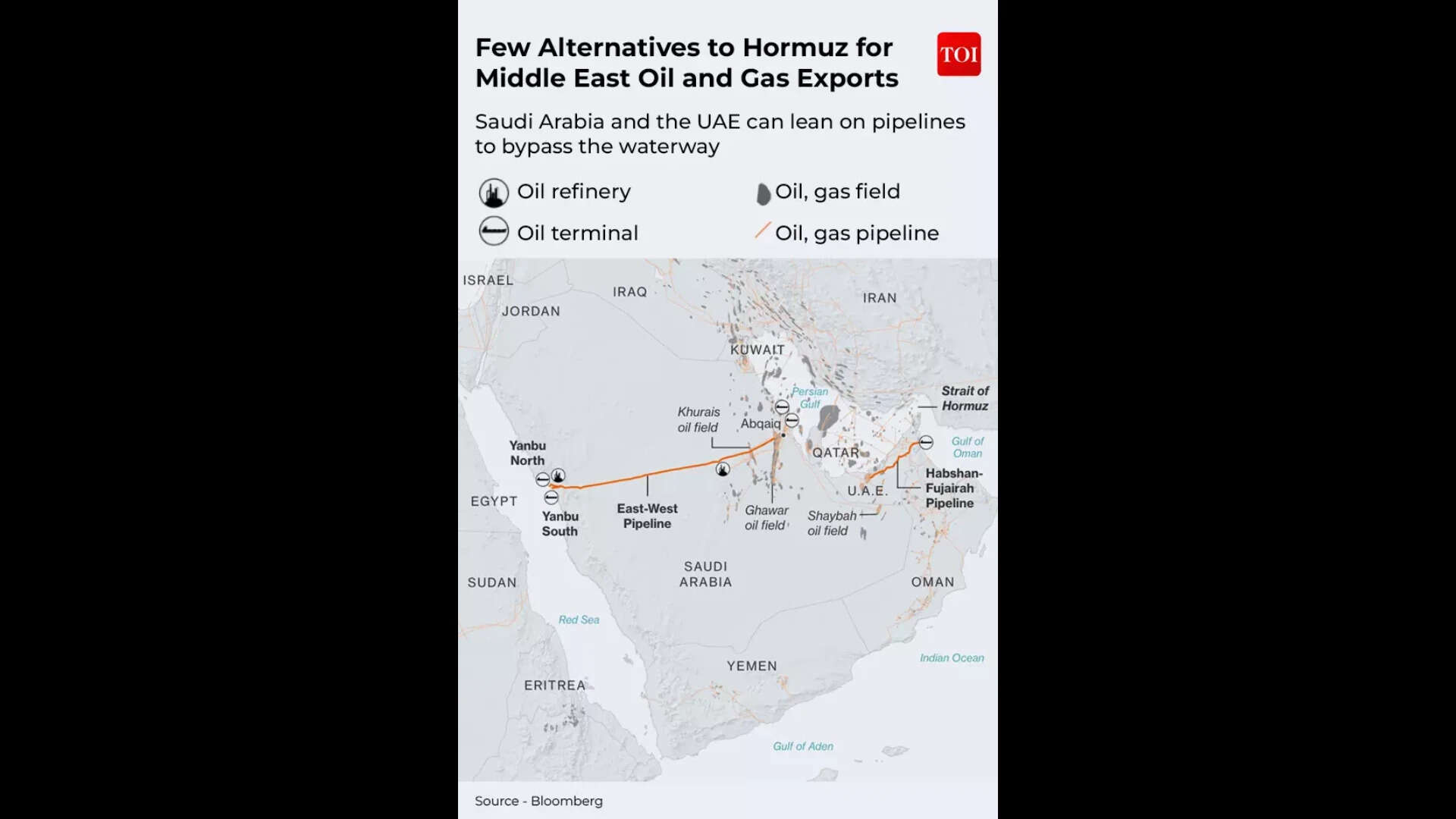
The United Arab Emirates also has limited alternatives, including a pipeline linking its oil fields to a port on the Gulf of Oman. The Habshan-Fujairah pipeline has the capacity to carry 1.5 million barrels a day.Iraq operates a pipeline through Turkey to the Mediterranean coast that resumed operations last year, though it only handles crude from northern fields. As a result, most Iraqi exports still leave by sea from Basra and pass through the Strait of Hormuz. Kuwait, Qatar and Bahrain have no practical alternative routes and must rely entirely on the waterway for shipments.
