
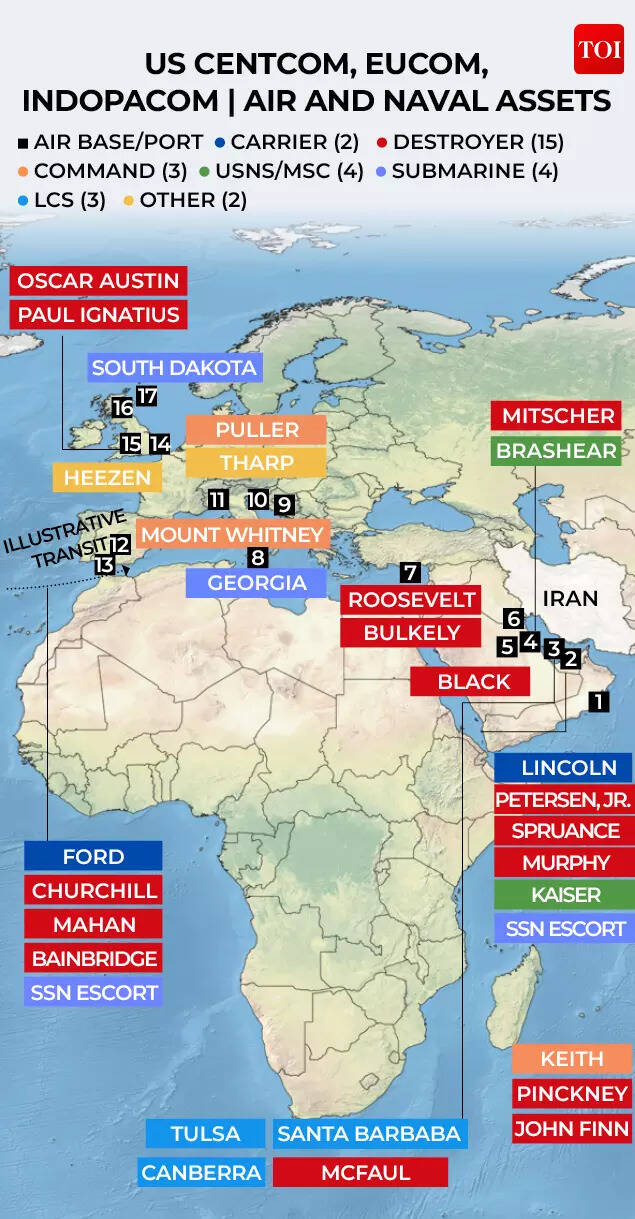
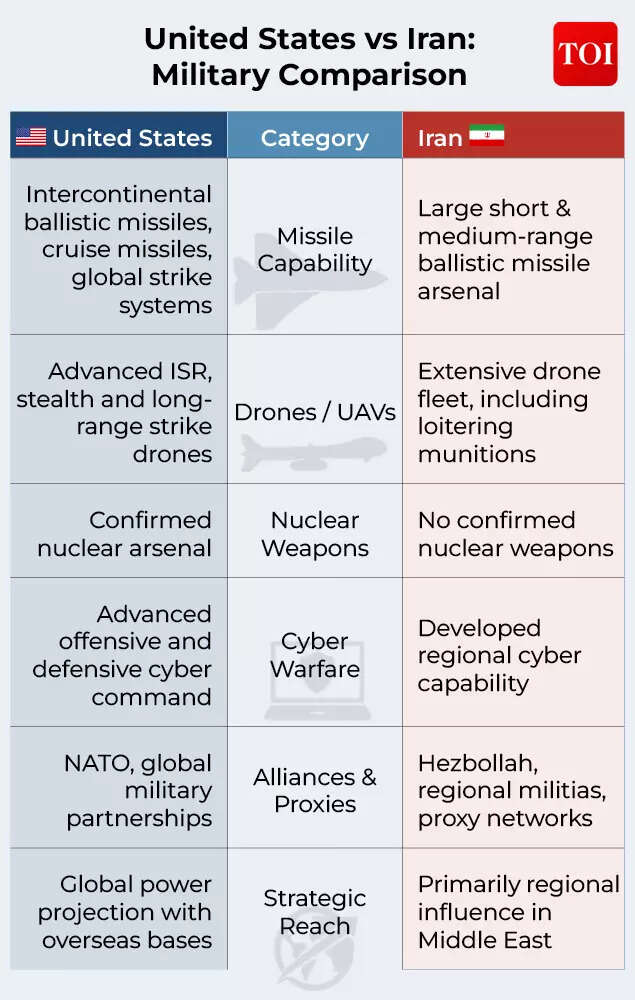
NEW DELHI: The United States and Israel launched coordinated airstrikes on Iran on Saturday, targeting military sites across the country in what both governments described as a pre-emptive operation, drawing swift retaliatory missile strikes from Tehran against American military bases across the Gulf and setting off a diplomatic scramble among world powers.Israeli Defence Minister Israel Katz announced that “the State of Israel launched a pre-emptive attack against Iran to remove threats to the State of Israel.” US President Donald Trump followed with a video statement saying American forces had begun “major combat operations in Iran” to eliminate what he described as imminent threats from the Iranian regime, vowing to destroy Iran’s missiles and missile industry. Loud explosions were reported across Tehran, with the Israeli military stressing it was targeting military sites.
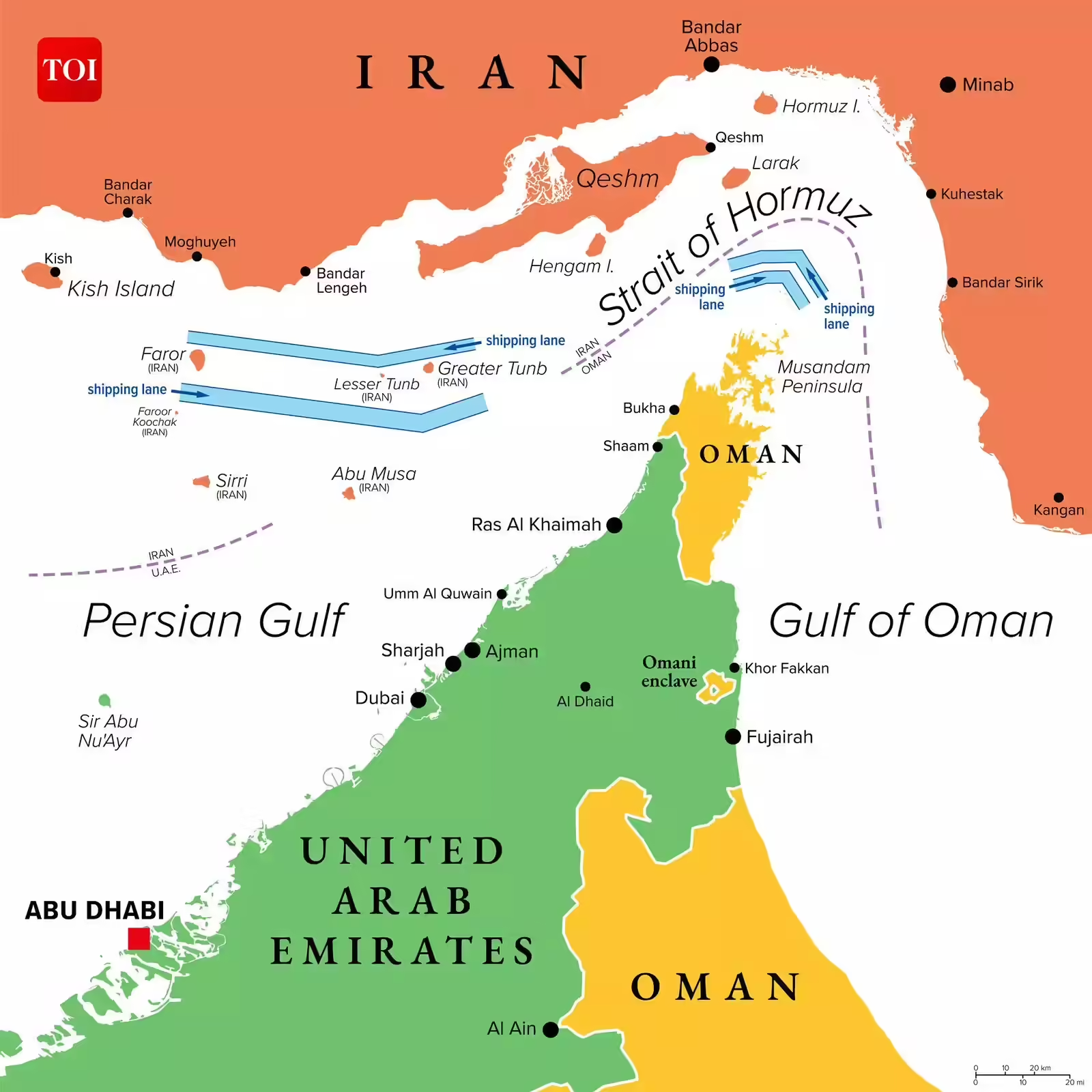
Iran’s response came within hours. Under an operation it named Truthful Promise 4, the Islamic Revolutionary Guard Corps launched retaliatory strikes on American military installations across the Gulf — including the US Fifth Fleet headquarters in Bahrain, and bases in Qatar and the UAE — as well as military sites in Israel. Qatar said it intercepted incoming missiles before they entered its airspace. The UAE reported one death from missile shrapnel. Bahrain called the strikes a violation of its sovereignty, and Qatar’s Foreign Ministry condemned what it described as an Iranian ballistic missile attack, saying it “reserves the right to respond” in accordance with international law.Supreme Leader Ayatollah Ali Khamenei, who had not been seen publicly for days as tensions mounted, was moved to a secure location before the strikes, according to Reuters. Israel closed its airspace to civilian flights, activated civil defence protocols nationwide, and asked citizens to remain close to protected spaces. India issued advisories urging its nationals in both Israel and Iran to exercise “utmost caution.“
A multipolar fault line
What distinguishes this confrontation from previous rounds of US-Iran or Israel-Iran tensions is the extent to which it has activated competing global alignments — and the speed with which it has done so.Russia condemned the strikes. China called for an immediate ceasefire while simultaneously issuing advisories to its citizens to leave Iran. Yet both nations’ public postures sit uneasily alongside their deepening ties with Tehran. Moscow and Beijing have in recent months held trilateral naval exercises with Iran and expanded defence cooperation — signals that, for many observers, point to a world in which the Middle East is no longer simply a theatre of US-led Western power projection but a contested arena of genuinely multipolar rivalry.
Prof. Swaran Singh, who teaches Arms Control & Disarmament, Conflict Resolution & Peace Studies at the School of International Studies, Jawaharlal Nehru University, argues that the picture is considerably more complicated than the strikes alone suggest.“The so-called pre-emptive strikes have not delivered expected outcomes for regime change,” he told TOI. “This means strikes and counter-strikes will continue with impact on the global energy market and disrupted airlines that will impinge on the entire world.”He added that the Russia-China dimension gives this confrontation a dimension previous Middle East crises lacked. “Both have displayed closeness with Iran through recent trilateral naval exercises and defence contracts. This confrontation is complicated and will impact Trump’s mid-term elections and his early April visit to Beijing.”
A ‘Clash of Civilizations’ or not?
One question already circulating in diplomatic and academic circles is whether Muslim-majority nations will frame the strikes as a civilizational assault — a renewal of Samuel Huntington’s much-debated “clash of civilizations” thesis. Prof. Singh is cautious. “That sentiment may be strengthened,” he said, “but Islamic nations are not likely to promote such a divide given their dependence on the US.”That calculus–caught between religious solidarity and strategic dependence on Washington — is precisely the bind many Gulf states now find themselves in. Several host American military bases that Iran has now explicitly targeted. None has publicly endorsed the strikes.
What next
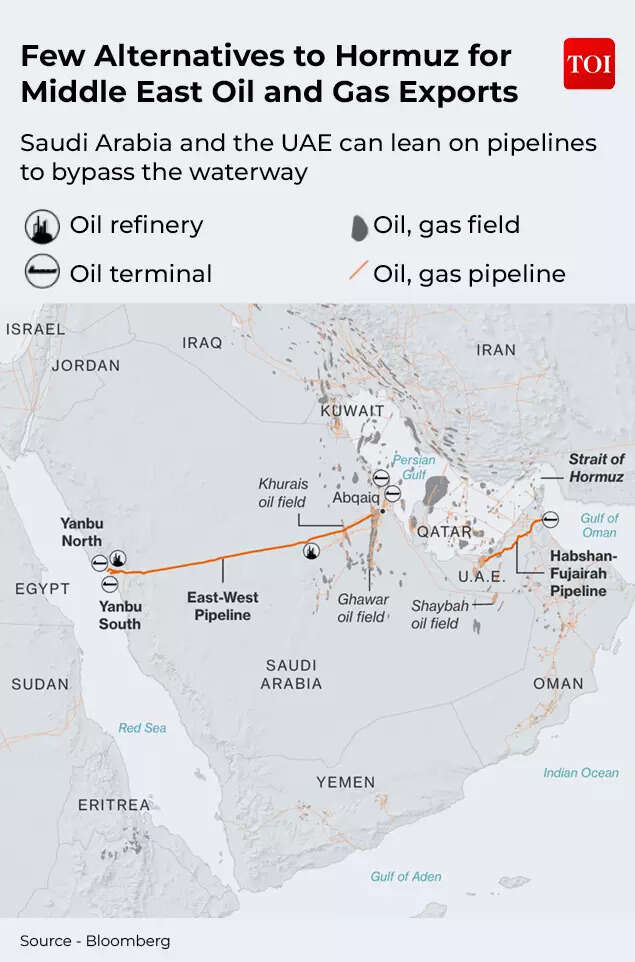
The immediate concern is escalation management. Global oil markets, civilian aviation across the region, and the broader architecture of Gulf security have all been disrupted. With Russia and China on one side of the diplomatic ledger and the US and Israel on the other, the space for neutral mediation has narrowed sharply.
Gulf states face perhaps the most uncomfortable position of all — caught between their security dependence on Washington and the immediate vulnerability that dependence has now created.On the question of diplomatic options, Prof. Singh told TOI: “Technically Geneva talks mediated by Oman continue but not next meeting scheduled.”
Whether this remains a contained — if severe –military exchange, or hardens into a more durable multipolar confrontation with the Middle East as its central theatre, may depend on whether that channel can be revived before the next round of strikes makes it irrelevant.

