
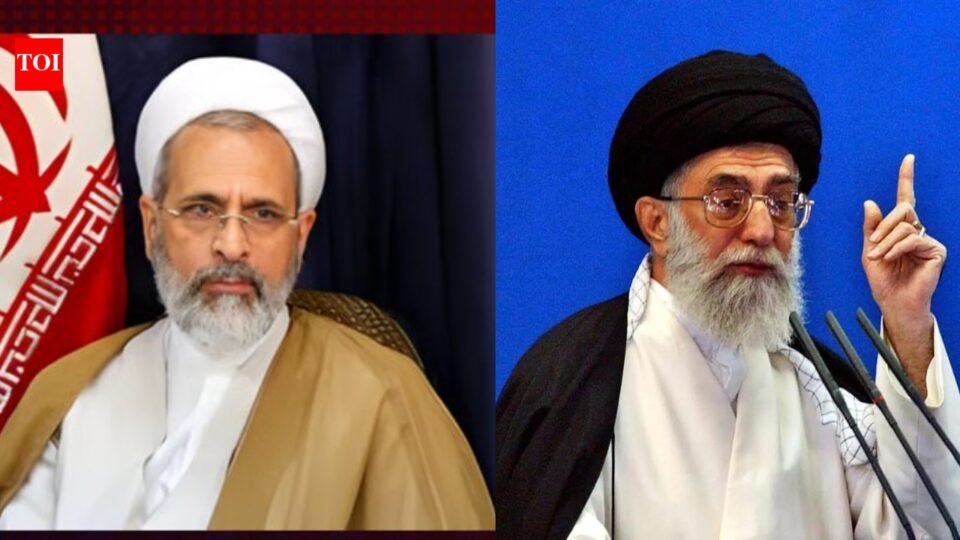
Iran has appointed Ayatollah Alireza Arafi as its interim Supreme Leader, a pivotal step in the country’s leadership transition following the death of longtime leader Ayatollah Ali Khamenei in joint US–Israeli airstrikes on Tehran early Saturday.Arafi, a senior cleric and a long-time insider in Iran’s religious and political hierarchy, now faces the challenge of steering the Islamic Republic during a period of heightened regional tensions and internal uncertainty.
Arafi’s rise within the clerical establishment
Arafi, born in 1959 in Meybod, Yazd province, comes from a clerical family and has spent decades within Iran’s theological and bureaucratic institutions. He studied in Qom, Iran’s principal seminary city, under prominent religious scholars and earned the rank of mujtahid, qualifying him to issue independent Islamic legal rulings.His career accelerated under the late Supreme Leader Khamenei, who appointed him to key roles over the years. These included Friday prayer leadership in Meybod and later in Qom itself, positions that signalled trust from the top leadership. Arafi also chaired Al-Mustafa International University, a key institution for training clerics from Iran and abroad, and in 2019 was appointed to the powerful Guardian Council, the constitutional body that vets legislation and candidates. CFR notes that Arafi’s mix of administrative and theological positions places him firmly within the core of Iran’s clerical elite, and that his elevation maintains continuity within the existing structure of religious authority.
Constitutional path to leadership
Under the Iranian Constitution, the supreme leader must be a senior Shia cleric chosen by the Assembly of Experts, an elected body of religious scholars. Following Khamenei’s death, Tehran will first establish an interim leadership council to carry out key functions pending the Assembly’s selection of a new supreme leader, according to the Middle East Institute. Arafi’s appointment comes amid competing names discussed in public and state media as potential successors to Khamenei, including figures from both hard-line and more pragmatic clerical factions. But his positions in the Guardian Council and Assembly of Experts gave him institutional leverage when the succession decision was made.
Arafi’s view and role
Arafi has spoken publicly about the role of seminaries and clerics in promoting a politically engaged version of Shi’a Islam, emphasising solidarity with the oppressed and an international outlook. As he put it in previous remarks: “Seminaries (in Iran) need to be from the people, in solidarity with the downtrodden, be political [Islamist], revolutionary, and international (in approach).”Observers note that while Arafi has extensive experience within Iran’s religious bureaucracy and enjoys strong establishment credentials, he lacks an independent political base outside those institutional structures, a factor that may shape how he leads during a period of both external conflict and internal uncertainty.
A crucial transition in Tehran
Khamenei, who ruled Iran for nearly 37 years, was killed late on February 28, 2026, in a joint US–Israeli strike, triggering a succession process and nationwide mourning. Arafi’s rise marks only the second transition of supreme leadership since the 1979 Islamic Revolution, a moment that will test Iran’s political framework and its ability to maintain cohesion under challenging conditions.As Arafi steps into Iran’s highest office, international attention will focus on how he balances religious authority with geopolitical pressures and domestic stability in the months ahead.
