
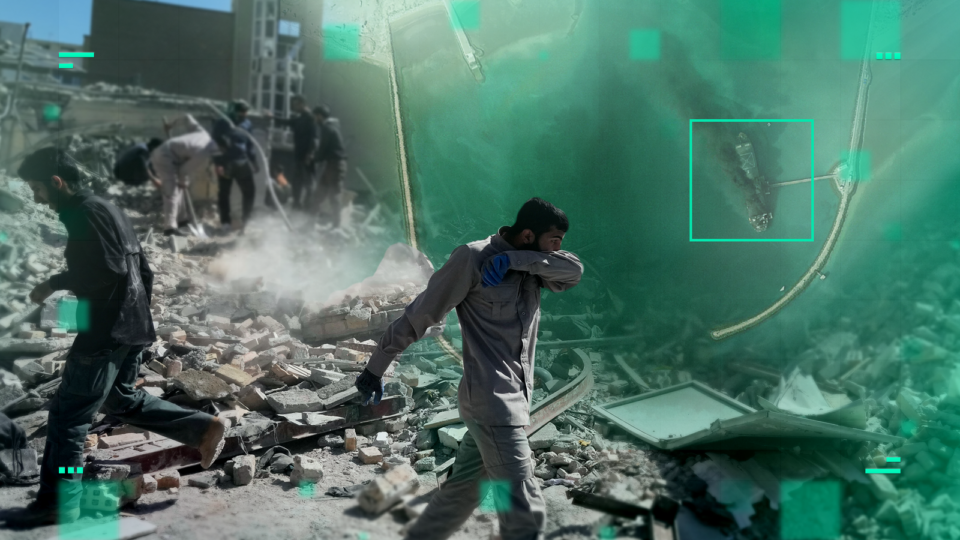
The US and Israel have carried out strikes on Iran for a fourth day after launching an operation which killed its supreme leader.
With no clear end in sight to hostilities, Sky News has mapped the assaults on both sides – and the military assets at play in the region.
A regional conflict
The US began Operation Epic Fury with a series of strikes on Saturday morning, killing Ayatollah Ali Khamenei in his Tehran compound.
Zoom in to explore strike locations in satellite maps
Israel joined the assault, killing dozens of top Iranian military officials in more than 100 aerial strikes in three days.
“Preliminary analysis shows that the United States and Israel used a variety of precision guided munitions to strike Iran,” Nic Jenzen Jones, director at Armament Research Services (ARES) said.
“These included air-delivered weapons such as the AGM-154 Joint Standoff Weapon (JSOW), Blue Sparrow-series air-launched ballistic missiles, and various 500-, 1,000- and 2,000-pound-class bombs.”
He added: “In addition, surface-to-surface missiles were also fired, including sea-based Tomahawk-series missiles and the land-based Precision Strike Missile (PrSm).”
Iran is continuing to retaliate, launching drones and missiles targeting Israel, the United Arab Emirates (UAE), Bahrain, Jordan, Oman and Qatar.
The US has confirmed the deaths of six service members, while an RAF base in Cyprus was also targeted in a drone strike.
How far can Iran strike?
Iran’s drone attack on RAF Akrotiri in Cyprus was a demonstration of its capabilities.
Its longest-range missile, the Sajjil, has a similar maximum range of up to 2,000km (1,240 miles), according to the International Institute for Strategic Studies, a defence thinktank.
That’s far enough to hit Moscow or Athens, though still well short of giving Iran the ability to strike the UK.
The UK’s base in Cyprus is well within range of not only the Sajjil, but also Iran’s Ghadr and Emad-1 missiles.
Fighter jets and airbases
Sky News’ Data and Forensics team has plotted US and UK air bases in the Middle East and Europe that can be used to launch attacks on Iran.
Flight tracking data shows the paths taken by 47 US military cargo and refuelling planes over recent days as they made their way to and from the Middle East.
At least 15 of the planes passed through British bases, including four through Diego Garcia in the Indian Ocean.
The site has been in the headlines over recent months, with Donald Trump criticising the UK’s plans to cede control of the Chagos Islands to Mauritius.
The Iran conflict has highlighted the strategic importance of the joint US-UK military base, with Sir Keir Starmer initially refusing permission for it to be used by the US to launch strikes on Tehran.
Satellite imagery captured over the base on Sunday morning shows at least 14 planes stationed next to the runway, including six F-16 fighter jets and two P-8 Poseidon maritime spy planes.
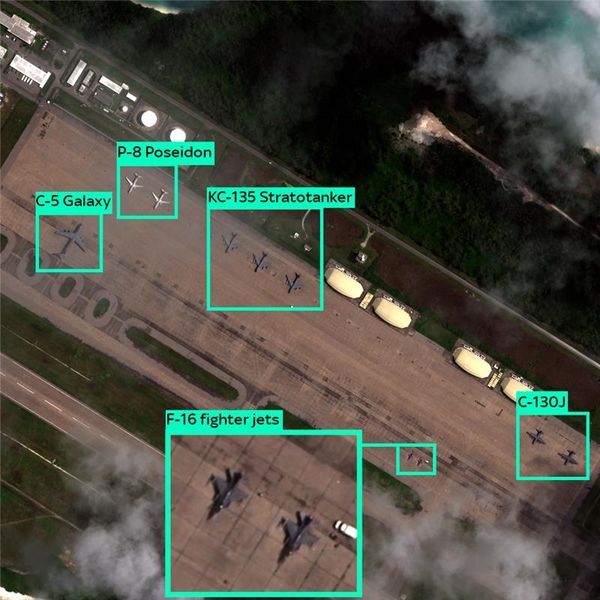
The rest are transport aircraft, including a C-5 Galaxy and three KC-135 Stratotankers, analysts at Jane’s Defence Weekly told Sky News.
The C-5 is the largest transport aircraft in the US arsenal, capable of transporting military vehicles and even fighter jets.
Analysts at Jane’s Defence Weekly said the UK does not operate any of the aircraft models visible in the satellite imagery, except for the P-8 Poseidon.
As planes head to the Middle East, America’s air bases in Germany have been significantly emptied.
While 161 planes have landed at Spangdahlem and Ramstein air bases since 23 February, at least 246 have departed – an overall decrease of 52.
Al Udeid Air Base in Qatar has also significantly emptied, 20 more planes leaving than arriving. The base was an anticipated target of Iranian counterattacks.
Planes have been accumulating, meanwhile, at bases in Kuwait, Israel and Jordan.
Iranian sea power targeted
The aftermath of strikes is visible on satellite imagery at two Iranian naval bases.
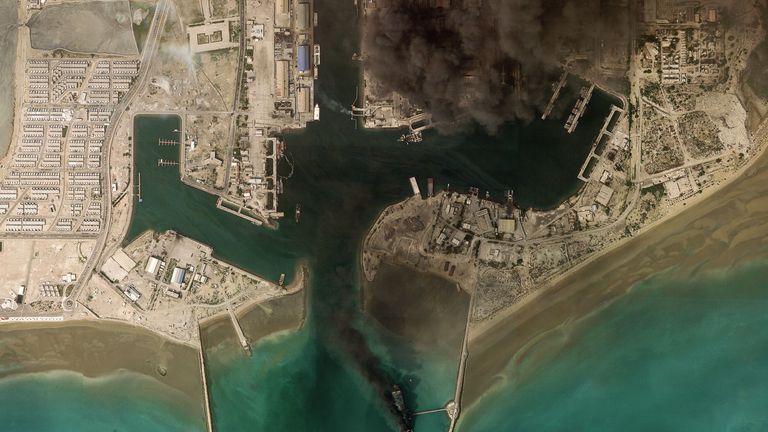
Bandar Abbas military harbour on 2 March. Source: Planet Labs PBC
Fires can be seen at the military harbour at Bandar Abbas, which is the main headquarters of the Iranian Navy, and oversees the strategically important Strait of Hormuz.
A burning ship, the Makran, is also visible in the image.
It is unclear from the imagery how much damage the vessel has sustained, but as the ship is Iran’s largest naval vessel and serves as a floating base, if it is inoperable this will be a blow to the naval capabilities of the regime.
The Makran is one of six Iranian ships Sky News has tracked using data from TankerTrackers, situated by Qeshm island in the strait of Hormuz.
The ships have been seen on satellite imagery on three recent dates, most recently 2 March.
Smoke can also be seen at dock of the Konarak Naval Base, which is also on the southern coast of Iran.
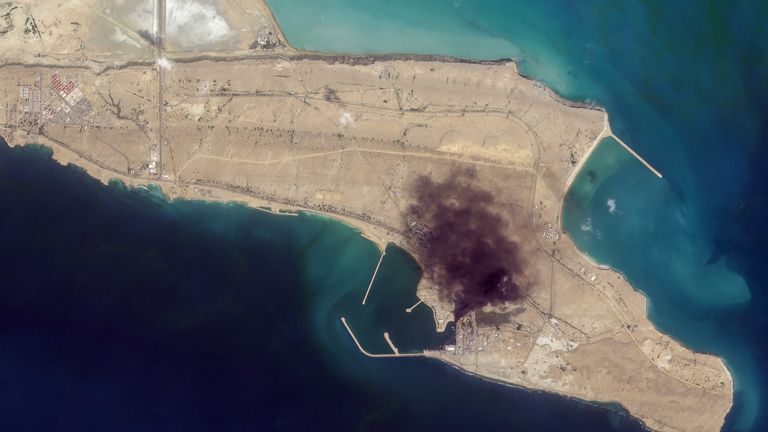
Damage visible at Konarak Naval Base, Iran, on 1 March. Pic: Planet Labs PBC
Strikes have also been reported at two other navy installations.
Sky News has mapped the facilities of the Iranian Navy, which are concentrated near the key Strait of Hormuz.
The Strait of Hormuz, between Iran and Oman, is a strategically vital waterway for Iran and other oil producers in the Middle East.
US naval assets
At least three US military ships are thought to be in the Persian Gulf, and 12 around the Middle East and Mediterranean.
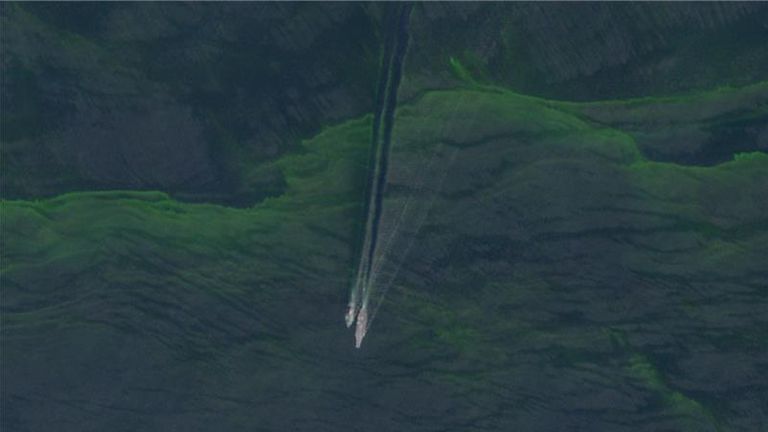
The aircraft carrier USS Abraham Lincoln was seen under 200km (124 miles) from the coast of Oman on 25 February.
Pic: EU Sentinel, Copernicus
It was accompanied by an unknown ship measuring over 200 metres and was potentially used for replenishing or drills.
The largest aircraft carrier in the US naval fleet, the USS Gerald R Ford, was last seen on satellite imagery on 27 February in the Mediterranean Sea, just under 400km (248 miles) from the coast of Cyprus.
It was reportedly travelling with three US destroyers, capable of carrying more than 6,000 personnel in total.
Maps created by data journalist Alicja Hagopian, digital investigations journalists Ben van der Merwe and Sophia Massam, and OSINT producers Freya Gibson and Lydia Morrish. Copy editing and production by Adam Parris-Long, assistant editor and Natasha Muktarsingh, forensic journalism editor.
The Data x Forensics team is a multi-skilled unit dedicated to providing transparent journalism from Sky News. We gather, analyse and visualise data to tell data-driven stories. We combine traditional reporting skills with advanced analysis of satellite images, social media and other open source information. Through multimedia storytelling we aim to better explain the world while also showing how our journalism is done.
