
INDORE: At the geographical heart of Dhar, an ancient walled city in western Madhya Pradesh that served as the capital of the medieval Parmar kingdom, stands a structure that no government, court or community has been able to fully claim — or fully surrender — for over a century. Known simultaneously as Bhojshala, the Maa Vagdevi Mandir and the Kamal Maula Mosque, the 11th-century complex is, on paper, an Archaeological Survey of India-protected monument. In practice, it is the site of one of India’s most persistent and politically charged communal disputes: a place where Hindus come every Tuesday to perform puja and Muslims assemble every Friday to offer namaz, where the arrival of Basant Panchami on a Friday has, on multiple occasions, provoked curfews, police firing and Supreme Court hearings, and where a 2,189-page scientific survey submitted in July 2024 has done more to intensify the debate than to settle it.The structure dates to the Parmar period — most scholars agree it was built, or substantially modified, in the 10th or 11th century CE. For Hindus, it is unambiguously the Saraswati temple founded by Raja Bhoj (c.1000–1055 AD), the polymath-king whose court at Dhar was a celebrated seat of Sanskrit scholarship. They believe the goddess Vagdevi was enshrined there, the complex served as a great college (the Bhojshala, or Hall of Bhoj), and that successive Muslim rulers from Alauddin Khilji in 1305 to Mahmud Shah Khilji in the 15th century progressively destroyed and converted the temple into what became the Kamal Maula Mosque.For Muslims, the complex is inseparable from the durgah of the Sufi saint Kamaluddin Chishti, who is believed to have died in Dhar in the 13th century, and the mosque that grew up around his tomb has been a place of continuous Friday worship for centuries.The Archaeological Survey of India (ASI), which first protected the monument in 1909 and declared it a Monument of National Importance in 1951, has tried to manage both claims through administrative fiat. Its most consequential intervention — an order dated April 7, 2003 — established the arrangement that has governed the site ever since: Hindus may perform puja every Tuesday from sunrise to sunset; Muslims may offer namaz every Friday between 1 pm and 3 pm. The arrangement pleased neither side when it was announced, has been contested in the Delhi high court, the Madhya Pradesh high court and the Supreme Court of India, and remains in force today even as a fresh legal battle over the site’s very identity is nearing a decisive moment in the Indore bench of the MP high court.Indore Bench of the Madhya Pradesh high court, comprising Justice SA Dharmadhikari and Devnarayan Mishra, on March 11, 2024 ruled: “The detailed arguments at the Bar by all the contesting parties fortify the court’s belief and assumption that the nature and character of the whole monument admittedly maintained by the Central government needs to be demystified and freed from the shackles of confusion.”What makes Bhojshala singular among India’s many temple-mosque disputes is the combination of factors that keeps it alive: the absence of any decisive medieval or British-era document establishing exclusive religious ownership; the ASI’s jurisdictional control, which places it outside the Places of Worship (Special Provisions) Act, 1991 that froze the character of other disputed sites; the site’s recurring role as an electoral flashpoint in Madhya Pradesh; and the sheer longevity of the contest, which in its modern form stretches back to at least 1902 and in its popular political form to the aftermath of the Babri Masjid demolition in 1992.
What Makes This Monument Different
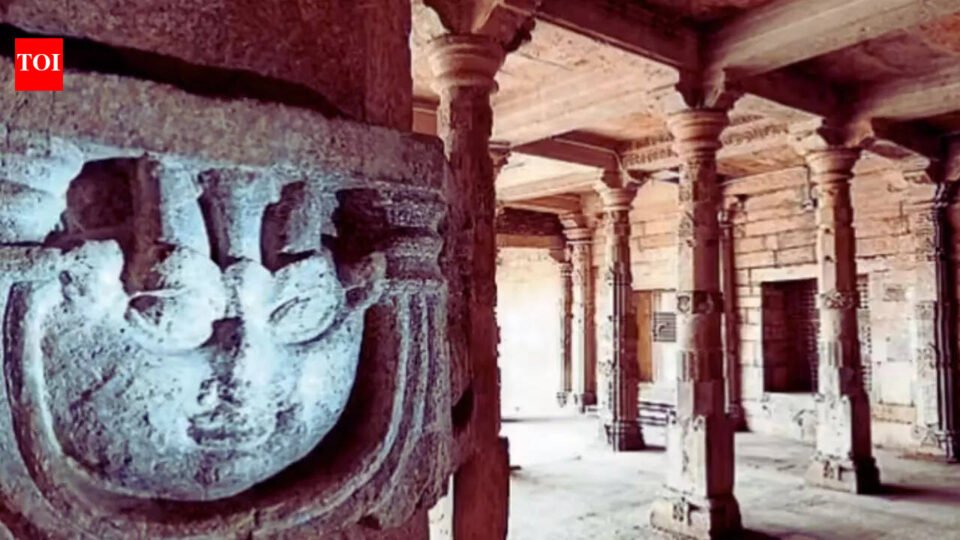
Physically, the Bhojshala is a hypostyle mosque — a large prayer hall supported by rows of columns — built primarily, as scholars and the 2024 ASI survey confirm, from reused temple materials. Carved pillars with images of Hindu deities (many of them deliberately defaced), Sanskrit inscriptions praising Goddess Saraswati, Parmar-era basalt slabs and a Havan Kund (fire-pit) are all visible to any visitor. So are the mosque’s westward-facing mihrab, its Persian inscriptions, and the adjacent durgah of Kamal Maulana. The building does not hide its composite history; it is literally constructed from it.The name ‘Bhojshala’ itself is a modern coinage, first appearing in a 1902–03 paper by KK Lele, the superintendent of education and head of archaeology for the princely state of Dhar, who was preparing the site for a visit by Viceroy Lord Curzon. German epigraphist Eugen Hultzsch published Lele’s findings in Epigraphia Indica (1905–06), and the term gradually entered popular use, even though the colonial Gazetteer of 1908 flagged ‘Raja Bhoj’s school’ as a ‘misnomer.’ Crucially, both John Malcolm in 1822 and William Kincaid in 1888 — prolific recorders of Malwa’s ruins — made no mention of any Bhojshala or Hindu tradition attached to the structure. Kincaid referred only to the ‘Well of Wisdom’ near the tomb of Kamal al-Din. Scholar Michael Willis, writing in the Journal of the Royal Asiatic Society in 2012, interpreted this silence as evidence that no living Hindu tradition around the name existed in the mid-19th century.The famous Saraswati idol — which Hindu petitioners have long described as the consecrated image installed by Raja Bhoj, now held in the British Museum — is itself the subject of scholarly dispute. K.K. Lele’s own 1943 records indicated the sculpture was found in debris at the old city palace in 1875, not at Bhojshala. Willis wrote that it is not even located in the British Museum but its ‘current location remains an interesting mystery.’Former ASI official K.K. Muhammad, who has spoken extensively to the media about the site, was categorical about the structure’s origins while urging both communities to work within the law. “Historically, Dhar (Bhojshala) was a Saraswati temple that was converted into an Islamic mosque. According to the Places of Worship Act 1991, if it was a temple in 1947, it remains a temple, and if it was a mosque, it remains a mosque,” he had told media in 2024.
Two Claims, One Complex
The Hindu position, pressed today by organisations including the Hindu Front for Justice, the Hindu Jagran Manch, the Vishwa Hindu Parishad and the Hindu Mahasabha, rests on three pillars: the archaeological evidence of a prior temple (Sanskrit inscriptions, sculpted pillars, the Havan Kund); the textual record of Raja Bhoj’s scholarship and his patronage of a Saraswati shrine at Dhar; and the 2024 ASI survey’s finding that ‘the existing structure was made from the parts of earlier temples.’ Their demand is full Hindu control and the end of Friday namaz at the site.Ashish Goyal, State Vice President, Hindu Front for Justice, and petitioner in the Bhojshala case, maintains: “Where in the world have you seen a mandir where people are allowed to offer namaz or a mosque where Hindus are allowed to do puja?”The Muslim position, advanced by the Maulana Kamaluddin Welfare Society, rests on the continuous practice of Friday namaz at the site for several centuries; the 1935 ruling by the Diwan of Dhar State formally declaring the complex a mosque; the 1985 notification of the site as Waqf property; and the argument that the 2024 ASI survey was compromised — that objects were ‘placed through the backdoor after 2003’ and that the survey team ignored Muslim objections. The Welfare Society has also challenged the survey in the Supreme Court and has announced it will file detailed objections before the Indore Bench.Abdul Samad, Maulana Kamaluddin Welfare Society, told TOI: “We will submit to the high court our objections to the ASI report. The ASI ignored our earlier objections and considered objects placed through the backdoor.”
A Century of Contest: The Chronological Record
The following is a continuous account of the Bhojshala dispute from its medieval origins to the present, drawn from court records, ASI documents, state government archives and over three decades of national media coverage. Court orders and legal milestones are embedded within the narrative as they occurred.
The Politics Behind the Dispute
Congress leader and Rajya Sabha MP Digvijaya Singh told reporters in January, “It is the responsibility of the government and the administration to ensure full compliance with the orders passed by the ASI — and to make every effort to maintain peace and harmony in Dhar.”Bhojshala has functioned as a reliable barometer of Madhya Pradesh’s communal temperature since the early 1990s. The BJP under Uma Bharti made the ‘liberation of Bhojshala’ a plank in its 2003 campaign — a poll in which the party ended the Congress’s ten-year rule. Yet once in power, successive BJP governments — under Uma Bharti, Babulal Gaur and then Shivraj Singh Chouhan — maintained the same ASI arrangement they had condemned from the opposition and used the same force against Hindu protesters they had accused Congress of deploying.Unlike the Ayodhya Ram Mandir site or the Gyanvapi mosque in Varanasi, which are governed by the Places of Worship (Special Provisions) Act 1991 that froze the religious character of disputed sites as of August 15, 1947, the Bhojshala complex was declared a Monument of National Importance in 1951 — after the Act’s reference date. This places it in a legal grey zone that the Indore Bench’s 2024 survey order has now actively exploited, ordering a scientific examination of the kind that has not been permitted at Gyanvapi.Hindu Front for Justice Ashish Goyal said: “The ASI report supports our contention that Bhojshala is a Parmar-period monument and a new structure was built after damaging it.”Where the Controversy StandsThe Bhojshala dispute now turns on how the Indore Bench of the Madhya Pradesh high court reads the 2,189-page ASI report filed in July 2024 — and what, if anything, it directs be done about a monument that is officially a protected archaeological site, simultaneously claimed as a temple and a mosque, and whose composite physical fabric embodies a history of coexistence and conflict that no court judgment can undo.The ASI’s finding — that the existing structure was built from the parts of earlier temples — is broadly accepted by scholars as corroborating the use of Parmar-era temple material in the building’s construction. It does not, by itself, resolve the legal question of what kind of worship may occur there and under whose authority. Former ASI official K.K. Muhammad, while affirming the site’s origins as a Saraswati temple, was emphatic that both communities must work within the law and resist actions that could ‘create problems for all.’For the people of Dhar — the Hindu devotees who queue at the gate every Tuesday, the Muslim families who have served the durgah for generations, the egg-seller who remembers when no one fought over the ground — the Bhojshala remains above all a neighbourhood, a place of worship, and a wound that has never been allowed to heal. The next hearing on March 16, 2026, will reveal how much longer it must wait.“Our main plea is for determining the religious nature of the complex. The ASI report supports our contention that Bhojshala is a Parmar-period monument and a new structure was built after damaging it.”— Ashish Goyal, Hindu Front for Justice, told TOI.“We will submit to the high court our objections to the ASI report. The ASI ignored our earlier objections and considered objects placed through the backdoor.”— Abdul Samad, Maulana Kamaluddin Welfare Society, Told TOIA Complete TimelineDhar, Madhya Pradesh | 11th Century AD to March 2026I. 10th–11th Century AD — Parmar Dynasty & Raja Bhoj’s CourtThe Parmar kings rule Malwa from Dhar (Dharanagara), one of medieval India’s most celebrated seats of power.Raja Bhoj (c. 1000–1055 AD), the polymath-king, established a renowned centre of Sanskrit learning at Dhar. He is a grammarian, astronomer, poet and military commander rolled into one.Sanskrit inscriptions later found at the complex — grammatical charts, Saraswati invocations, references to teaching traditions — are linked to this era.Parmar-style architecture and sculpture are embedded in the structure that stands at Bhojshala today, visible to any visitor who looks at the pillars. (ASI findings)C. 13th Century AD — Kamal Maulana and the Chishti DargahThe Sufi saint Kamaluddin Chishti arrives in Dhar. His tomb is established adjacent to what becomes the hypostyle mosque.Muslim families claiming descent from his attendants have served at the dargah for what they say is close to 700 years.This association is the bedrock of the Muslim community’s historical claim to the complex.1305 AD — Alauddin Khilji’s Invasion of MalwaDelhi Sultanate forces under Alauddin Khilji enter Malwa.Hindu nationalist accounts describe the destruction of the Saraswati temple at Bhojshala at this point.The Parmar kingdom weakens; Malwa is absorbed into the Sultanate’s sphere.The composite structure visible today — with temple material inside a mosque framework — begins to take shape over the following century.1392–93 — Dilawar Khan’s InscriptionAn inscription beside the building records repairs by Dilawar Khan, then governor of Malwa under the Delhi Sultanate.Among the earliest documentary evidence of the structure under Muslim administration, distinct from the pre-existing Parmar temple material embedded in its walls.c. 1456–57 — Mahmmud Shah Khilji’s ConstructionA Persian inscription documented during the 2024 ASI survey records construction of a gallery, courtyard, chamber, well and bathhouse within the dargah complex by Sultan Mahmmud Shah I of the Malwa Sultanate.This is the most specific medieval Islamic building record associated with the site.II. Colonial-Era Documentation (1822–1909)1822 — John Malcolm’s RecordBritish administrator John Malcolm visits Dhar and notes a ‘ruined mosque’.He makes no mention of a Bhojshala or any Hindu tradition attached to the structure.Scholars later cite this silence as evidence that the name ‘Bhojshala’ was a 20th-century coinage, not a centuries-old living tradition.1888 — William Kincaid’s SilenceKincaid’s Rambles among Ruins in Central India (Indian Antiquary) mentions only the ‘Well of Wisdom’ near Kamal al-Din’s tomb.No reference to Bhojshala or a Saraswati temple anywhere in the account.Scholar Michael Willis (Journal of the Royal Asiatic Society, 2012) later cited this as evidence that no living Hindu tradition around the name existed as late as the mid-19th century.1902–03 — K.K. Lele Discovers the InscriptionsK.K. Lele, head of archaeology for the princely state of Dhar, discovers Sanskrit and Prakrit inscriptions in the mosque’s pillared hall while preparing the site for Viceroy Lord Curzon’s visit.He describes the building as ‘Raja Bhoj ka Madrasa’. The term ‘Bhojshala’ begins to take root in popular usage.This discovery — and the scholarly excitement it generates — effectively launches the modern controversy.1905–06 — Epigraphia Indica PublicationGerman epigraphist Eugen Hultzsch publishes Lele’s Dhar findings in Epigraphia Indica.The identification of the complex with Raja Bhoj enters international scholarly literature for the first time.The structure continues to function as a mosque with Friday prayers undisturbed.1908 — The Colonial GazetteerC.E. Luard’s Gazetteer calls the building ‘Raja Bhoj’s school or madrasa’, noting the term is a ‘misnomer’.Acknowledges the inscriptions but does not suggest exclusive Hindu worship rights over the structure.1909 — Dhar State Declares It a Protected MonumentThe princely state of Dhar formally declares the complex a protected monument and restricts prayers inside.This is the first official state intervention to manage the site’s dual-use character — a precedent that will be replicated, contested and reversed many times over the following century.III. Princely State Rulings & Pre-Independence Tensions (1924–1944)1924 — The British Museum Idol Controversy BeginsO.C. Gangoly and K.N. Dikshit publish findings on a sculptured image held in the British Museum, initially associating it with Raja Bhoj’s consecrated Saraswati.The image becomes the most potent symbol of Hindu claims to Bhojshala.Later scholarship — including K.K. Lele’s own 1943 records — establishes the sculpture is likely a Jain Ambika figure recovered from the Dhar city palace ruins, not from Bhojshala at all.1935 — Dhar State Rules: It Is a MosqueFollowing Hindu Mahasabha agitation demanding Hindu control, the Diwan of Dhar State, K. Nadkar, issues a formal proclamation declaring the complex a mosque and stating it ‘would forever remain so’.Friday namaz is formally resumed.Hindu Mahasabha member Ganesh Datta Sharma — whose son Gopal Sharma would continue the same fight 80 years later — resists the order.This is the first modern political ruling on the site’s religious character.1944 — First Formal Urs at the DargahThe first formal Urs (death anniversary observance) is held at the Kamal Maulana dargah.Consolidates the Muslim community’s religious association with the complex in the late colonial period.IV. Post-Independence Period (1947–1991)1947–1951 — National Monument StatusIndia achieves independence. The ASI takes over the complex in 1951, declaring it a Monument of National Importance under the Ancient and Historical Monuments Act.Regular worship of any kind is restricted except on notified special days.Critically, the Places of Worship (Special Provisions) Act 1991 — which will later freeze the character of Ayodhya and Gyanvapi — does not apply here, as Bhojshala was already under monument protection before 1947.1952 — First Post-Independence TensionsThe ASI reinstates a ban on all prayers inside the monument.The first hints of communal tension emerge over permissions for Bhoj Diwas celebrations.By 1953, Muslims begin organising Urs celebrations in November as a counter-assertion.A pattern of competing religious assertions at the same protected monument begins to take shape.1961 & 1977 — Idol Repatriation EffortsArchaeologist Dr. Vishnu Shridhar Wakankar visits London and argues that the British Museum sculpture was installed by Raja Bhoj.He meets Prime Minister Jawaharlal Nehru in 1961 and Prime Minister Indira Gandhi in 1977, seeking the idol’s repatriation. Both efforts fail.Later scholarship confirms the idol’s provenance as the Dhar city palace, not Bhojshala.1985 — Waqf NotificationThe Bhojshala complex is notified as Waqf property.No objection is filed within the prescribed one-year window — a procedural lapse that later becomes a point of contention for the Hindu side.This Waqf status becomes a cornerstone of the Muslim community’s legal standing in all subsequent court proceedings.The Hindu side contests this on the grounds that an ASI-protected monument cannot simultaneously be Waqf property.1987 — ASI Floor Repairs Yield Hindu IdolsDuring routine floor repair work, the ASI uncovers approximately 32 idols of Hindu deities, including Lord Kuber.The find intensifies Hindu demands for recognition of the site’s temple character.The ASI documents the idols but does not alter its administrative arrangements.V. Post-Babri Mobilisation & The 2003 crisis (1992–2003)December 1992 Onwards — Post-Babri Upsurge in DharFollowing the demolition of the Babri Masjid in Ayodhya on December 6, 1992, right-wing organisations in Madhya Pradesh sharply intensify demands for full Hindu control of Bhojshala.Demands include removal of Friday namaz, installation of a Saraswati idol, and exclusive Hindu ownership.The issue, previously local and episodic, acquires national political valence for the first time.1994 — VHP Flag Incident and First Major CurfewThe Vishwa Hindu Parishad threatens to hoist a saffron flag on the monument.Dhar district is placed under curfew; around 40 people are arrested.Peace talks follow. An informal arrangement granting limited access to both communities begins to take shape, anticipating the formal ASI order that would come nine years later.March 12, 1997 — Digvijaya Singh’s Disputed OrderMadhya Pradesh (Congress) Chief Minister Digvijaya Singh issues an order formally permitting Friday namaz inside Bhojshala while barring Hindus from entry except on Basant Panchami.Hindu groups call it ‘draconian’ and accuse Singh of formally declaring the site a mosque through administrative fiat.VHP threatens to unfurl saffron flags; the administration restricts all public access entirely.The order haunts Singh politically for the rest of his tenure and beyond.1998 — The Sumitra Mahajan Affidavit (Legal Milestone)An affidavit filed on behalf of the ASI before the Indore High Court — signed by G.V. Mahajan, husband of former Lok Sabha speaker and senior BJP leader Sumitra Mahajan — questions whether the structure is truly Bhojshala.On the basis of Persian inscriptions found at the site, the affidavit acknowledges it as a Muslim shrine.The document resurfaces explosively in 2003 when CM Digvijaya Singh tables it in the MP Assembly, causing a serious political storm within the BJP.2000–2002 — Sustained Hindu MobilisationHindu Jagran Manch and allied organisations hold Bhoj Rath Yatras across all of Dhar district.Dharm Raksha Samitis are established in every sector of the city.The slogan to ‘free Bhojshala’ gains mass popular traction.A large, organised Hindu constituency has now formed around the dispute, creating political pressure that no future Madhya Pradesh government can ignore.February 6, 2003 — Basant Panchami: Over One Lakh Defy RestrictionsMore than one lakh Hindus converge on Bhojshala for Basant Panchami, defying government restrictions.VHP leader Praveen Togadia addresses the crowd.Hindu organisations issue an ultimatum: free Bhojshala by February 18 or they will do so themselves.Police use tear gas and lathi-charges; around 50 women are among those arrested.The city is placed under heavy security.February 18–19, 2003 — Police Firing and DeathsCM Digvijaya Singh imposes Section 144 and curfew across Dhar.When protesters march toward Bhojshala, police open fire.Reports document 2 deaths and more than 35 critically injured.Over 1,200 people are arrested under IPC Sections 302 and 307.Collective fines of Rs 1.16 crore are imposed on 315 people.This is the most violent episode in the entire modern history of the dispute — and it effectively ends Digvijaya Singh’s moral authority on the Bhojshala question.March 31, 2003 — BJP’s Shivraj Singh Chauhan Speaks OutA BJP delegation including Shivraj Singh Chauhan (then Lok Sabha MP from Vidisha) formally criticises Digvijaya Singh for ‘politicising the issue to appease a particular community’.Chauhan says publicly: “There are so many evidences that Bhojshala is a temple. Even a blind person can identify it as a temple, leave alone others.”April 7, 2003 — The Landmark ASI order; The Tuesday–Friday formulaUnder pressure from Deputy Prime Minister L.K. Advani, the ASI’s Director General issues the order that has governed Bhojshala for over 22 years.Hindus may perform puja every Tuesday from sunrise to sunset.Muslims may offer namaz every Friday from 1 pm to 3 pm.The complex is open to tourists on all other days at a Re 1 entry fee.Hindu devotees may carry only flowers and rice grains — no lamps, incense or ritual paraphernalia.The order is challenged before the Delhi High Court. The petition is rejected.
VI. BJP governments and the recurring standoff (2003–2022)
November–December 2003 — BJP Wins MP; Uma Bharti Becomes CMThe ‘liberation of Bhojshala’ features as a major plank in BJP’s Madhya Pradesh assembly campaign.The BJP defeats Digvijaya Singh’s Congress government after ten years of Congress rule.Uma Bharti becomes Chief Minister.Once in power, successive BJP governments maintain the same ASI arrangement they had condemned from the opposition benches.2006 — Basant Panchami Falls on Friday; BJP Government Also Uses ForceUnder CM Shivraj Singh Chauhan, Basant Panchami falls on a Friday for the first time since 2003.The BJP government upholds the Friday namaz arrangement.Police use tear gas and lathi-charges on Hindu protesters who refuse to vacate the premises at 1 pm.The irony is widely noted: the party that rode to power partly on the Bhojshala issue is now deploying the same force as its predecessor against the same community.2012 — BJP Removes The Saraswati PalkhiThe Shivraj Singh Chauhan government refuses to permit a Palkhi Yatra (palanquin procession) of Mata Saraswati.Activists are arrested; a newly installed Vagdevi idol is confiscated by police and reportedly taken to Gwalior.2013 — Basant Panchami Falls on Friday; Violence RepeatsAnother Basant Panchami–Friday coincidence triggers the same confrontation.Hindu activists refuse to vacate the premises at 1 pm. Violence erupts; heavy police deployment.The ASI reissues the access protocol: Hindu puja sunrise–1 pm and 3:30 pm–sunset; Muslim namaz 1–3 pm.The pattern of 2003 and 2006 deepens into an entrenched, recurring cycle.February 13, 2016 — Basant Panchami on Friday; SC Involvement; Hindus BoycottThe Supreme Court of India is drawn into managing the day’s access arrangements for the first time.Hindu organisations, unwilling to pause their puja for the two-hour namaz window, boycott entry into Bhojshala entirely.Priests and devotees perform fire sacrifices outside the complex’s gates.This is the most organised public rejection of the 2003 ASI arrangement from within the Hindu community.2022 — Shivraj Government’s Idol Repatriation PromiseCM Shivraj Singh Chauhan announces his government will work to ‘bring back’ the Saraswati idol from the British Museum to Bhojshala.The pledge resonates strongly in the Dhar constituency ahead of elections.Scholars note the idol’s true provenance is disputed and its current location is unconfirmed.
VII. The 2022–2024 Legal Battle And The ASI Survey
May 2022 — Hindu Front for Justice Files PIL Before MP High CourtThe Hindu Front for Justice files PIL No. WP 10497 before the Indore Bench of the Madhya Pradesh High Court.Petitioners include Ashish Goyal, Ashish Janak, Sunil Saraswat and Mohit Garg.Demands: daily Hindu worship rights and a scientific investigation of the complex.The Maulana Kamaluddin Welfare Society is impleaded as a respondent.May 2, 2023 — Separate PIL Challenges Friday NamazThe Hindu Front for Justice files a separate PIL challenging the 2003 ASI order in its entirety.Seeks a complete ban on Muslim namaz inside the Bhojshala complex.The MP High Court (Indore Bench) admits the petition and issues notices to the MP government, the Union government and the ASI.February 19, 2024 — Survey Application Filed Before HCThe petitioners in PIL No. WP 10497 file an application seeking direction to the ASI to conduct a time-bound ‘scientific investigation’ of the complex using GPR survey, excavation and carbon dating.March 11, 2024 — HC ORDER: Indore Bench Orders Scientific SurveyA Division Bench of Justices S.A. Dharmadhikari and Devnarayan Mishra orders the ASI to conduct a ‘complete scientific investigation, survey and excavation’ within six weeks.The team is to be led by the ASI’s Director General or Additional Director General, comprising at least five senior officers.Methods specified: GPR-GPS technology, excavation, videography, photography and structural documentation up to 50 metres beyond the boundary wall.The court observes: “The nature and character of the whole monument admittedly maintained by the Central government needs to be demystified and freed from the shackles of confusion.”The Maulana Kamaluddin Welfare Society immediately approaches the Supreme Court to challenge the order.March 22, 2024 — Survey BeginsA 21-member ASI team with 32 labourers begins work under Additional Director General Dr. Alok Tripathi.Both Hindu petitioners (Gopal Sharma and Ashish Goyal) and Muslim representative Abdul Samad Khan are present on the first day.The Welfare Society objects by letter, demanding that objects placed inside after 2003 not be included in the findings.GPR, GPS, carbon dating, photography and structural analysis begin simultaneously.April 1, 2024 — SC ORDER: Supreme Court Refuses Stay but Sets ConditionsA Supreme Court bench of Justices Hrishikesh Roy and P.K. Mishra refuses to stay the ASI survey.However, it lays down critical conditions: no physical excavation that alters the permanent character of the premises; no action to be taken on survey findings without prior Supreme Court permission.Notices are issued to the Centre, the MP government and the ASI.This order becomes the key legal restraint preventing either side from acting unilaterally on the findings.April 23, 2024 — HC Grants First Extension: Eight More WeeksThe ASI applies to the Indore Bench for more time, citing the complexity of the exposed structural portions.The court grants eight additional weeks. The original six-week mandate is effectively doubled.May 11, 2024 — HC ADMITS Namaz-Stay PetitionThe Madhya Pradesh High Court (Indore Bench) admits the petition seeking a stay on Friday namaz inside the Bhojshala complex.Summons issued to the MP government, the Union government and the ASI.Both the survey and the namaz-ban petition are now running concurrently before the same bench.July 4, 2024 — HC Order: Court Sets July 15 DeadlineThe Indore Bench orders the ASI to submit the complete survey report by July 15, noting the survey has already run for nearly three months.The ASI’s counsel, Himanshu Joshi, undertakes to comply.July 15, 2024 — ASI Submits 2,189-Page Report in 10 VolumesThe ASI delivers one of the most exhaustive scientific surveys ever ordered by an Indian court for a disputed religious site.The report runs to 2,189 pages across 10 volumes.Key findings:The existing structure was built from the parts of earlier temples.Over 1,700 artefacts recovered, including 37–94 idol fragments of Shiva, Ganesha, Brahma, Krishna, Parvati and Hanuman.Sanskrit inscriptions including ‘Shri Saraswatyai Namaha’ (Salutation to Goddess Saraswati).56 Arabic and Persian inscriptions, including Quranic verses on tombs.31 coins spanning the Indo-Sassanian to the British period.A Persian inscription referencing Sultan Mahmud Shah I (1456–57).A Havan Kund and Parmar-era architectural elements visible within the structure.Central conclusion of the ASI: “The existing structure was made from the parts of earlier temples.”The Hindu side claims vindication; the Muslim side announces formal objections.VIII. Post-Survey: Courts, Objections And The Road To 2026Post-July 2024 — SC Orders Sealed CoverFollowing submission of the report to the High Court, the Supreme Court directs that the ASI survey report be kept in a sealed cover before the Indore Bench.Neither side may act on the findings without prior Supreme Court authorisation.The case enters a holding period as parties prepare their legal positions.2024 Lok Sabha Elections — Bhojshala in the Dhar CampaignThe Bhojshala issue features prominently in campaigning for the Dhar Lok Sabha constituency.Both BJP and Congress stake out positions on the ASI survey findings.National media attention focuses on Dhar district during the campaign.January 23, 2026 — Basant Panchami Falls on Friday; SC Permits Dual WorshipBasant Panchami coincides with Friday again — the first such occurrence since 2016.The Supreme Court (hearing the Maulana Kamaluddin Welfare Society’s 2024 petition) permits both communities to observe their rituals on the same day.Hindus are permitted from sunrise to sunset; Muslims from 1 pm to 3 pm in a separate, demarcated enclosure with distinct entry and exit points.Muslim leaders subsequently allege they were denied their ‘rightful place’ inside the mosque; the district administration rejects the allegation.Former CM Digvijaya Singh urges strict compliance with the ASI’s standing orders, recalling the 2003, 2013 and 2016 arrangements.February 23, 2026 — HC ORDER: Indore Bench Unseals Report; Directs ObjectionsA Division Bench of Justices Vijay Kumar Shukla and Alok Awasthi formally says that unsealed the ASI survey report copies may supplied to all parties.Parties directed to file their objections, suggestions and recommendations within two weeks.Next hearing fixed for March 16, 2026.Hindu petitioner Ashish Goyal says: “Our main plea is for determining the religious nature of the complex. The ASI report supports our contention that Bhojshala is a Parmar-period monument and a new structure was built after damaging it.”Abdul Samad of the Maulana Kamaluddin Welfare Society reiterates: “We will submit to the high court our objections to the ASI report. The ASI ignored our earlier objections and considered objects placed through the backdoor.”The Indore Bench of the Madhya Pradesh High Court is scheduled to hear all parties’ objections to the 2,189-page ASI survey report.This hearing is widely expected to determine whether the court will proceed to final arguments on the site’s legal and religious character — the question that has eluded resolution for over a century.
