
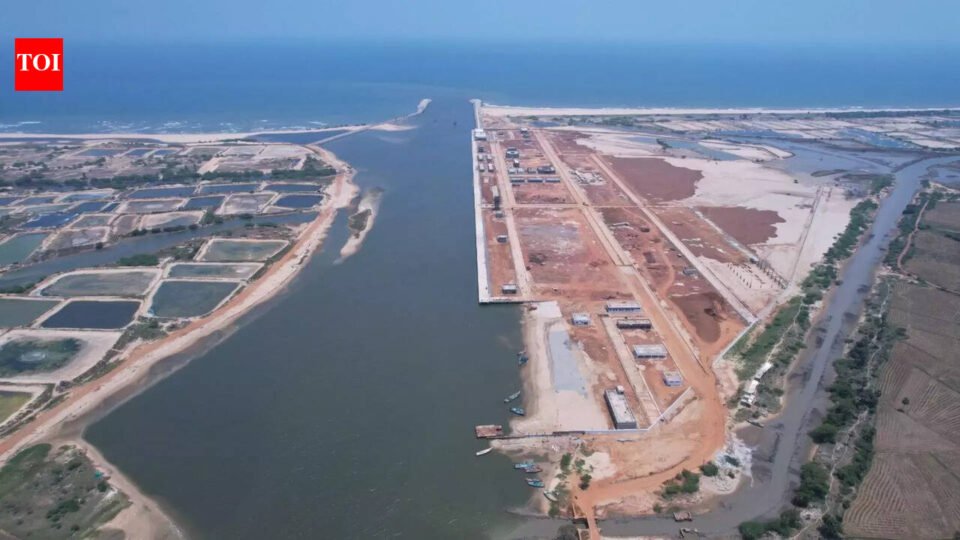
NEW DELHI: A Mumbai-headquartered defence company on Thursday laid the stone-breaking ceremony of the world’s first Autonomous Maritime Shipbuilding and Systems Centre at Juvvaladinne fishing harbour in Andhra Pradesh. Sagar Defence Engineering’s project represented a major step forward in strengthening India’s indigenous defence manufacturing and advancing the nation’s maritime technological capabilities.The Andhra govt authorised the allocation of 29.58 acres of land at fishing harbour in Nellore district for the project, enabling direct sea access for vessel construction, launch, testing and deployment for the establishment of the centre. The initiative is aligned with the state govt’s vision to strengthen India’s marine technology ecosystem and build advanced manufacturing capabilities along its coastline.The centre will focus on developing platforms such as unmanned surface vessels (USVs), autonomous underwater vehicles (AUVs), intelligent navigation systems, maritime sensors and communication networks, and command-and-control platforms for autonomous operations. These technologies will enable maritime systems to operate with minimal human intervention, enhancing efficiency, safety and operational capabilities.The shipyard will also deploy digital twin technology, creating virtual replicas of vessels and shipyard infrastructure to simulate performance, test upgrades, and optimise designs before real-world deployment.Capt Nikunj Parashar, founder & CEO, Sagar Defence, said, “Our vision is to redefine how maritime systems are designed, built, and operated. The autonomous maritime shipbuilding and systems centre represents the next chapter in that journey. As global maritime operations increasingly move toward autonomy, this facility will enable India to design, test, and manufacture next-generation unmanned maritime systems within the country. With the support of the govt of Andhra Pradesh, we are building a platform that will accelerate indigenous innovation, strengthen maritime security, and position India as a global hub for autonomous maritime technologies.”Smart manufacturing technologies will further strengthen the shipyard’s operational capabilities through robotic fabrication systems for automated welding, cutting, painting, and assembly, along with autonomous material handling using robots and automated guided vehicles (AGVs) that transport components across the yard. The facility will also utilise additive manufacturing (3D printing) for the rapid production of specialised components and spare parts.The initiative is also expected to support the development of smart fishing fleet networks, where vessels can connect to satellite and cloud-based systems to access real-time fish location maps, weather alerts, fleet coordination tools, and mechanisms for detecting illegal fishing activities.
