
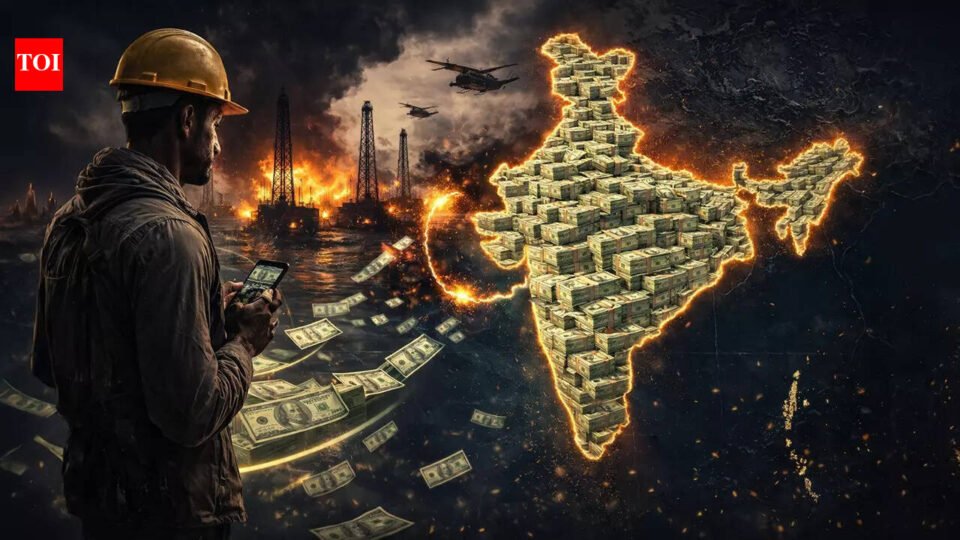

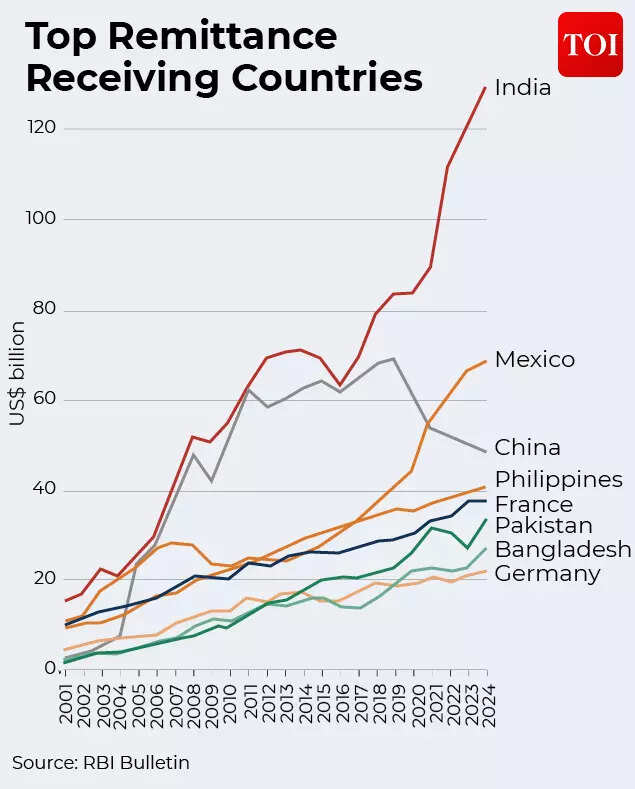
‘Gulf se paisa aaya hai’ – it’s a common statement in several households across India whose family members work in the Middle East countries. But will this money keep flowing in as much as it does in the wake of the US-Iran war? For years now, remittances by Indian migrants in the Gulf countries have formed an important financial lifeline for households in India.Fundamentally, remittances are cross-border money transfers to support families back home. They are a result of migrant labour sending money to their home countries. In the case of India, a major portion of cross-border inward remittances comes from personal transfers, which are primarily made of inward remittances for family maintenance from Indian workers residing abroad, and local withdrawals from non-resident deposit accounts.India’s remittances have more than doubled from $55.6 billion in 2010-11 to a whopping $118.7 billion in the financial year 2023-24. According to a Reserve Bank of India (RBI) survey in 2025, remittances to India are likely to remain elevated and are projected to increase to around $160 billion in 2029. Remittances increased to $73 billion in the first half of FY 2025-26, up from $64.7 billion in the same period the year before. The Economic Survey 2025-26, released earlier this year, says that remittance inflows increased steadily from $55.6 billion in FY11 to $135.4 billion (provisional) in FY25 – around 3.5% of GDP in FY25 (provisional).In fact, India continues to be the largest recipient of remittances in the world. India’s share in the world remittances stood at 14% in 2024. Some of the other major economies that get a big share of remittances are Mexico, China, Philippines, France, Pakistan, and Bangladesh.
What does the current US-Iran war and the Middle East conflict mean for remittance flows to India? What is the dependence, macro importance? Which states have maximum exposure to remittances from Gulf countries? We explore:
Why are remittances important for India?
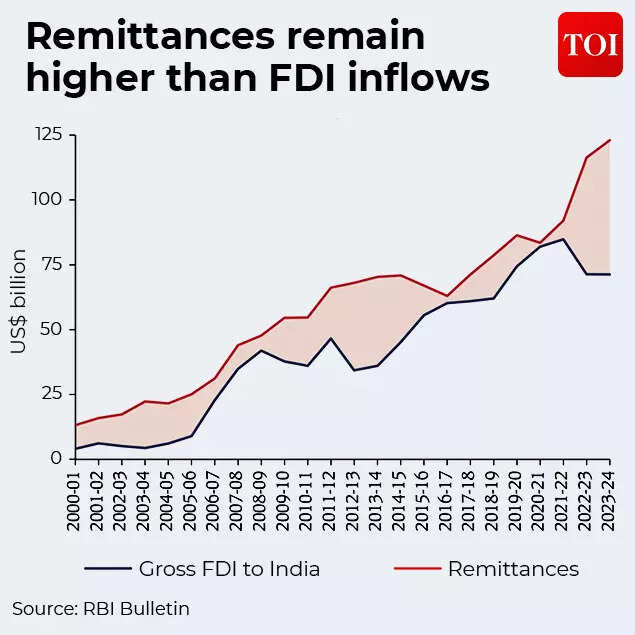
Remittances are important, not only for enabling a higher purchasing power in the hands of the recipients, but also for the forex inflow they bring. Remittances strengthen an economy’s balance of payments.What is interesting is that India’s remittance receipts have generally been higher than its gross inward foreign direct investment or FDI flows. This clearly highlights its role as a stable source of external financing.
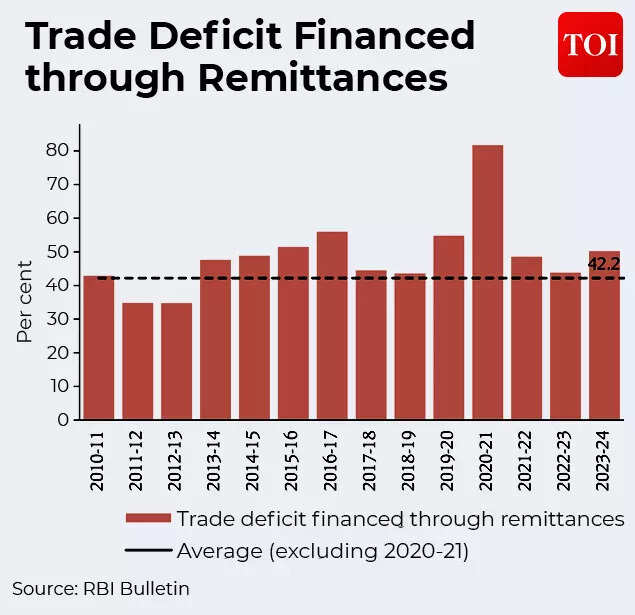
In the last few years, even as they helped finance around half of India’s merchandise trade deficit, net remittance receipts have been an important absorber of external shocks.Even the Economic Survey says that private transfer receipts, mainly representing remittances by Indians employed overseas, remained a key source of external-sector strength in FY26. India as an economy has a notable flow of remittances – as a ratio to GDP, India’s remittances have been around 3% of GDP since 2000. Contrast it with the case of China, where this ratio has remained below 0.3%. The reason this assumes significance is that China ranks third in the list of top remittance receiving countries. Hence, the vulnerability and impact of a curtailed flow of remittances on India is under focus.
As HDFC Bank notes in its latest report, “A prolonged war poses a risk to remittance flow for India. In recent years, strong remittance inflows have cushioned the impact of a widening merchandise trade deficit, along with net services.”Also Read | India’s Goldilocks under threat? How US-Iran war, crude oil above $100 may deal a blow to growth story – explainedSachchidanand Shukla – Group Chief Economist at Larsen & Toubro sees remittances as a stable variable in the India macro story. “It is something that has held India in good stead. “In case of a prolonged conflict in terms of duration or intensity eg. Iraq invasion of Kuwait in 90-91, there can be knock on impact on livelihoods as the region has 9-10 million people from the diaspora employed across sectors including white collar & construction,” he tells TOI.
Remittances: Which countries contribute the most – how important is GCC?
The United States of America was the largest source of remittances for India in FY 2023-24, as per the RBI survey. The survey noted that the US has overtaken the UAE to become the biggest remittance provider for India. The share of the US in India’s total remittances was 27.7 per cent in 2023-24, rising from 23.4 per cent in 2020-21.The Gulf Cooperation Council (GCC) countries – UAE, Saudi Arabia, Kuwait, Qatar, Oman and Bahrain – together contributed 38% to the total remittances that India received in 2023-24.It’s important to note that the United Arab Emirates (UAE) maintained its position as the second largest source of India’s remittances in 2023-24. Its share in the total remittances inflow has actually gone up from 18% in 2020-21 to 19.2% in 2023-24.
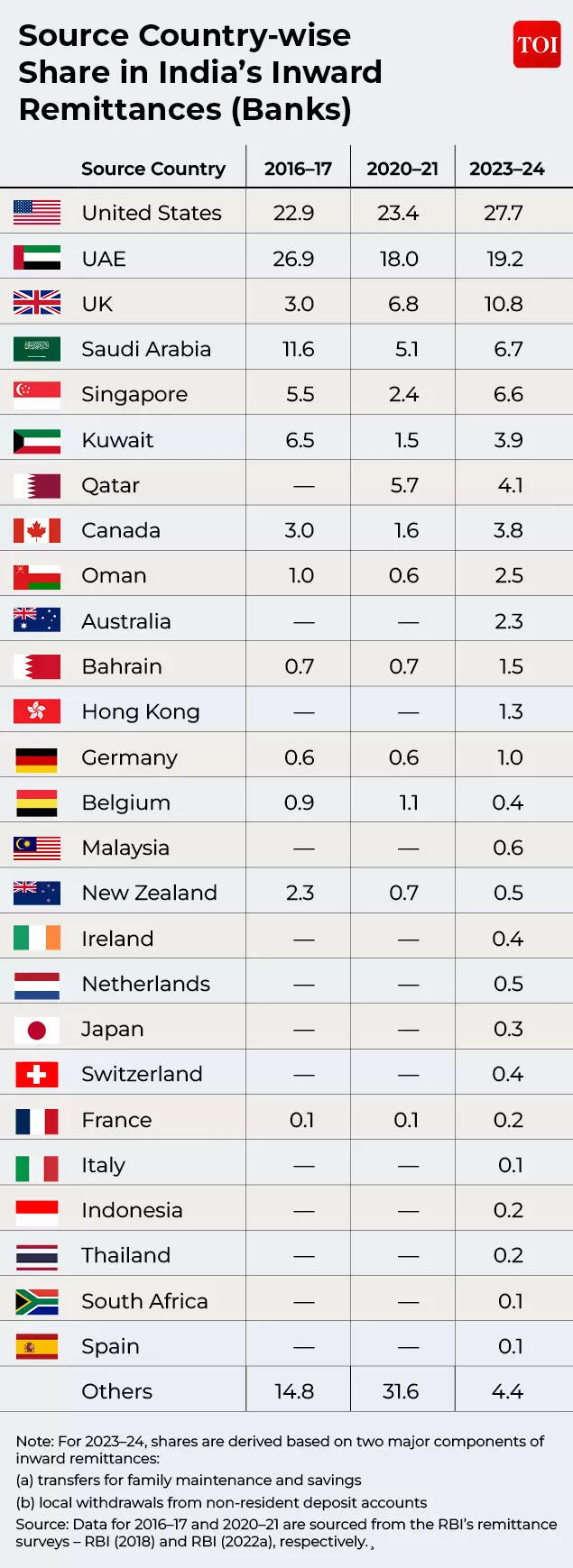
According to the RBI survey on ‘Changing Dynamics of India’s Remittances’, UAE is the largest hub for migrant Indian workers. Most of these are employed in blue collar jobs in the construction, healthcare, hospitality, and tourism industries.This is in direct contrast to the kind of jobs Indians are engaged in the US, where most migrants are employed in white-collar jobs. “This explains the higher remittances received from the US despite the lower number of migrants as compared to the UAE,” the survey says.But, equally noticeable is the gradual shift in dominance of India’s remittances from the GCC countries to the advanced economies particularly the US, the UK, Singapore, Canada and Australia which together accounted for more than half of the remittances in 2023-24.For example, the share of inward remittances from the UK increased to 10.8% in 2023-24 from 6.8%. The RBI survey also found a notable uptick in the share of remittances from Singapore (6.6%), Canada (3.8%) and Australia (2.3%) in 2023-24.
Middle East Conflict impact: Major Remittance Hit Loading?
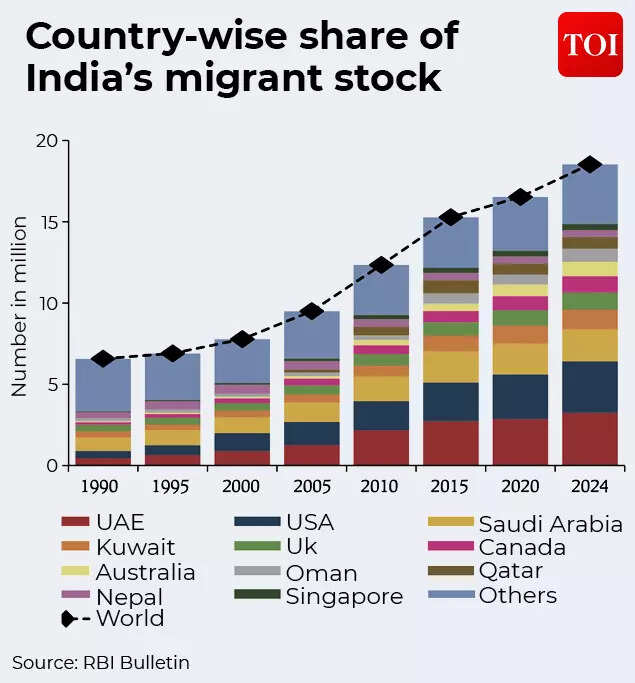
As per the RBI survey, the number of international migrants from India have tripled from 1990 – rising from 6.6 million to 18.5 million in 2024. The share of India in global migrants has risen from 4.3% to over 6% in the same period. Of this enormous number, the GCC countries have around half of the total Indian migrants in the world!
Vivek Kumar, Economist at QuantEco Research notes that while Iran is not a major contributor, adjoining countries like the UAE, Saudi Arabia, Qatar, Kuwait, Oman, etc., provide a key source of remittances to India.“It is challenging to predict how remittances would behave in the very near term, as an increase in crude oil prices is generally a supportive factor. At the same time, supply disruptions and potentially adverse sectoral implications,” Vivek Kumar tells TOI. “Real estate, construction, oil & gas, hospitality, and finance have a sizable Indian migrant population. If the crisis persists for long – on the lines of the ongoing Russia-Ukraine war – then this could adversely impact employment in some of these sectors, thereby changing the medium-term trajectory of inward remittances,” he says.Madan Sabnavis, Chief Economist, Bank of Baroda explains that remittances would be affected in two ways: first, the employees in the oil industry which has started closing down in some places; and second is slowdown in these economies due to these disruptions. Workers can lose their jobs or earn lower salaries on this score which will affect remittances. In the immediate period, the impact can be less than 5% (on a monthly basis), but would rise depending on the length of the war, Sabnavis tells TOI.“If we are talking of annual remittance inflows of around $140-145 billion per annum, this region would get in around $50 billion,” he says, adding that a prolonged war will lead to lower incomes and hence remittances. “This will also affect spending patterns in India as the recipients receive lower transfers. Workers in this region would tend to be more in the working class engaged in construction related activities. However, those working in the organized sector may be affected less,” he says. Sabnavis is of the view that a 10-20% remittance hit would lead to the inflow dropping by anywhere between $5-10 billion.Remittances from the GCC dropped during the pandemic period when a lot of contractual migrant workers returned to India. In case the war situation persists, some workers may choose to come back this time as well.According to Ranen Banerjee. Partner and Leader, Economic Advisory Services, PwC India, the immediate impact is that business confidence and consequently business activity would be negatively impacted owing to the uncertainty and safety considerations. “This will have an impact on employment and earnings of the diaspora and that in turn will impact remittances. There could also be some relocation back to India of some workforce in the short to medium term if the hostilities continue,” he says.Sachchidanand Shukla feels that banking players that disintermediate these remittance flows can also see some impact.At a state-level impact, Maharashtra, Kerala, and Tamil Nadu may see a higher hit compared to others since they get a big chunk of the inbound remittances. As per the RBI remittance survey, Maharashtra received the largest share of remittances at 20.5%. Kerala followed closely with its share of 19.7%. Tamil Nadu got 10.4%, Telangana received 8.1%, and Karnataka bagged 7.7%.
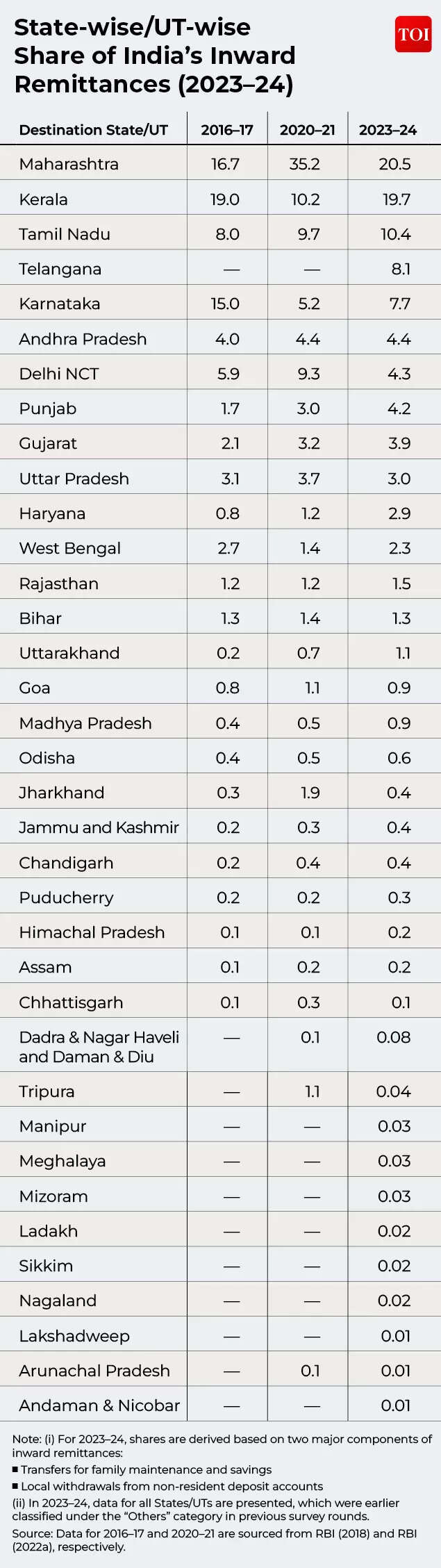
Ranen Banerjee of PwC India points out that Kerala has the highest number of population in the Middle East amongst Indian states. “The other southern states of Andhra Pradesh, Tamil Nadu and Telangana too have significant populations there. Even Punjab, Bihar, UP and Gujarat have large exposures. Thus, the impact could be felt quite widely across these 8 states in terms of consumption over the next quarter or two if the conflict continues,” he tells TOI.Madan Sabnavis explains that while the exposure has been coming down with the western regions like the US and Europe gaining share, the dependence is still there.Akhil Chandna, Partner and Leader, Global People Solution at Grant Thornton Bharat tells TOI that in the near term, geopolitical shocks in the Gulf region have not historically translated into a sustained decline in remittance inflows to India.“Past trends suggest that oil price volatility, when not accompanied by a prolonged collapse, has a limited effect on overall employment levels for expatriates. Consequently, immediate job losses – and therefore remittance disruptions – are likely to be modest,” he says.However, the expert says that if geopolitical tensions persist for several months, the risk profile for Indian expatriates becomes more adverse. He lists some key vulnerabilities:
- Wage arrears and delayed payments, particularly in infrastructure and construction sectors where project pipelines may slow.
- Liquidity constraints faced by employers as public spending priorities shift or funding becomes uncertain.
- Shrinking labour demand, disproportionately affecting low-skilled migrant workers.
These risks are compounded by the intensification of labour nationalisation policies across major GCC economies. Governments are increasingly enforcing localisation targets through stricter compliance mechanisms. For instance:
- In Saudi Arabia, authorities now have enhanced powers to deny work permit renewals for non-compliant firms.
- In the UAE, Emiratisation requirements have been extended to firms with as few as 20–49 employees.
“As enforcement tightens, employers may respond by trimming expatriate compensation packages, aligning wages more closely with domestic benchmarks. This weakens expatriates’ bargaining power and increases job insecurity, prompting workers to retain savings locally rather than remit them – potentially triggering a medium-term softening of remittance inflows,” he explains.As data suggests, remittances are an important factor driving domestic consumption and external sector stability. They are an important cushion in an otherwise turbulent global economic scenario. The key takeaway is straightforward: India’s sources of remittances are changing and diversifying over time, yet the exposure to Middle East economies is notable. While the short term scenario is unlikely to have a meaningful impact, a prolonged war will dent remittances, hitting a crucial part of external resilience.
