
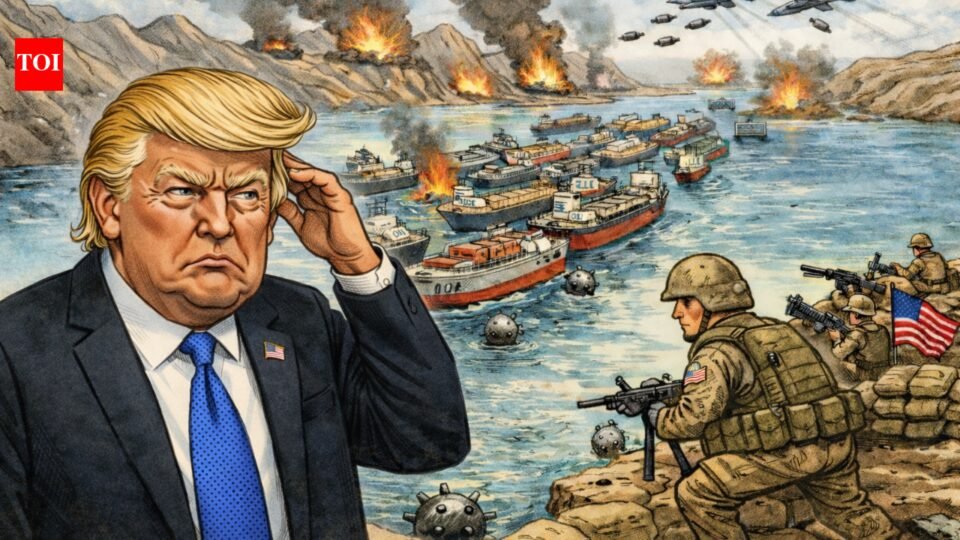
The Strait of Hormuz is no longer just a shipping route and it has become a pressure point in a widening conflict in Middle East. As tensions escalate, this narrow stretch of water is now at the centre of a high-stakes standoff, where geography, military power and global energy flows collide.The narrow sea lane, now squeezed tight by Iran, has turned into the world’s most tense maritime chokehold, blocking ships as Tehran’s strongest answer to the US-Israel offensive launched on February 28, that also saw the killing of its long-serving supreme leader Ayatollah Ali Khamenei.
In response to the combined military heat from Washington and Tel Aviv, Tehran has not just fired missiles across the region, but also played its strongest card, throttling the Strait of Hormuz, the busiest petroleum artery of the world.At either end of the Strait, hundreds of ships, flying flags from across the globe, sit idling in a live war zone, under the shadow of incoming missiles. The chokepoint isn’t just blocked; it’s gasping.Yet, even in this squeeze, Tehran has left a narrow passage open, a calculated breather for “friendly nations.” India, China, Russia, Pakistan and Iraq find themselves on that selective list, granted cautious leeway through the tense waters.Iranian foreign minister Abbas Araghchi himself extended the helping hand, saying, “We have permitted passage through the Strait of Hormuz for friendly nations including China, Russia, India, Iraq, and Pakistan.”
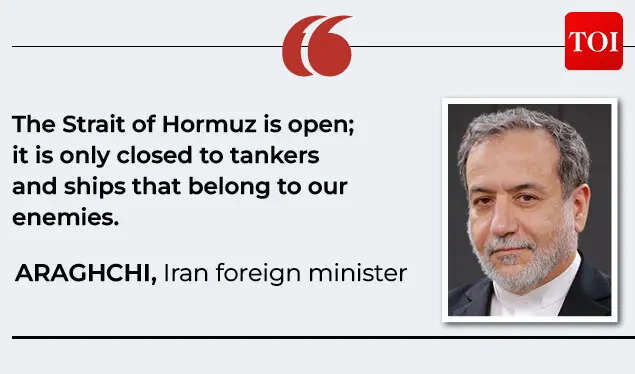
“The Strait of Hormuz is open; it is only closed to tankers and ships that belong to our enemies,” he added.Meanwhile, a visibly agitated Donald Trump has vowed to force the waters open “one way or another,” as Washington pushes to bring Tehran back to the table, hoping diplomacy can cool what the sea has already set on fire.
Why it’s so hard to reopen the Strait of Hormuz?
At either end of the world’s most critical energy artery, tankers remain frozen in the waters, hulking, silent, and waiting. The Strait of Hormuz, once a relentless conveyor belt of global oil, is now a chokehold. Iran, responding to the joint military push by US President Donald Trump and Israeli Prime Minister Benjamin Netanyahu against the long-standing Khamenei order, now under Mojataba’s control, has effectively suffocated these waters.
Sea tensions are sending oil prices sky-high, shaping the ground reality for the world. Trump has vowed to reopen the route “one way or another.” Yet, even before the conflict spiralled, Washington and Tehran had cycled through multiple rounds of nuclear talks without resolution. Relations have remained brittle since Ayatollah Ali Khamenei’s rise around 40 years ago. Now, with Tehran rejecting Washington’s 15-point peace proposal to bring peace, especially after coming under pressure around Hormuz, the path to de-escalation looks anything but smooth.As The New York Time reports, cracking open the Strait again may prove far harder than it sounds.
Where geography becomes a weapon
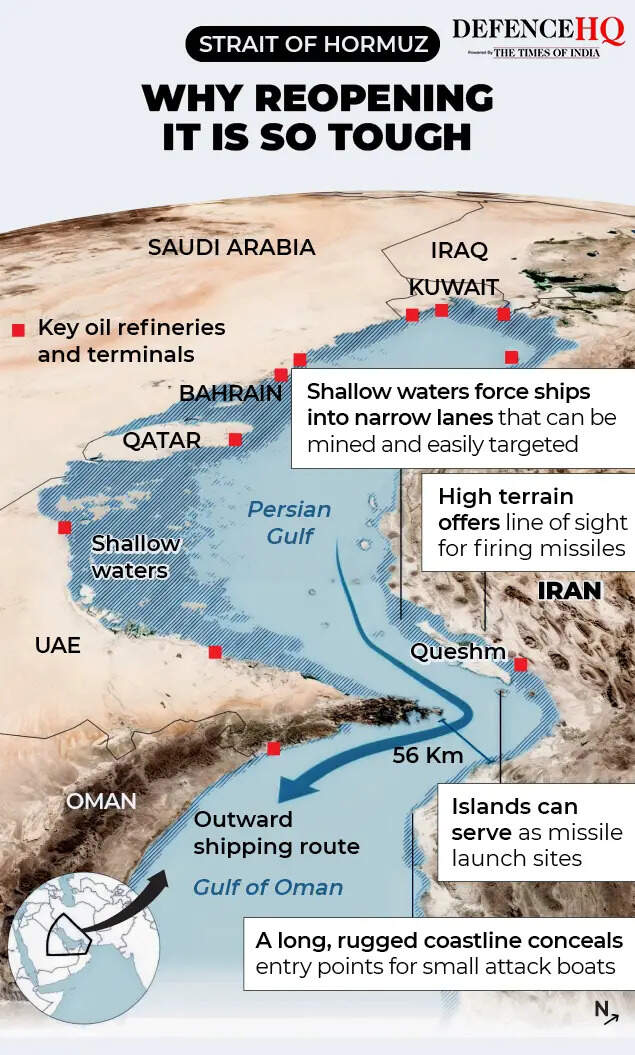
The Strait’s geography is its greatest weapon. Narrow and shallow, it forces ships to pass within striking distance of Iran’s rugged, mountainous coastline in Musandam Peninsula, terrain tailor-made for asymmetric warfare.“The Iranians have thought a lot about how to utilize the geography to their benefit,” said Caitlin Talmadge, a professor at the Massachusetts Institute of Technology who studies Gulf security issues.
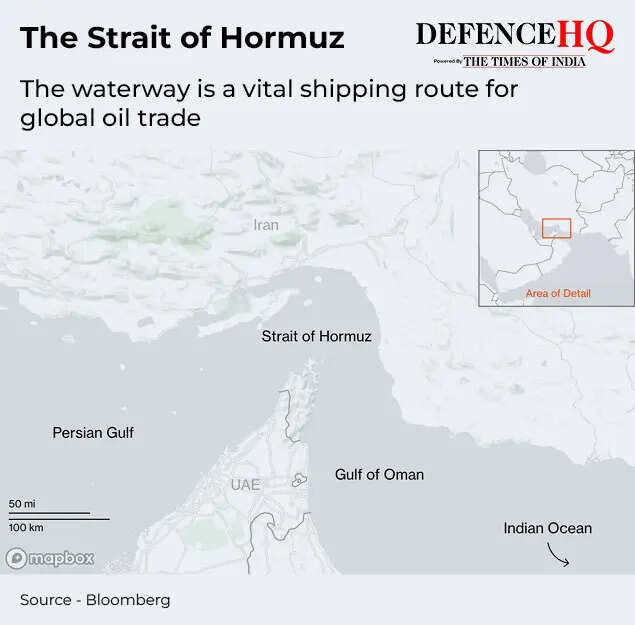
The weapons may be relatively small, but that allows the Iranians to hide them in cliffs, caves and tunnels, and then deploy them at close range along the coastline.“The sheer proximity of Iran and width of the strait is what makes it so difficult,” said Jennifer Parker, a former naval officer now at the National Security College of Australian National University.A vessel that comes under attack in the waterway doesn’t have much time to act.“You have very limited time from a detection,” Parker said. “To then try and respond and take out that missile or drone, your response time, depending on the speed of it, could well be minutes.”
The invisible arsenal along the coast
Trump has floated multiple ideas, even suggesting joint control of the Strait with Iran’s leadership, but most viable options lean heavily on military force.The first step would be neutralising Iran’s ability to strike ships. Yet, since the war began in late February, as many as 17 vessels have already been hit, according to maritime data firm Kpler. Despite thousands of US and Israeli strikes on Iranian targets, the threat still persists.
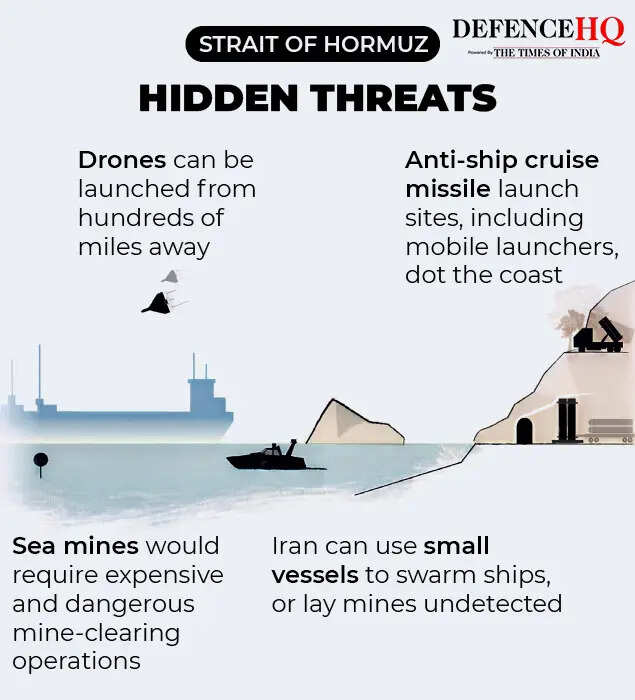
“They have many places where they could put missile batteries,” said Mark F Cancian, a senior adviser at the Center for Strategic and International Studies and a retired Marine Corps colonel. “And because the missile batteries are mobile, it’s hard to find and target them.”Naval escorts for commercial tankers are on the table, but they would require a massive, multi-layered military operation.“It would involve ships escorting the tankers,” he said.
There would be minesweepers to take care of any mines that might have been laid. There would be aircraft overhead to intercept any drones and to attack any missile batteries on shore.
Mark F Cancian
Sending in warships to fend off drone and missile attacks brings its own risks.“The destroyer’s defensive systems are really designed for something different than the close-in knife fight of the strait,” said Eugene Gholz, an associate professor of political science at the University of Notre Dame. “Every part of the destroyer is sensitive to being attacked.”
Mines, missiles and minutes to react
If missiles and drones shrink reaction windows, mines stretch the danger indefinitely, and perhaps most dangerously.“If there’s a seriously credible threat of mines being in the water, that changes things completely,” said Jonathan Schroden, an expert on irregular warfare at CNA, a nonpartisan defense research institute.
No navy is going to want to put their capital ships in a waterway that is potentially or actually mined.
Jonathan Scroden told NYT
Mine-clearing operations could take weeks, exposing slow-moving crews directly to harm. Every minute spent sweeping is a minute under threat, and every delay keeps global supply chains on edge.
War doesn’t stop at sea
Beyond the water, the risks deepen on land. US Marines are already moving into the region, and analysts suggest as NYT reported that they could be used for limited ground operations, raids or air defence deployments to protect convoys.Given the scale of Iran’s ground forces, any such move would likely be cautious, possibly limited to islands in the Strait rather than the mainland. Even then, the stakes remain high.“If the ground forces are killed or captured, it changes the dynamics completely,” Parker, the former naval officer told NYT.
The limits of success
Even a large-scale military operation offers no guarantees. All it takes is one successful strike to shatter fragile confidence.Right now, most tanker operators are unwilling to risk the passage. Nearly 500 tankers sit idle in the Persian Gulf, according to S&P Global Market Intelligence. Before the war, roughly 80 vessels crossed the Strait every day.“The important thing is to reassure the shipping companies and insurance markets that the risk is low enough for them to make it worthwhile to go through the strait,” said Kevin Rowlands, a naval expert at the Royal United Services Institute.
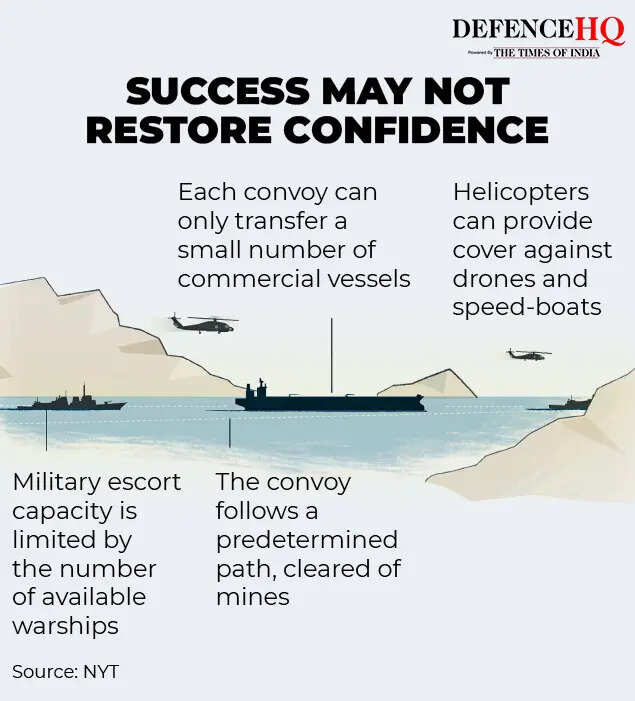
But reassurance is hard to manufacture in a live conflict zone. Escort operations would stretch US military resources, diverting assets from other fronts. And with Iranian strikes reported beyond the Strait, in both the Persian Gulf and the Gulf of Oman, protection would have to extend far beyond a single chokepoint.“I think as long as there is a residual Iranian threat to the strait, you will see an effect on traffic,” said Talmadge. “For things to truly return to normal, it will require a diplomatic and political solution.”
Trump tense or triggered?
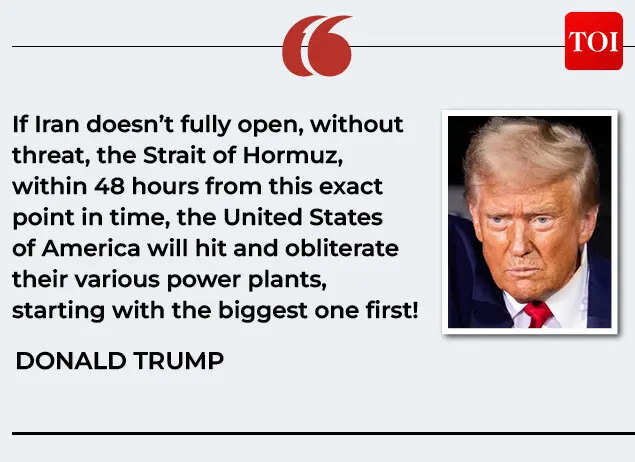
Days ago, Trump issued a stern warning to Iran, giving a 48-hour ultimatum to “fully open” the crucial waterway, which carries around 20% of global crude supplies.“If Iran doesn’t fully open, without threat, the Strait of Hormuz, within 48 hours from this exact point in time, the United States of America will hit and obliterate their various power plants, starting with the biggest one first!” Trump said earlier.
Now, however, Trump has struck a more measured tone. While continuing to post in all caps, his stance appears to have softened. He has paused military strikes on Iran’s energy infrastructure for five days and described ongoing talks with Tehran as “productive.”Trump posted on Truth Social in all caps, “I am pleased to report that the United States of America, and the country of Iran, have had, over the last two days, very good and productive conversations regarding a complete and total resolution of our hostilities in the Middle East. Based on the tenor and tone of these in-depth, detailed, and constructive conversations, which will continue throughout the week, I have instructed the Department of War to postpone any and all military strikes against Iranian power plants and energy infrastructure for a five-day period, subject to the success of the ongoing meetings and discussions.”
A ‘toll booth’ at sea?
Adding another layer to the crisis, a report by shipping news platform Lloyd’s List suggests Iran’s Islamic Revolutionary Guard Corps (IRGC) may have introduced a de facto “toll booth” system in the Strait.Under this system, vessels are required to submit detailed documentation, obtain clearance codes, and transit through a single IRGC-controlled corridor under escort. Since March 13, at least 26 ships have reportedly passed through using pre-approved routes.Crucially, no vessel has used the “normal” route since March 15, according to Lloyd’s List Intelligence data.After tightening its grip on the Strait of Hormuz for its “enemies,” Iran has now raised the stakes.
One strait choked, another in focus
On Thursday, Tehran warned it could also threaten the Bab al-Mandeb Strait, another crucial global shipping route, if the United States and Israel escalate the war, especially through any ground invasion of Iranian territory, including the strategic Kharg Island, NYP reported.Opening pressure on another chokepoint could deepen the economic shockwaves from the Middle East conflict.The Bab al-Mandeb Strait, whose name translates from Arabic as “Gate of Tears”, connects the Red Sea to the Gulf of Aden, making it one of the world’s most vital maritime corridors.Any disruption there could trigger far-reaching economic consequences, adding to the shocks already felt at Hormuz.
