
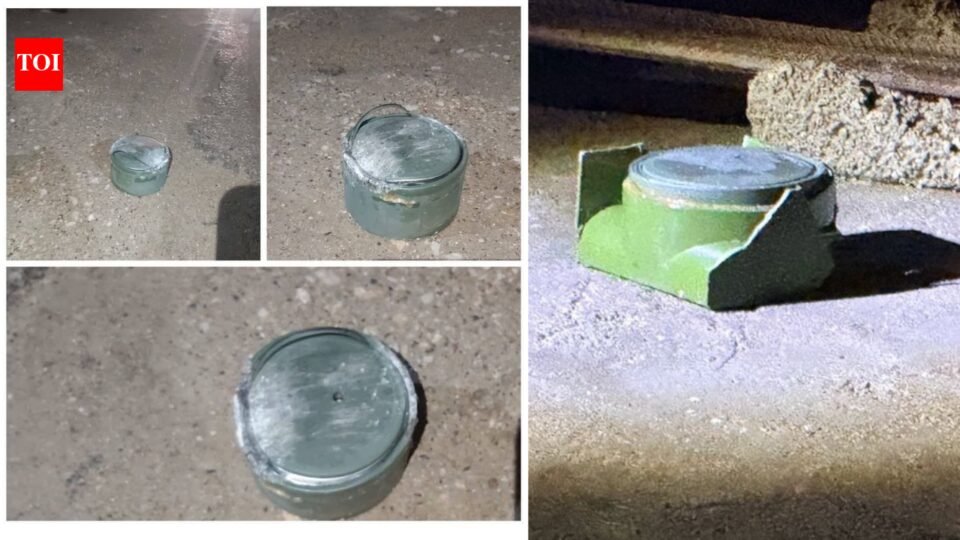
As the Middle East war intensifies, Iran has accused the United States of dropping anti-tank landmines near one of its underground missile facilities. The incident has caused multiple casualties.The allegation was first reported by Iran’s official Tasnim news agency, which said explosive devices were scattered in areas near Shiraz, particularly around the village of Kafari.“These explosive packages resemble ready-made canned food, are somewhat larger than tuna cans and contain explosives that detonate after being opened, causing casualties,” Tasnim said in a post on Telegram.“These packages have been dropped in the skies over the southern suburbs of Shiraz, especially in the village of Kafari, and unfortunately have caused the martyrdom of several people in these areas,” the agency further wrote.
What evidence has emerged so far?
Images shared by Iranian media showed BLU-91/B scatterable anti-tank landmines, part of the US-made ‘Gator’ mine system.Open-source investigation group Bellingcat said it geolocated some of the devices near Kafari village, close to the Shiraz South Missile Base, one of Iran’s ‘missile cities.’“This video shows at least three mines approximately two kilometres away from the entrance to what is reported to be Shiraz South Missile Base,” Bellingcat said, citing footage recorded in the area.The group also highlighted that the United States is the only known participant in the conflict that possesses such mines.At present, there is no independent confirmation that the mines were dropped by the US.Analysts say it is unlikely, but not impossible that Iran could have access to similar systems, either through reverse engineering or by using replicas for propaganda purposes.
Why would such mines be used?
Despite sustained airstrikes, Iran continues to launch missiles across the region. A key reason is its network of underground missile facilities, often referred to as ‘missile cities.’These facilities allow Iran to store and move launchers while protecting them from aerial attacks. Even when entrances are bombed, Iran has reportedly been able to reopen or bypass them.In this context, deploying anti-tank mines could serve as an “area denial” tactic aimed at restricting movement around these facilities.Mining access routes or entrances could block heavy equipment from reopening damaged tunnels, disable or destroy mobile missile launchers, limit their movement and prevent resupply or repositioning of missile systems.
What are BLU-91/B ‘Gator’ mines?
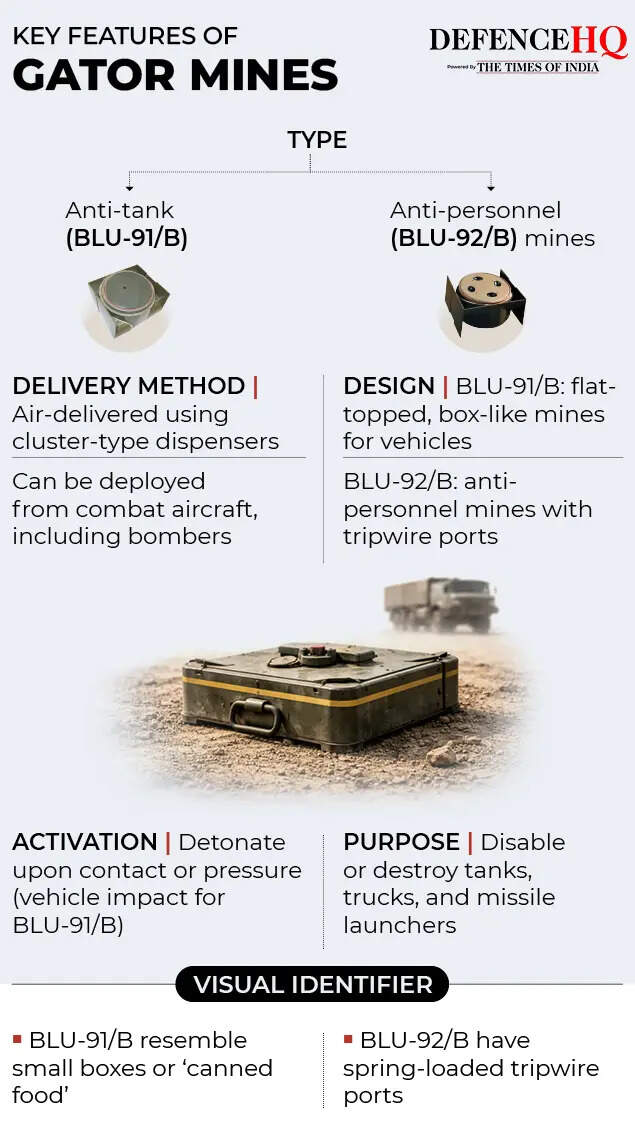
The suspected devices belong to the Gator mine system, which includes BLU-91/B anti-tank mines and BLU-92/B anti-personnel mines.These are air-delivered using cluster-type dispensers that scatter mines across a targeted area.BLU-91 mines are designed to destroy or disable vehicles such as tanks and trucks. They can be programmed to self-destruct after a set period, ranging from a few hours to several days.
.
Unlike anti-personnel variants, BLU-91 mines do not have tripwire mechanisms, making them less likely to target individuals directly.The last confirmed combat use of Gator mines dates back to the 1991 Gulf War, with unverified reports of use in Afghanistan in 2001, according to WarZone.
Humanitarian concerns of using landmines
The use of landmines raises serious humanitarian concerns, especially if deployed near civilian areas.There are fears that civilians could accidentally trigger the devices or pick them up without recognising the danger.However, experts highlight that Iran’s missile facilities are typically located in restricted zones away from urban centres. If the mines were deployed strictly within such areas, the risk to civilians may be relatively lower.Importantly, while the United States is not part of the Ottawa Convention banning anti-personnel mines, it has restrictions on their use. Anti-tank mines like the BLU-91 are not covered by the same prohibitions.It remains unclear whether the reported deployment of mines is an isolated case or part of a broader military strategy.As the conflict continues, targeting Iran’s missile infrastructure remains a key objective for US-led operations. Using air-dropped mines to deny access to these facilities could become a more prominent tactic.
