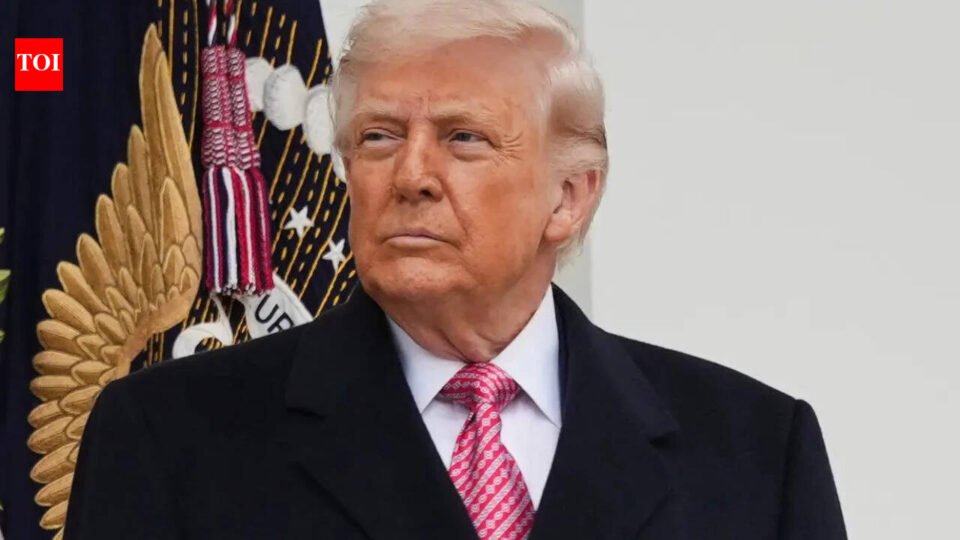
TOI Correspondent from Washington: In a pair of incendiary social media posts on Tuesday, MAGA supremo Donald Trump told US allies and partners to “go get your own oil” from an inflamed Gulf region or buy American energy, even as gas prices in the US breached $ 4 a gallon (Rs 100/liter). Trump taunted allies, implicitly accusing them of cowardice, because they have declined to support what even domestic critics see as Washington’s reckless war that is torching the Gulf region and the global economy.Laying bare an extraordinary rupture in the transatlantic alliance, with European powers increasingly distancing themselves from the US, Trump lashed out at allies, asking them to “build up some delayed courage” and “ start learning how to fight for yourself,” because “the USA won’t be there to help you anymore, just like you weren’t there for us.”
At the heart of the growing rift is a perception across European capitals, and indeed much of the world, that the US launched the war without consultation and now expects logistical and political backing as a matter of entitlement. Trump’s war, ostensibly triggered by Israeli leader Benjamin Netanyahu, has disrupted energy supplies from the region and is threatening to tank the global economy, even as the MAGA boss is transparently opportunistic in telling “All of those countries that can’t get jet fuel because of the Strait of Hormuz… I have a suggestion for you…buy from the US, we have plenty.”India, which is the world’s second largest importer of crude after China, is heavily dependent on supplies from the Gulf. The disruption in Hormuz— and the unsubtle pressure to shift to US energy—poses multiple challenges for New Delhi, including higher costs, logistical constraints, and a diminution of India’s strategic autonomy that has traditionally diversified suppliers to avoid overdependence.But it is the European nations that are in Trump’s immediate line of fire for declining, some of them bluntly – to support what even domestic critics say is an unprecedented show of American hubris. The UK —traditionally Washington’s closest military partner—has stopped short of joining offensive operations and restricted the use of its facilities for combat missions, reflecting both domestic opposition and strategic caution.France has reportedly denied overflight permissions for operations linked to the conflict and even blocked airspace for the transfer of US weapons in support of Israeli operations. Italy has denied American aircraft access to the strategic Sigonella airbase in Sicily – a critical NATO node for Mediterranean operations – citing legal constraints and lack of parliamentary approval. Spain has gone further still, with Madrid not only refusing use of joint bases but also closing its airspace to US military flights involved in the war, forcing American aircraft to reroute and complicating supply chains. Spanish Prime Minister Pedro Sanchez has openly described the war as “illegal,” positioning Spain as the most vocal European critic of Washington’s campaign. The rebuff has enraged Trump, who on Tuesday singled out the UK and France for being unhelpful, and warned “The USA will REMEMBER!!!” The “go get your own oil” remark, aimed particularly at Britain, reflects a broader shift in US posture: from security guarantor to transactional supplier. It is a message that resonates poorly across the world, particularly in Europe, where leaders already view the war as a unilateral American venture with destabilizing global consequences. Trump minions also flagged Europe’s non-cooperation. From Secretary of State Marco Rubio: If NATO is just about us defending Europe if they’re attacked, but them denying us basing rights when we need them, then that’s not a very good arrangement. Secretary of War Pete Hegseth: You don’t have much of an alliance if you have countries that are not willing to stand with you when you need them.Public opinion underscores the shift, even as Trump and his sidekicks are all over the place with inconsistent messaging, sometimes threatening to expand the war with ground troops and invasion, and sometimes indicating they will simply pull back leaving Iran in control of Hormuz; sometimes insisting Iran is decimated and other times claiming Iran still has the ability to strike back. The back and forth has left the American public, which is largely against the war, confused, while majorities across Europe too oppose it. What emerges is a picture of incoherent American arrogance colliding with a more assertive and risk-averse Europe. The result is not merely a policy disagreement over Iran, but a structural weakening of the Western alliance.
