


There is a strange contradiction playing out in everyday life. People step out, feel the warmth of the sun, and still show up with low Vitamin D levels in routine blood tests. It feels unfair, almost confusing. After all, sunlight has always been seen as the simplest source of this nutrient.But the body does not work on assumptions. It works on conditions. And when those conditions are even slightly off, Vitamin D production and use can quietly fall apart.A large body of research reflects this concern. A study published by the Indian Council of Medical Research (ICMR) has repeatedly highlighted widespread Vitamin D deficiency across urban and semi-urban populations, even in a tropical country like India.
So what is going wrong?
When sunlight isn’t really sunlightDr Chirag Tandon explains it simply, “Production of Vitamin D in the body only occurs when the skin is directly exposed to sunlight, as well as between 10 am and 3 pm.”That one sentence changes everything.Many people step out early in the morning or late in the evening, believing they are doing enough. But the UVB rays needed for Vitamin D synthesis are strongest only during midday hours.Then there are hidden barriers. Sitting near a sunny window does not count. Glass blocks UVB rays. Covering most of the body with clothing limits exposure. Even consistent use of high-SPF sunscreen can reduce Vitamin D production.Add another layer: air pollution. Studies, including those referenced in government environmental health reports, show that particulate matter in polluted cities can block UVB penetration.So the sun may be present, but the body never truly receives it.
Skin tone, lifestyle, and the unseen slowdown
Not all bodies respond to sunlight the same way.Darker skin contains more melanin, which naturally reduces the skin’s ability to produce Vitamin D. This is not a flaw, but it does mean longer exposure is needed.Then comes lifestyle. Long work hours indoors, screen-heavy routines, and minimal outdoor activity all reduce meaningful exposure.Dr Tandon adds another layer, “Vitamin D production can also be slowed down by even pollution and darker skin color.”It becomes a quiet accumulation of small misses. None of them seem serious on their own, but together, they tip the balance.

Factors like pollution, skin tone, low-fat diets, and magnesium deficiency further complicate the problem.
The absorption problem most people miss
Even when sunlight exposure is adequate, the story does not always end there. The body still needs to absorb and activate Vitamin D properly. And this is where things often break down.Dr Tandon explains, “Regardless of whether there is sufficient sunlight exposure, your body might still not absorb or use the Vitamin D adequately.”Several factors play a role:
- Gut health issues can reduce nutrient absorption
- Liver and kidney conditions affect Vitamin D conversion
- Obesity can trap Vitamin D in fat tissue
- Low magnesium levels interfere with activation
One surprising factor is diet. Vitamin D is fat-soluble, which means it needs dietary fat to be absorbed. Extremely low-fat diets, often followed for weight loss, can quietly work against this process. Stress and inactivity also affect metabolism, which influences how nutrients are processed. This is why deficiency often persists despite “doing everything right.”
Small, thoughtful shifts that actually work
Fixing Vitamin D deficiency does not require extreme changes. It requires precise ones.Dr Tandon suggests a balanced approach, “Get adequate exposure to the sun without barriers… intake of Vitamin D rich foods… and have a healthy diet with good fats and magnesium sources such as nuts and seeds.”Here is what that looks like in daily life:
- Step out between 10 am and 3 pm, even for 15-30 minutes
- Expose arms, face, and legs without sunscreen for a short duration
- Include foods like eggs, fortified milk, and fatty fish
- Add nuts, seeds, and whole foods for magnesium
- Move your body; exercise improves metabolic function
Supplementation can help, but it should not be random. Blood tests guide the right dose.The National Institute of Nutrition also recommends periodic monitoring of micronutrient levels, especially in high-risk groups.
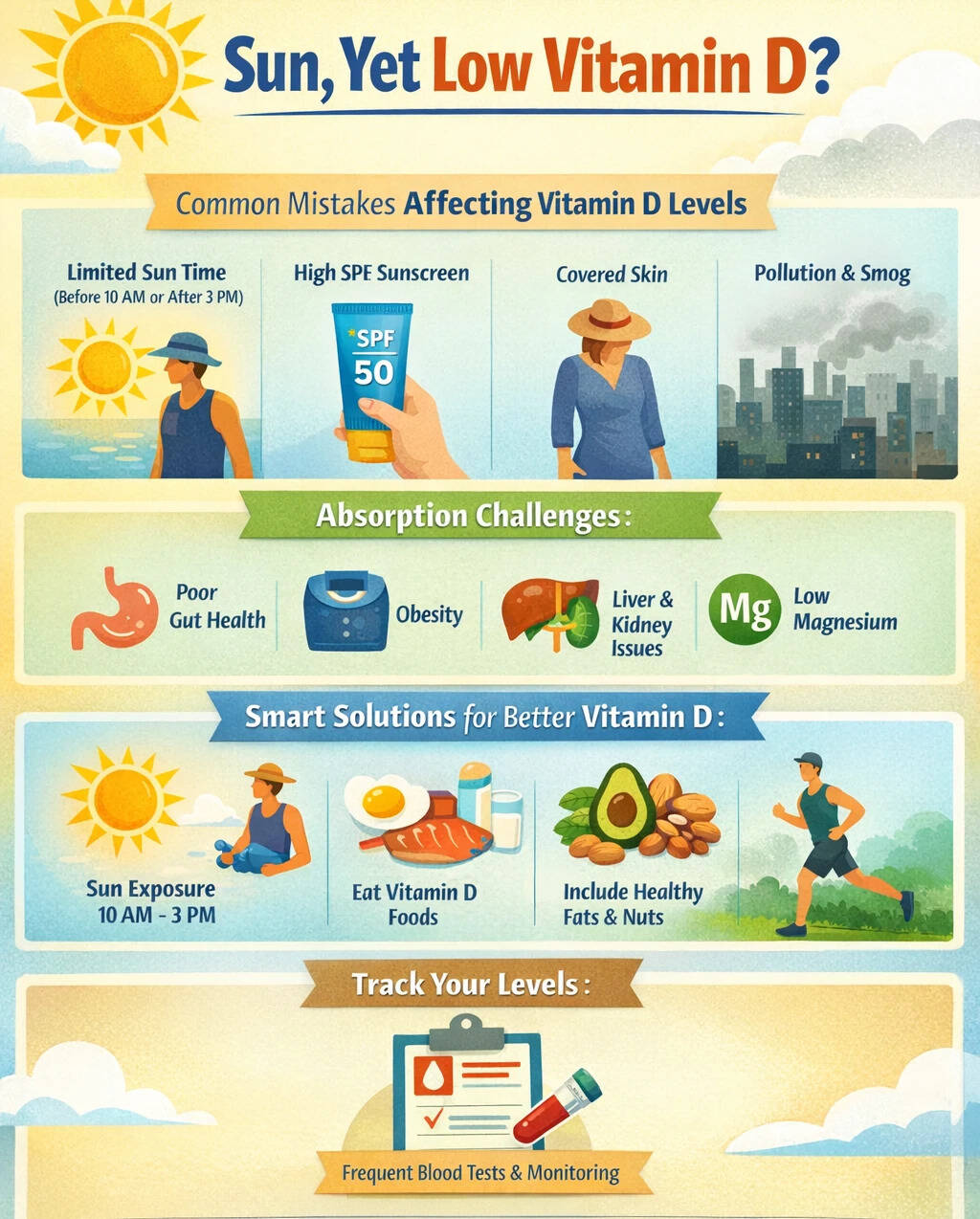
With targeted sun exposure, better nutrition, and regular testing, levels can be restored effectively.
Why tracking matters more than guessing
Vitamin D deficiency rarely causes dramatic symptoms early on. That is what makes it dangerous. Fatigue, body aches, or low mood can be brushed off as stress or poor sleep. But over time, deficiency can affect bone health, immunity, and even metabolic balance. Regular blood tests bring clarity. They replace guesswork with data.As Dr Tandon puts it, “Frequent blood tests should be done to keep track of the levels and modify treatment.”This is not about fear. It is about awareness.Vitamin D deficiency is often misunderstood as a simple lack of sunlight. But the reality is more layered. It is about timing, exposure, absorption, and overall health. A few small adjustments, done consistently, can make a visible difference. Not overnight, but steadily.Medical experts consultedThis article includes expert inputs shared with TOI Health by:Dr Chirag Tandon, Director – Internal Medicine, ShardaCare-Healthcity.Inputs were used to explain why vitamin D deficiency can persist despite regular sun exposure, the common mistakes that affect absorption, and simple ways to correct them.
