

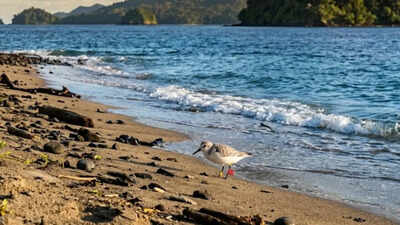
A small shorebird, around 40-100 grams (about 1.5-3.5 ounces), has successfully migrated more than 7,472 kilometres (over 4,640 miles) from its non-breeding grounds – with the help of a tagged red flag coded (DYM) – to the remote Narcondam Island located within the Andaman and Nicobar Archipelago. Two months after being tagged near Brown Bay in South Australia in April 2025, this bird was photographed on Narcondam Island by an officer of the Andaman Police. The Bombay Natural History Society (BNHS) has confirmed the photograph; therefore, it represents the first documented re-sighting of a tagged bird on this volcanic island. Additionally, this demonstration of migration supports the critically important role played by the East Asia-Australasia Flyway (EAAF), often referred to as a ‘superhighway,’ used by millions of birds during migration between their breeding and wintering grounds.
Role of remote islands in the migratory success of Australian shorebird reaches Andaman’s Narcondam Island
On April 13, 2025, Maureen Christie tagged a Sanderling (Calidris alba) in South Australia. By June 16, 2025, this individual bird was located on Narcondam Island. This Sanderling travelled 7,472 kilometres in just over 2 months, returning to its Arctic breeding grounds after stopping at Narcondam Island while on its way back. This bird was identified as having a unique ‘DYM’ tag (red flag) and a yellow tag.The East Asia-Australasia Flyway (EAAF) is one of the world’s major migratory routes, spanning 37 countries from the Arctic Circle to East Asia/Southeast Asia all the way to Australia and New Zealand. Narcondam Island acts as an important refuelling stopover for over 50 million migratory waterbirds of 210 species that utilise the EAAF for their seasonal survival.
Why Narcondam is a critical avian stopover
Narcondam Island is a remote oceanic volcano located 140 nautical miles from Port Blair. In addition to being known for the Narcondam Hornbill, recent ecological research confirms it to be a critical stopover for many migratory birds, including Sanderlings, that stop at Narcondam Island due to its pristine and non-fragmented littoral zones.Sanderlings breed around the world in the northern hemisphere and migrate to sandy beaches across the globe. Sanderlings are documented to fly long distances without stopping and will often gain a significant amount of body fat to enable them to fly across oceans during portions of their migration across the Bay of Bengal.
Why shorebirds shrink their organs to fly
The journey of a Sanderling weighing roughly the same as a playing card to migrate 7,400 kilometres is an incredible feat of biological efficiency. Sanderlings prepare to fly between vast bodies of water, such as the Bay of Bengal, by undergoing dramatic physiological changes as documented in the Cornell Lab. In preparation for migration, they enter into hyperphagic feeding, a period of rapid feeding in which they can nearly double their body weight through lipid storage. Lipids are a high-energy source and provide 8-10 times the energy as proteins or carbohydrates. Some shorebirds are even capable of shrinking their internal organs, such as their digestive tract, to reduce ‘dead weight’ and enhance their pectoral muscle strength, allowing for longer, nonstop flights.
Why pristine volcanic islands must be preserved
The recent confirmation of a DYM (Diverse Year Maximising) tagged sanderling at Narcondam Island highlights the island’s role in a larger, fragile ecosystem. According to the East Asian-Australasian Flyway Partnership (EAAFP), this flyway supports the highest global number of threatened species that migrate. As migratory bird habitat is being degraded through coastal development and habitat loss in the Yellow Sea and Southeast Asia, ‘refuelling’ stations such as Narcondam Island are becoming increasingly important. Narcondam is a low-human-impact volcanic island that provides an important predator-free area for migratory birds to rest without being impacted by human disturbances.
Narcondam as a bridge between hemispheres
The endemic Narcondam Hornbills make this island a well-known Important Bird and Biodiversity Area (IBA) designated by BirdLife International and the BNHS; this very sighting confirms that. The island is a geographic island in the Andaman Sea, and the island acts as a stepping stone for birds migrating from the Southern Hemisphere to reach their nesting sites on the tundra of Siberia. The sighting of the (DYM) bird indicates that these remote oceanic outcroppings are more than just isolated rocks and, in fact, form part of an interconnected ecological network.
