
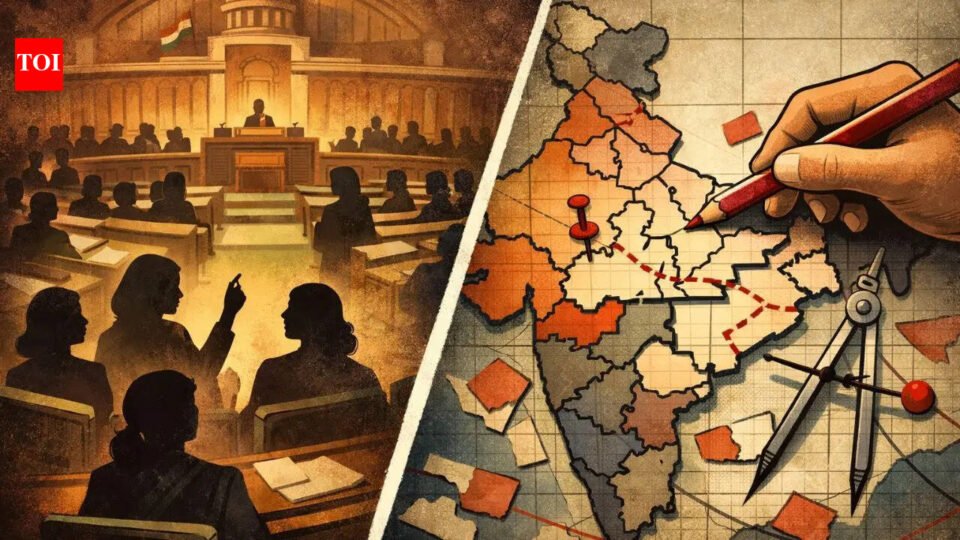
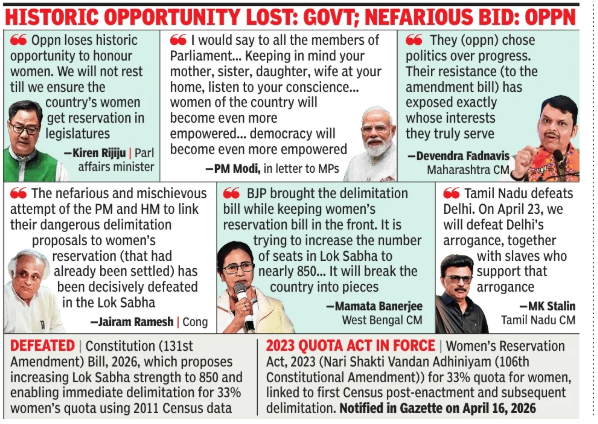
NEW DELHI: Parliament has voted down the government’s proposal to expand the Lok Sabha from 543 to 850 seats, implement 33% reservation for women, and redraw constituencies accordingly, but the defeat has not closed the issue. If anything, it has exposed how a once-technical constitutional mechanism has become one of the most consequential unresolved questions in electoral politics.It is important to note that the Women’s Reservation Act 2023, which provides for a 33% reservation for women in the Lok Sabha and state legislative assemblies, came into force on April 16, 2026 amid the ongoing debate on proposed bills.The opposition was unambiguous about these bills. “This defeat is not of women’s quota but of delimitation by the backdoor,” said Revolutionary Socialist PartyMP N K Premachandran. Samajwadi Party chief Akhilesh Yadav called it a “defeat of BJP’s malice.” Trinamool Congress, whose 21 MPs had been urgently mobilised by the INDIA bloc, proved critical to the margin. After the vote, Congress’s Rahul Gandhi spoke personally with TMC’s Abhishek Banerjee to thank him for the support.Congress’s Priyanka Gandhi Vadra was direct: “PM Modi maliciously linked women’s quota to delimitation based on the 2011 census. His hollow attempt to pose as the messiah of women has failed today.”CPI MP Sandosh Kumar put the charge differently- that women should “see through BJP’s approach of delaying women’s quota by linking it to the census and delimitation.”On the government side, home minister Amit Shah, as the bill’s fate became clear, offered to adjourn the House and return with an amended bill. “I have the amendment prepared,” he said, pressing the government’s commitment to the 50% seat expansion. Prime Minister Narendra Modi made a final appeal before voting, asking MPs to “reflect on your conscience” and act on behalf of women across the country.The bill failed. Two related pieces of legislation, including the one to set up a delimitation commission, were not tabled in the Rajya Sabha. Parliament was adjourned.
What government proposed
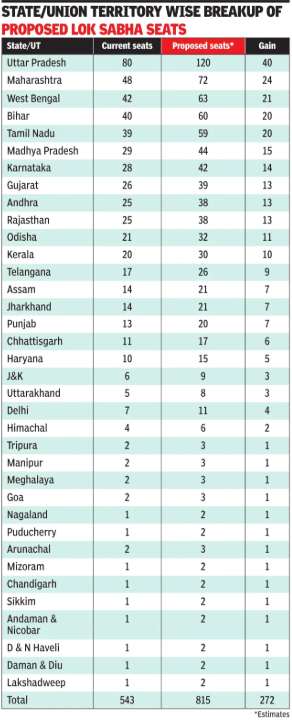
The government’s plan was architecturally different from any previous delimitation exercise. Its central proposal was to increase total Lok Sabha seats by 50%, from 543 to 850, while keeping each state’s proportional share of seats unchanged. Uttar Pradesh, which currently holds 80 seats, would have received 120; Tamil Nadu, with 39, would have received 58 or thereabouts.The mechanism for women’s reservation flowed from this expansion. If every state’s seats increased by 50%, one-third of the new total — 33% — could be reserved for women, equalling precisely the one-third of the expanded total. The arithmetic was designed to be self-contained: no state would lose share, and the reservation obligation would be met without redistributing existing seats.The proposed delimitation commission, as described in the bill circulated to lawmakers, would be headed by a former Supreme Court judge, with the chief election commissioner or a nominee as a member, consistent with past practice.The exercise for the Lok Sabha, government sources made clear, was to be delinked from the 2011 census. Constituency boundaries would be redrawn; the proportional shares of states in the Lok Sabha would not change. In that structural sense, it was closer to the 2008 delimitation exercise than to the full reallocation exercises of 1952, 1963, or 1973.
.
Why opposition read it as threat
The bill’s legal architecture contained a provision that drew sustained fire. As Vidhi Centre for Legal Policy’s Swapnil Tripathi, lead at Charkha (Centre for Constitutional Law), explained: “Currently, Article 82 requires that delimitation of constituencies and readjustment of seats among states be undertaken after completion of every census, using population data of that census. The present bill removes this obligation and instead leaves it to parliament to determine both timing of delimitation and census to be used for the exercise. Importantly, this transforms what was a constitutional obligation into a matter of legislative discretion.”That shift from constitutional mandate to parliamentary choice was the provision that most alarmed critics. It would have allowed parliament to decide, at will, which census data to use and when to act, stripping Article 82 of its periodic, automatic character.Congress lead speakers Gaurav Gogoi and K C Venugopal accused the government of using women’s quota as “cover” for a larger electoral reengineering. Gogoi invoked the American term explicitly- BJP was using delimitation “like gerrymandering in the US, where seats are redrawn for political exploitation.” He pointed to what he called precedents in Jammu & Kashmir, where a delimitation commission used census 2011, and in Assam, where the election commission used census 2001, bypassing norms of geographical contiguity and uniformity. “What was done in Assam and J&K, government wants to do it in the entire country,” he said.DMK chief M K Stalin, who had led protests in Tamil Nadu, said his party’s concern was squarely about delimitation–”which requires careful thought to ensure it is fair, especially for southern states.” He said the government should have delinked women’s reservation from delimitation entirely.Congress challenged the government to implement women’s reservation immediately in the existing 543-seat House without linking it to census or delimitation. The government declined.
.
Stakes for southern states
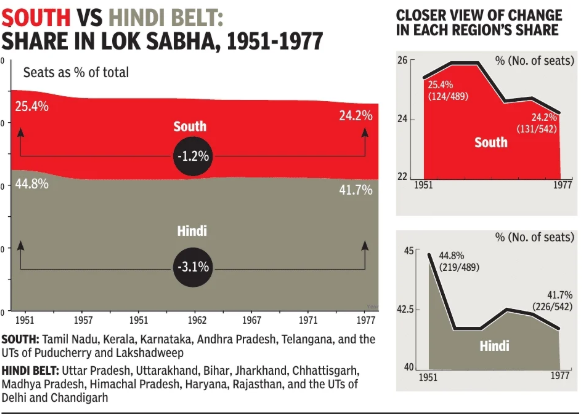
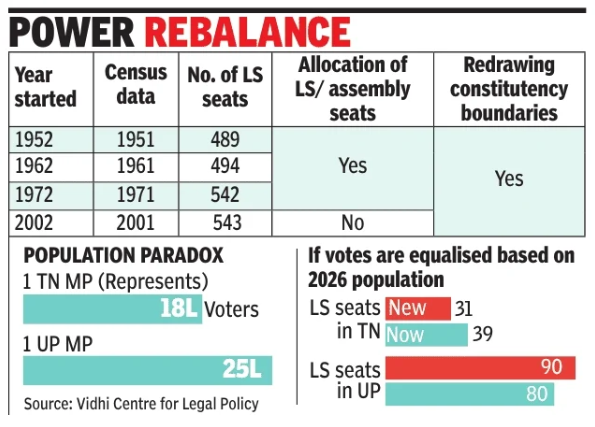
The underlying anxiety that animated the southern bloc is rooted in demography and mathematics that are not in dispute.India’s seat allocation in the Lok Sabha has not been updated since 1977. It rests on the 1971 census. In the five decades since, population growth has been sharply uneven. Northern states Uttar Pradesh, Bihar, Madhya Pradesh, Rajasthan grew faster. Southern states Tamil Nadu, Kerala, Karnataka, Andhra Pradesh invested earlier in public health and fertility reduction, and their populations stabilised sooner.Based on 2011 census data, Tamil Nadu has a population of approximately 7 crore and sends 39 MPs to the Lok Sabha. Uttar Pradesh has a population of roughly 20 crore, nearly three times as large, and sends 80. A Tamil Nadu MP represents approximately 18 lakh voters; and a UP MP represents approximately 25 lakh.Vidhi Centre for Legal Policy’s research quantifies what a strict population-based delimitation could produce: going by projected 2026 population, Tamil Nadu could fall to 31 Lok Sabha seats while Uttar Pradesh could rise to 90. More populous northern states have reason to argue their representation has been frozen unjustly. But southern states–which implemented family planning successfully, raised literacy, and reduced fertility–fear they are being penalised for effective governance.The government’s expansion plans–keeping proportional shares frozen while growing the overall House–was presented precisely as the resolution to this conflict. Each state keeps its share; all states gain seats; women get their quota. Critics, however, argued that the real issue was not the immediate arithmetic of the current bill, but the constitutional discretion it would have created for all future delimitation exercises.
.
What delimitation actually means
The word is used loosely in political debate to describe three distinct processes. The first is the allocation of seats among states — how many of the Lok Sabha’s total seats each state receives. This is the most consequential dimension and the one frozen since 1977. The second is the redrawing of constituency boundaries within states — carving a state’s allotted seats into geographic units of roughly equal population. The third is the reservation of specific constituencies for Scheduled Castes and Scheduled Tribes, placed in areas where those communities form the largest share of the local population.These three processes have different constitutional triggers and very different political stakes. The 2008 delimitation exercise, for instance, redrew boundaries within states using 2001 Census data — but left the inter-state seat distribution entirely untouched. The current debate is almost entirely about the first category, which has not moved in over five decades.
The Constitutional framework
The architecture begins with Article 81 — seats in the Lok Sabha shall be allocated broadly in proportion to state populations. Article 82 mandates that upon completion of each census, allocation and constituency division shall be readjusted by such authority as Parliament may by law determine. Article 170 mirrors this for state assemblies.Article 327 empowers Parliament to make laws on all matters relating to elections, including delimitation. Article 329(a) removes courts from the picture: the validity of any law relating to the delimitation of constituencies or the allotment of seats “shall not be called in question in any court.”The original design was automatic: every census triggered a readjustment, keeping representation tethered to population. It was a commitment to equal citizenship — one person, one vote, one value.
The Freeze: Why it happened
In 1976, the 42nd constitutional amendment suspended inter-state seat revision until after the 2001 census, freezing Lok Sabha seats at 543. The stated rationale was protective — states that had successfully implemented family planning should not be penalised in representation relative to faster-growing states.In 2001, the 84th constitutional amendment extended the freeze to the first census after 2026. The delimitation commission’s own guidelines, issued in 2002 under Secretary Shangara Ram, recorded the consequence plainly: “the total number of existing seats as allocated to various states in the House of the people on the basis of 1971 census shall remain unaltered till the first census to be taken after the year 2026.“The 87th constitutional amendment (2003) permitted a partial exercise using 2001 data — constituency boundaries within states could be redrawn, and SC/ST reserved seat calculations updated — without altering state-wise seat totals. The 2008 delimitation order resulted from this partial exercise. It redrew boundaries. It did not reallocate seats. India has now operated under 1971 population figures for over five decades.
.
How a delimitation exercise proceeds
When the next exercise is triggered, it will follow a structured, multi-stage procedure documented in the delimitation commission’s official guidelines.Parliament first enacts a new delimitation act — each exercise requires fresh legislation, and the old act is repealed. The Union government then constitutes a delimitation commission, chaired by a retired Supreme Court judge, with the chief election commissioner and relevant state election commissioners as ex-officio members. For each state, the commission associates five MPs and five MLAs as nominated members. These associate members can attend hearings, consult on working papers, and submit dissenting notes. They cannot vote. They cannot block final orders.The commission then prepares working papers covering district-wise population data, seat entitlements, SC/ST population distributions, and proposed constituency boundaries. Guidelines specify that constituencies must be “geographically compact areas” with regard to “physical features, existing boundaries of administrative units, facilities of communication and public convenience.” A deviation of 10 percent plus or minus from the state or district average population is permissible where geography demands it.Draft proposals are published in the Gazette of India and in state gazettes, in at least two vernacular newspapers per state, with a deadline for public objections. Public sittings follow in each state. A final order, signed by the full commission, is then published. Copies are laid before the Lok Sabha and state assemblies, but — as the guidelines confirm — “no modification shall be permissible therein by them.” Parliament receives the orders. It cannot change them.The last such exercise, covering 28 states, took over six years from commission to final order.
The courts cannot intervene — and why
The insulation of delimitation from judicial review was definitively established in Meghraj Kothari vs. Delimitation Commission (1967). The petitioner challenged a notification that converted his constituency, Ujjain, from a general to an SC-reserved seat, removing his right to contest it. The Madhya Pradesh High Court dismissed the petition on the short ground that Article 329(a) barred any such challenge. The Supreme Court upheld the dismissal.The court held that Delimitation Commission orders, once published in the Gazette, carry the same force as law made by Parliament itself under Article 327. The practical reasoning was explicit: if such orders could be challenged in courts, “any voter, if he so wished, could hold up an election indefinitely by questioning the delimitation of the constituencies from court to court.” Section 10(2) of the Delimitation Commission Act reinforced this — every such order “shall have the force of law and shall not be called in question in any court.“This does not mean all constitutional questions are foreclosed. Whether Parliament had authority to enact a particular enabling statute, or whether a commission exceeded its mandate, remains theoretically arguable in narrow circumstances. But courts have historically exercised great deference in this space, and the constitutional design strongly discourages litigation that would delay elections.
What happens next
The defeated bill has not resolved the underlying questions–it has deferred them. The Census itself is overdue. Scheduled for 2021, it was delayed by the pandemic and houselisting of census has been started this year. The ‘caste census’–which was accepted by the government after opposition parties demanded it–will be done in the second phase. Without published Census figures, the constitutional trigger under Article 82 cannot fire. Whether it will be completed in time to enable delimitation before the 2029 general election is uncertain.If delimitation proceeds, Parliament will determine what form it takes. An expansion of the House, constitutionally permissible, could soften proportional losses for southern states while meeting the women’s reservation mandate. A full population-based reallocation within the existing 543-seat cap would produce the gains and losses that drove this week’s confrontation. A further extension of the freeze remains a third option.The bill defeated in Parliament had proposed to strip Article 82 of its mandatory character, giving Parliament discretion over both timing and census data. That change is now off the table. But the underlying tension — between the democratic principle that each citizen’s vote should count equally, and the federal principle that states should not be penalised for effective governance — has not been resolved. It has been sent back to Parliament, and to the constitutional negotiation that will have to happen before 2029.Delimitation has never been purely about constituency boundaries. It is India’s recurring constitutional effort to reconcile two things that periodically fall out of alignment: the democratic imperative that every citizen’s vote count equally, and the federal imperative that the compact between states remain intact.The freeze of 1976 resolved that tension by choosing federation over arithmetic. The 84th Amendment of 2001 extended that choice for another quarter-century. What happens after 2026 will define which principle governs India’s political geography for decades to come
