
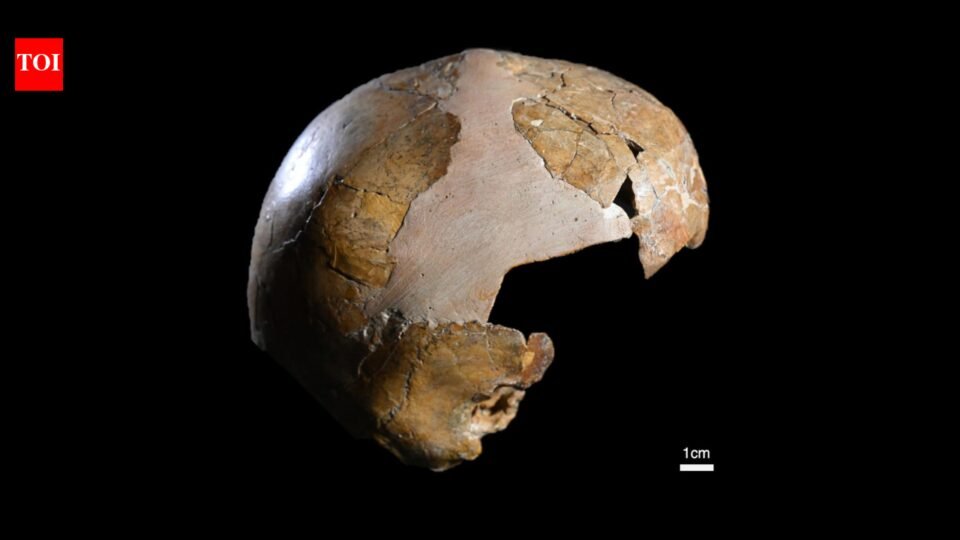
There was once an enigma that intrigued people all around the world and baffled scientists for many years: the skull of a man who lived in Eastern Europe 7,500 years ago. The odd combination of its facial features made some scientists believe that this individual could be a rare example of a hybrid between Homo sapiens and Neanderthal man. It is well-known that the two species interbred at one point in history; thus, this theory seemed quite plausible. However, science progressed, and now, due to the advancements in genetics, this case does not seem so mysterious anymore.
Re-examining the “human-neanderthal hybrid” claim
Analysis of the skull based on morphological characteristics revealed a mix of features where some were comparable to Homo sapiens while others looked like those of Neanderthals. The possibility of this being a hybrid species was raised due to the known interbreeding between these two groups of people. Various studies conducted after the discovery of the Neanderthal genome indicate that most humans possess a portion of Neanderthal DNA.Morphology does not always provide an accurate depiction of a species. According to the paper entitled, ‘A new analysis of the neurocranium and mandible of the Skhūl I child: Taxonomic conclusions and cultural implications,’ there was greater diversity among skeletal remains belonging to early human populations than had been expected. What used to be classified as archaic might just be normal variation within Homo sapiens groups.
DNA analysis reveals a different story
However, things began to change once there was an opportunity to conduct genetic analysis on the specimen. The scientists isolated the DNA from the remains of the person and used cutting-edge technology to conduct their analysis, thereby enabling them to get accurate information about his ancestry. Based on the findings, this particular person had no traceable signs of Neanderthal blood except those that can be commonly seen among early modern humans.In fact, according to research conducted in the field of human genomics, “genetic data provide a much more robust framework for the study of admixture events in ancient populations than morphological evidence alone” (Nature Communications, research on ancient human genomics). Thus, it is clear that this person was not a hybrid but simply an early modern human.
Why was there scepticism around the skull
Firstly, it is important to highlight the problem of differentiating between inherited features and evolutionary changes. In addition, it is necessary to mention the fact that early humans were characterised by numerous differences due to long migrations and changes in conditions. Thus, there is nothing unusual about the mosaic appearance of early humans.Secondly, it is vital to underline that there were certain connections between Neanderthals and modern humans, which were first discovered and described by geneticists. Therefore, some similarities are quite possible in this regard. However, they cannot prove the existence of a human-Neanderthal hybrid.Finally, it is possible to emphasise that this case is an example of scientific discoveries. At the same time, scientists should avoid exaggerations in order not to provide distorted facts. As a result, the skull under discussion does not change the history of human evolution significantly but reminds people about its complexity.Overall, the discovery of the skull under discussion can be considered a good illustration of how the process of scientific exploration changes. Initially, the information provided was interesting for scientists. Nevertheless, thanks to the latest technologies, they managed to prove that the individual had nothing to do with Neanderthals. It is a quieter conclusion—but one that brings us closer to the truth about who we are and where we come from
