


It takes a village to raise a child. Really? Maybe not literally, but financially, it can certainly feel like that, especially in today’s day and age. For many parents, bringing a new human into the world is one of life’s most joyful milestones. But, it’s not just the start of your journey into parenthood, but also the beginning of a carefully curated financial support for your baby.Alongside the excitement comes financial planning implications, which are important to consider if you want to secure your child’s needs. While most parents prepare themselves for sleepless nights and endless diaper changes, the financial side of raising a child often requires even more thought, foresight, and planning. So while you might be excited for your little bundle of joy, having a kid also requires you to be financially sound. The costs begin even before the baby arrives — doctor visits, prenatal care, and hospital bills quickly start adding up. And this is just the beginning. Once the baby arrives, a whole new list of expenses follows, vaccinations, diapers, baby gear, clothes, childcare and a lot more. As the child grows, the costs increase, and parents are constantly talking about school fees, extracurricular activities, and everyday needs. Now, add to this the responsibility of setting aside money to support their child’s future and dreams. Remember your parents’ classic quip: “paise kya ped pe ugte hain?” (Does money grow on trees?) The comment starts to make a lot more sense now. The numbers, in fact, can be quite startling.
Let’s talk figures
Raising a child from conception until the age of 21 costs an estimated Rs 74.3 lakh, according to 100 Ways to See India: Stats, Stories, and Surprises by Rohit Saran. Factor in 3% inflation, and the cost soars to about Rs 1.16 crore and to a further Rs 1.83 crore if inflation averages 6% annually.
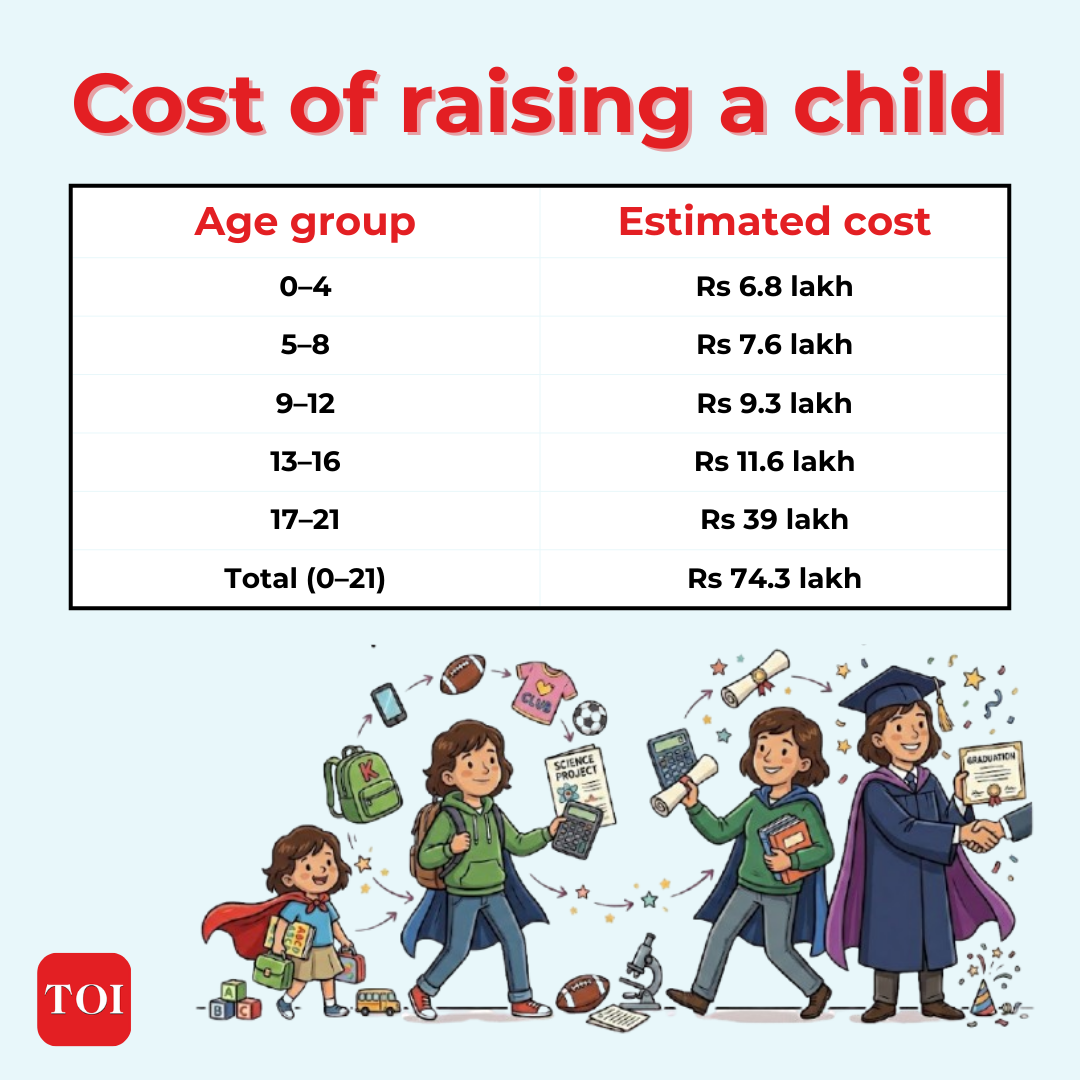
Cost of raising a child
If these costs don’t give you a clear picture at first glance, it helps to place them in the context of average earnings in India. Data from Glassdoor shows that monthly salaries for Indian employees in 2024 range widely — from around Rs 8,000 to Rs 1,43,000 — highlighting the significant variation in earning capacities across regions, industries, and experience levels. On average, the annual base salary is estimated at about Rs 9,45,489, providing a broader snapshot of typical income levels in the country, ClearTax reported. Now pause and think. From your lifetime earnings, everyday expenses such as housing, meals, clothing, healthcare, transportation and other necessities, take away a significant share year after year. What remains for savings and long-term goals is often far smaller than the headline figure suggests. That reality is exactly why having a clear financial roadmap for a child’s future becomes essential for many families.For many parents, these numbers are a constant reminder of the long financial journey that comes with raising a child. It is this realisation that often pushes families to start planning early and think about how they can steadily build savings to support their child’s future.
Where the money actually goes
Among all the expenses associated with raising a child, education stands out as the biggest cost.
Education
It begins with schoolAccording to Rohit, Nearly 59% of total child-raising expenses go toward education. School admissions, annual fees, books, transportation, and private coaching gradually add up over the years. And the spending rarely stops at school, stretching through competitive exams, skill-building courses, technology purchases, and potentially overseas education.Data from the CMS Education Survey, part of the 80th round of the National Sample Survey (NSS) 2025, shows how sharply education costs vary. Government schools still enroll most students, about 55.9% nationwide, but spending in private institutions is dramatically higher. On an average, households spend an average of Rs 2,863 per student annually in government schools, while non-government schools cost roughly Rs 25,002 per student, nearly nine times more.
Parents show strong global ambitions
Even beyond school fees, parents face another parallel cost: coaching and tuition classes. Around 27% of students nationwide attend private coaching. Urban families spend an average of Rs 3,988 per student annually, compared with Rs 1,793 in rural areas. At the higher secondary level, coaching expenses rise even further.And then comes perhaps the biggest financial decision many families face, overseas education.
Top it up with further studies and take it abroad
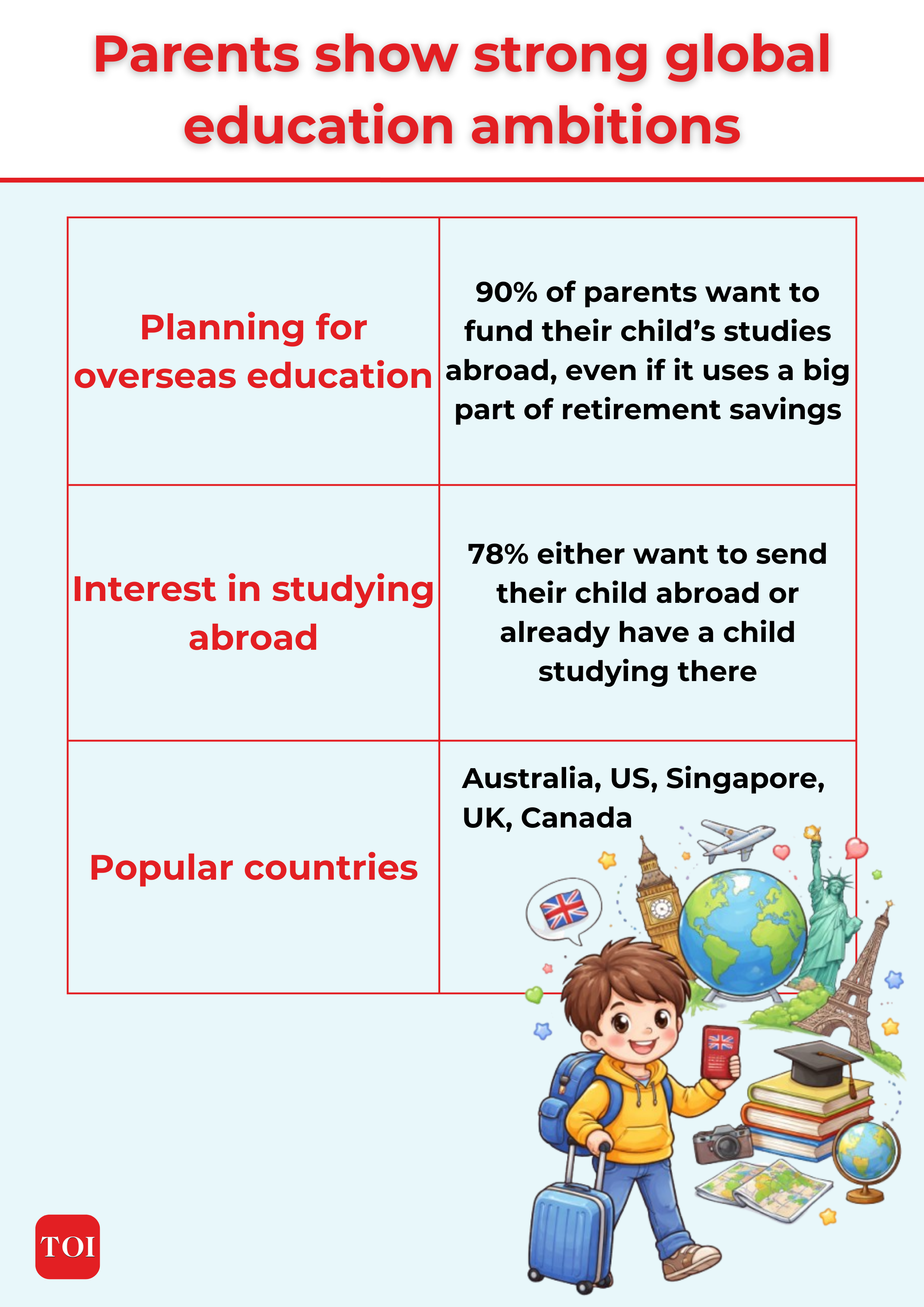
According to HSBC’s Quality of Life Report 2024, nearly 90% of affluent Indian parents plan to fund their child’s education abroad. But doing so can consume up to 64% of parents’ retirement savings. While some families expect scholarships or student loans to ease the burden, others even consider selling assets to finance international degrees.Education, however, is only one piece of the financial puzzle.
Readjusting accommodation
Housing typically accounts for around 10% of child-raising expenses, as many parents move to larger homes or safer neighbourhoods once they start a family. One government officer said he upgraded to a bigger apartment before his daughter was born so she could grow up in a more child-friendly environment. Because his job involves frequent transfers, he is also planning to eventually settle near the NCR region to ensure she has access to major educational institutions.
Entertainment
Entertainment represents another 9% of total expenses, often increasing sharply during teenage years. What begins with toys and birthday parties gradually evolves into spending on smartphones, laptops, hobby classes, sports coaching, and outings with friends. Even a modest 16th birthday celebration at a café, combined with gifts and decorations, can cost anywhere between Rs 25,000 and Rs 40,000.
Clothes
Clothing adds another 6%, reflecting the constant need to replace school uniforms, shoes, and everyday wear as children grow.
Health, food and transportation
Health, food, and transportation also contribute to the overall cost of raising a child, with each category accounting for nearly 5% of the total expenses.
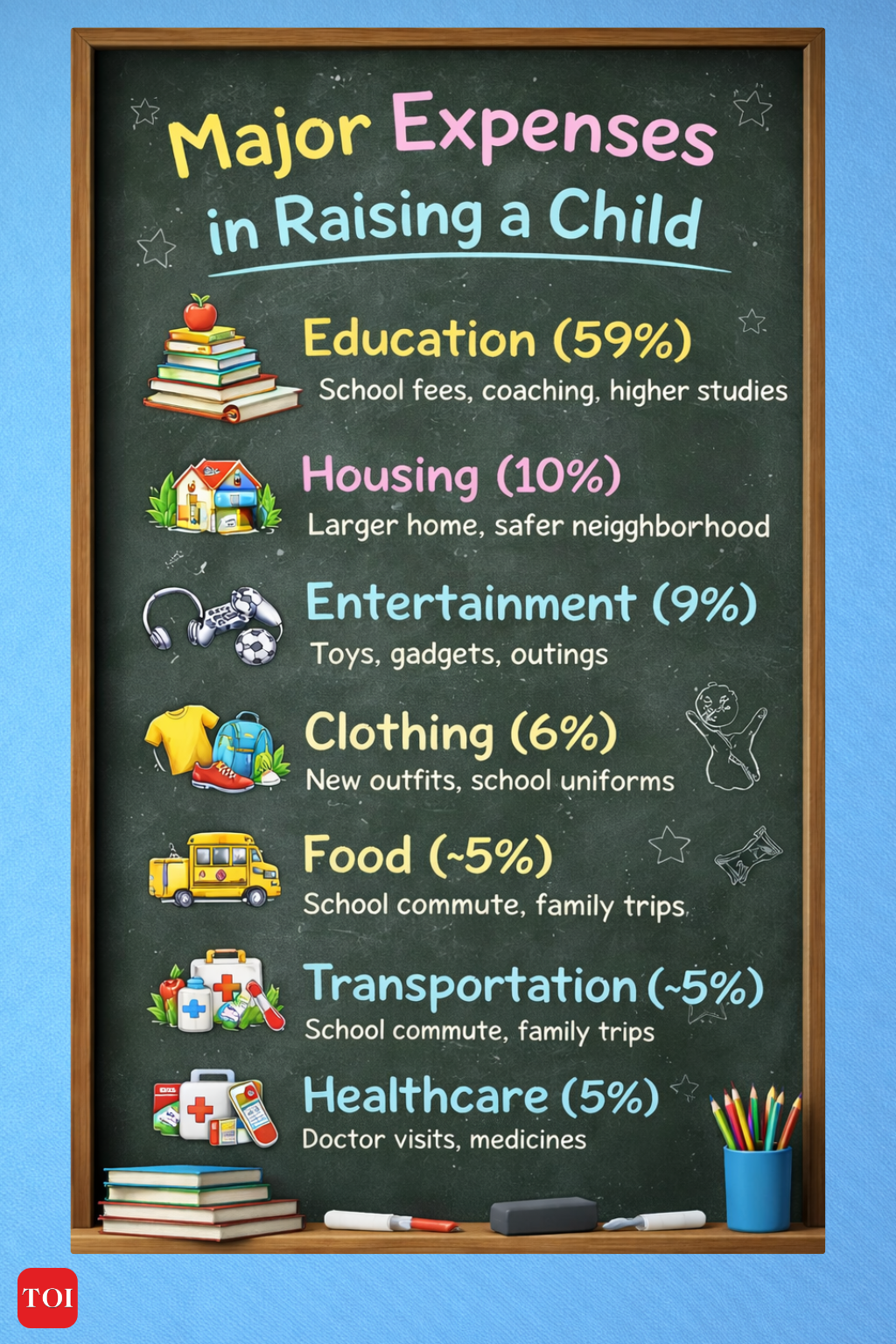
Major expenses in raising a child
When planning meets reality
Raising a child often reshapes a household’s financial priorities. Conversations gradually shift from everyday expenses to bigger questions; how to afford a good school that gives a child the right start, which extracurricular activities or hobbies to support, and eventually how to plan for the rising cost of higher education.For many parents, this journey naturally involves trade-offs. As one parent put it, sacrifice becomes an integral part of parenting. “Sacrifice is part of being a parent. When you know your child needs a high-end laptop to study comfortably, you don’t dwell on your slow phone or the winter vacation you had planned, it’s not even a question,” a middle-aged father told TOI.Over time, these small choices quietly reshape how families manage money. Vacations may be postponed, lifestyle upgrades delayed, and even retirement plans adjusted so that children can access better opportunities.Most parents begin with a rough financial roadmap, estimating school fees, college education, or perhaps the cost of a professional course. But the reality often turns out to be more complex. As children grow, their interests evolve, new opportunities emerge, and costs rise faster than expected, prompting families to revisit and adjust their financial plans along the way.One government official, the father of a one-year-old, has already begun thinking decades ahead. Explaining to TOI he said, “I began investing in a Voluntary Provident Fund for my daughter so that the savings accumulated over time can support her ambitions later in life. Over time, the fund could help pay for higher studies, skill-building, or even a business venture, giving her the freedom to pursue her dreams without financial limitations.”Even with careful budgeting, many parents say the actual costs almost always exceed expectations. One parent whose child is currently studying abroad says the biggest lesson they learned was the importance of consistent saving early in life. “The overall cost always exceeds what you planned for as there will be unexpected expenses at any point of time. One thing I would advise working couples is to start saving consistently at the start of your career (because I didn’t!). A simple lifestyle goes a long way to maximise savings,” Swapna Sanand, a publishing professional, told TOI.She further added that modern lifestyles that include frequent travel, fine dining, and luxury experiences, can easily become distractions when families are trying to build long-term savings. However by consciously prioritising needs over wants, parents can continue growing wealth and allow compounding to work in their favour.
Securing your little one’s future: How parents can plan finances for the years ahead
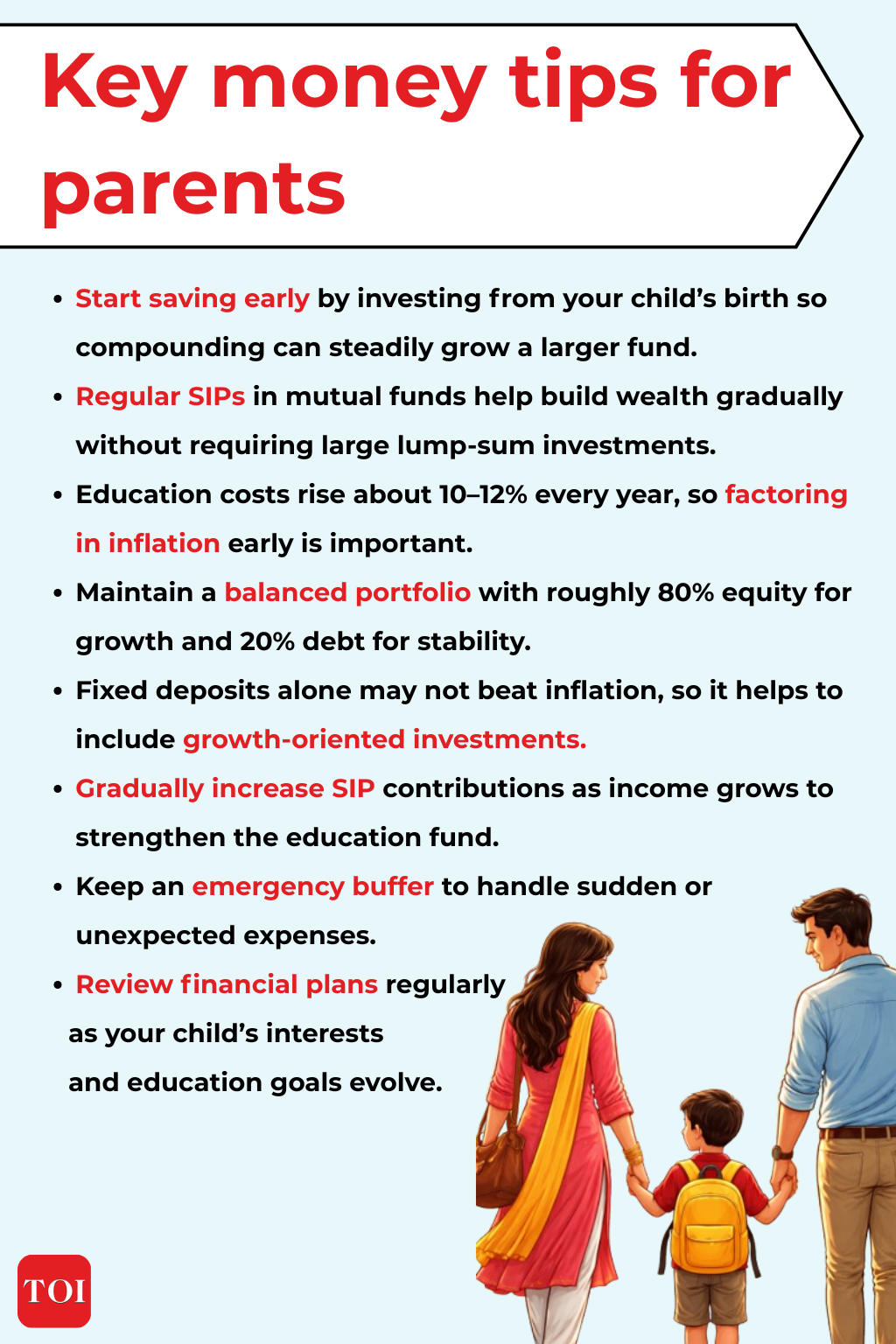
Key money tips for parents
While the numbers may appear daunting, disciplined planning can make the goal achievable. According to financial planner Rohit Shah, the cost of raising a child varies widely depending on lifestyle and education choices. For an upper-middle-class urban family, the total cost typically ranges between Rs 60 lakh and Rs 90 lakh if the entire education is within India. However, if the child pursues an undergraduate degree abroad, the figure can rise to Rs 1.5 crore to Rs 3 crore.Financial experts say that while the cost of raising a child can appear overwhelming, a structured approach to planning can make the goal manageable. Here are some key steps parents can follow:1. Start saving earlyThe earlier parents begin planning, the easier it becomes to build a large corpus over time. According to Bharath Rathore, executive director at Anand Rathi Wealth Limited, long-term investing benefits from the power of compounding, returns generated over time begin to earn additional returns themselves. Even a modest investment started at a child’s birth can grow significantly by the time they reach college.2. Use systematic investments (SIPs)Regular monthly investments in mutual funds through SIPs help parents build wealth gradually without the need for large lump-sum investments. For example, a Rs 15,000 monthly SIP earning around 12% annually can potentially grow to about Rs 75 lakh to Rs 1 crore over 18–20 years, according to Rathore.3. Plan with inflation in mindEducation inflation in India is estimated at 10–12% annually, which means costs can double within six to seven years. A course that costs Rs 25 lakh today could exceed Rs 50 lakh by the time a child turns 18. Financial planning must account for this rise to avoid falling short later, the Anand Rathi Wealth expert added.4. Diversify investmentsExperts often recommend building a balanced portfolio. A common approach is an 80:20 allocation: roughly 80% in equity investments for long-term growth and 20% in debt instruments for stability and liquidity. “Equity is the growth asset and will serve as the long term wealth creator. Debt adds balance to the portfolio and provides liquidity if any short term requirement comes up,” Rathore said.5. Move beyond traditional routesMany families rely primarily on fixed deposits or traditional insurance plans that generate returns of around 5–7%. However, when inflation and education costs rise faster than these returns, the real value of savings may decline. Diversifying into growth-oriented investments becomes important.6. Increase investments as income growsAs parents progress in their careers and their incomes increase, they can gradually step up their monthly investments. Incrementally increasing SIP contributions each year can significantly boost the final education corpus.7. Build a financial cushion for unexpected expensesFinancial planners advise preparing for worst-case scenarios rather than assuming every cost will be covered exactly as planned. Emergencies, sudden opportunities, or unexpected academic expenses can arise, and having a financial buffer helps families manage them without stress. Swapna Sanand shares her tips as a parent: Prepare for the worst case scenarios rather than expect that your planning will cover everything your child would need. Be 200% prepared. Talk to everyone who has had a similar journey, understand the areas to be cautious about, what the possible risks are and be as prepared as you can possibly be.8. Align financial plans with the child’s evolving goalsChildren’s interests and career aspirations often become clearer over time. Parents should review their financial plans periodically and adjust investments based on the child’s potential career path, whether that means professional courses in India or higher education abroad.Ultimately, as financial planner Shah noted, “Parents should build in a higher assumption for education inflation and plan for a range of funding outcomes, adjusting over time based on how their finances evolve and the potential and interests the child demonstrates.”
