
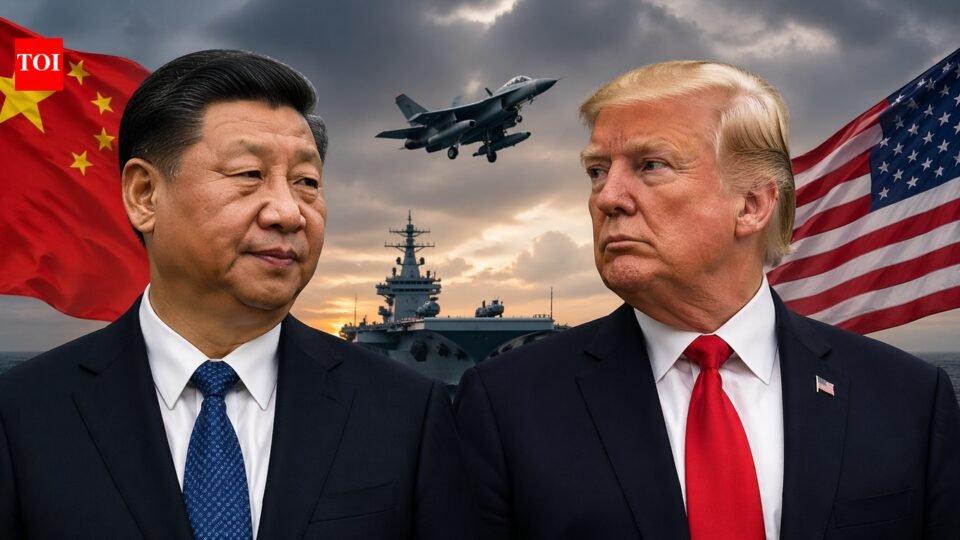
The United States has consumed large quantities of advanced missiles and interceptors during its military campaign against Iran, triggering internal concern that a prolonged drawdown could complicate Washington’s ability to respond quickly to a future crisis involving China and Taiwan, according to multiple US officials and new strategic assessments.The issue has emerged as one of the most consequential hidden costs of the Iran conflict. While the US military retains overwhelming global power and officials insist readiness remains intact, analysts warn that missile stockpiles depleted in the Middle East may take years to rebuild, creating what some describe as a temporary vulnerability in the Indo-Pacific.At the centre of the concern is not troop strength or aircraft numbers, but munitions. Modern wars are increasingly determined by access to precision missiles, interceptors and industrial production capacity. A navy without enough air-defence interceptors or an air force short on long-range strike weapons can see its battlefield advantages narrow quickly.
What the US has used in the Iran war
Since the conflict with Iran began on February 28, the US has reportedly fired more than 1,000 Tomahawk cruise missiles and between 1,500 and 2,000 key air-defence interceptors, including THAAD, Patriot and Standard Missile systems, according to US officials cited in Washington.Those are among America’s most advanced and strategically valuable weapons. They are used not only in Middle East operations, but also in Pentagon planning for any major conflict with China.Replacing such inventories is not immediate. Officials say fully rebuilding some stockpiles could take up to six years, depending on the system, industrial capacity and congressional funding.That has prompted discussions inside the administration about whether operational plans for Taiwan and the western Pacific may need adjustments if a near-term emergency were to emerge.
Why Taiwan matters in this debate
US defence planners have long treated a possible China-Taiwan conflict as one of the most demanding military scenarios America could face.China possesses a rapidly expanding military, including naval forces, missile systems, drones and more than 600 nuclear warheads, according to recent Pentagon assessments. Any war over Taiwan would likely require enormous quantities of long-range strike missiles, naval interceptors and air-defence systems.Many of the same weapons now being used against Iran would be essential in such a scenario.Strategists say that creates a core dilemma: every missile fired in one theatre is unavailable in another until replaced.The US intelligence community reportedly assessed in March that Beijing is unlikely to launch a war over Taiwan in 2027 and has no fixed timeline for unification, though China still seeks sovereign control of the island by 2049.There is no indication of imminent conflict. But defence planning is based on capability as much as intent.
White House rejects readiness concerns
Senior Trump administration officials have strongly pushed back on claims that the Iran war has weakened US preparedness.White House press secretary Karoline Leavitt said: “The entire premise of this story is false.”She added: “The United States of America has the most powerful military in the world, fully loaded with more than enough weapons and munitions, in stockpiles here at home and all around the globe, to effectively defend the homeland and achieve any military operation directed by the commander in chief.”Chief Pentagon spokesman Sean Parnell also rejected suggestions of strain, saying the military “has everything it needs to execute at the time and place of the President’s choosing.”Officials further argue that production can be accelerated through investment, procurement reform and expanded manufacturing.
Pacific commander says no immediate cost
Admiral Samuel Paparo, who would oversee any major Pacific war, told lawmakers this week that ongoing operations in the Middle East are also giving US forces valuable combat experience.“For now,” Paparo told the Senate Armed Services Committee, “I don’t see any real cost being imposed on our ability to deter China.”That view reflects the Pentagon’s public confidence that current inventories remain sufficient.However, analysts note that sufficient for deterrence today is different from ideal for a prolonged multi-theatre war tomorrow.
CSIS warning: Years to rebuild stocks
A new report from the Center for Strategic and International Studies has echoed concerns over shrinking inventories.Based on prewar estimates, the think tank said munitions used in the Iran war could amount to:
- Roughly 27% of Tomahawk stockpiles
- About 36% of JASSM long-range missiles
- Around one-third of SM-6 missiles
- Nearly half of SM-3 interceptors
- More than two-thirds of Patriot interceptors
- More than 80% of THAAD interceptors
That means the deepest pressure may be on defensive systems rather than offensive strike weapons.Mark Cancian, senior adviser at CSIS, said: “It’s going to be years before we can rebuild those inventories.”The report also warned that high expenditure rates have created “a window of increased vulnerability in the western Pacific.”
Why missile defence matters most
Much public attention focuses on aircraft carriers or stealth bombers, but wars are often constrained by missile availability.A destroyer without interceptors is exposed. A Patriot battery without reloads has limited value. Fighters without stand-off missiles must fly closer to danger.That is especially important in any Pacific conflict, where China’s military doctrine emphasises anti-access and area denial. This strategy relies on missiles designed to keep US ships and aircraft at distance.To counter that, the US would need large numbers of interceptors and precision weapons.Kelly Grieco of the Stimson Center said: “The U.S. would have to fight China in a way that is potentially much more costly and dangerous for US forces.”“You’re going to take higher attrition.”
Pentagon response: Build more, faster
The Pentagon is now moving to expand production and refill stocks. The White House has reportedly asked Congress to approve $350 billion for critical munitions in the fiscal 2027 budget. Defence companies RTX and Lockheed Martin have signed agreements to sharply increase output.Lockheed said it would quadruple production of THAAD and PAC-3 Patriot interceptors. RTX said it would accelerate deliveries of Tomahawks, AMRAAM air-to-air missiles and Standard Missile variants.The Pentagon has also approached US automakers and industrial manufacturers for help expanding wartime production capacity.US Defense Secretary Pete Hegseth said last year: “Our objective is simple: transform the entire acquisition system to operate on a wartime footing.”
Trump says arsenal remains deep
President Donald Trump has dismissed concerns over supply constraints and recently claimed the US retains a “virtually unlimited supply of Medium and Upper Medium Grade Munitions.”At the same time, he has warned that bombing operations against Iran could resume if Tehran refuses a deal over its nuclear programme.That creates a strategic paradox for Washington. The US can continue striking Iran in the near term. But every additional week of conflict consumes premium missiles needed for deterrence elsewhere.
