The Make it in the Emirates campaign will bring manufacturers, investors and industry leaders together with MoIAT to drive the next phase of industrial growth
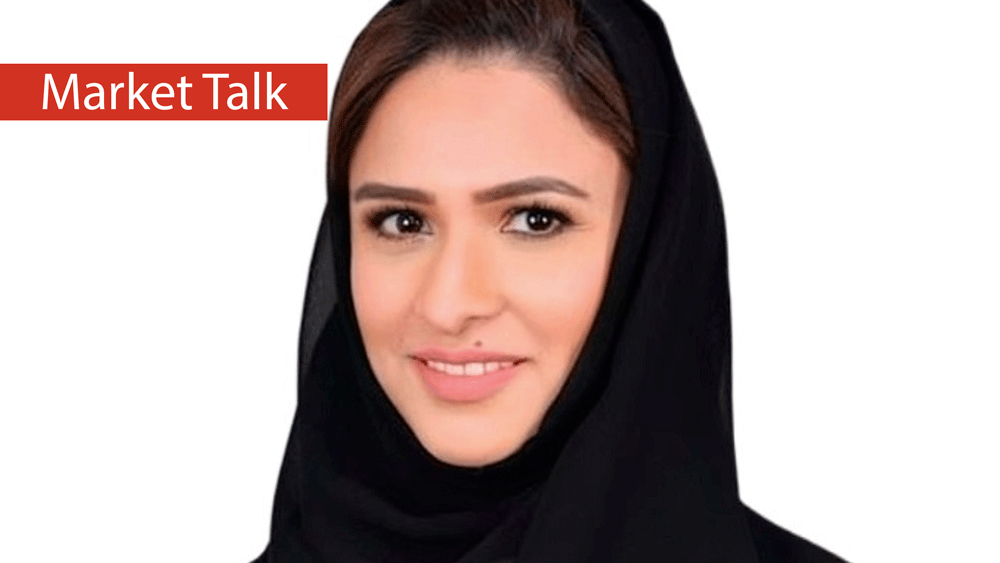
In conversation with Ibtisam Ali Alsaadi, Acting Assistant Undersecretary for the Industrial Development Sector at the Ministry of Industry & Advanced Technology (MoIAT)
 How does the UAE’s approach provide a proven model for industrial resilience, and what concrete examples demonstrate the ability to turn disruption into long-term industrial opportunity?
The UAE’s industrial resilience model is defined by preparation rather than response. Long before recent disruptions, it had already put in place the policy frameworks, infrastructure and public-private coordination needed to act quickly under pressure. In a more fragmented global trading environment, resilience is no longer just an operational requirement. It has become a strategic industrial advantage.
That was evident during recent supply chain disruptions in critical sectors. The UAE moved quickly to identify import dependencies, pinpoint the most exposed product categories and support targeted localisation efforts. In sectors such as pharmaceuticals and food, this included linking manufacturers to offtake commitments, giving them the demand visibility needed to invest, expand capacity and bring production closer to market.
Make it in the Emirates 2026 brings that approach into one platform. More than an exhibition, it serves as a mechanism to align demand, financing and manufacturing capability, helping turn short-term disruption into long-term industrial opportunity.
MIITE 2026 coincides with the Cabinet’s approval of a set of strategic initiatives and decisions aimed at strengthening the resilience of the industrial sector, ensuring business continuity and reinforcing the readiness of the national economy. These include the establishment of a national industrial resilience fund valued at AED1bn to support the localisation of vital industries, enhance supply chain resilience, and accelerate the adoption of artificial intelligence across production, operations and planning. The package also expands the National In-Country Value Program (ICV) to become mandatory across all federal government entities and national companies, alongside a policy to strengthen the presence of UAE-made products across retail outlets and e-commerce platforms.
How is MoIAT facilitating collaboration between local manufacturers and technology partners, and what outcomes is this producing in terms of supply-chain depth and investor confidence?
MoIAT’s approach has evolved from supporting individual factories to strengthening the wider industrial ecosystem in which they operate. That shift is significant. In a more fragmented global environment, resilience depends not only on the performance of a single plant, but on the strength, connectivity and depth of the supply chains around it. The focus, therefore, is on building an industrial base that is more integrated, more adaptable and better positioned for long-term growth.
In practice, this means aligning technology adoption, financing and demand from the outset. Manufacturers are being connected with technology partners to accelerate advanced manufacturing, while financing support helps ensure that capability upgrades are commercially viable.
The results are already visible. More than AED7bn has been deployed under industrial technology transformation index, over 600 factories have been upgraded and productivity gains of up to 40% have been recorded. For investors, that creates confidence. It means entering a market where financing, demand and industrial capability are increasingly aligned, and where supply chains are deepening rather than being built from scratch.
This has translated into the implementation of over 3,000 technology projects within factories, marking a clear shift from planning to real, on-the-ground deployment.
At the same time, national capabilities are being strengthened, with over 70 certified assessors, including more than 10 Emirati specialists, supporting the sustainability of this transformation and embedding advanced industrial expertise locally.
How does MoIAT ensure that the UAE’s Comprehensive Economic Partnership Agreement (CEPA) architecture translates into manufacturing investment and positions the UAE as a global industrial hub rather than solely a re-export gateway?
Concluding 36 CEPAs in less than five years is more than a diplomatic achievement. It gives the UAE a trade architecture that supports its position as a manufacturing and export base, not simply a re-export hub. At a time when global trade flows are being redrawn, that market access has become a clear industrial advantage. extending across multiple continents and connecting UAE-based manufacturers to some of the world’s fastest-growing markets.
A CEPA alone, however, does not create manufacturing investment. It creates market access. The real task is turning that access into a reason to produce locally, and that is where our approach is deliberate.
Rules of origin are central to this. Preferential tariff benefits apply when goods are manufactured in the UAE. That means investors who produce here can access markets on preferential terms, while those simply routing goods through cannot. The CEPA network therefore becomes an incentive to build, not just to trade.
We reinforce this by linking CEPA market access to our offtake programme and ICV framework, so investors can see what to produce, at what scale and against what level of committed demand. Combined with financing support, that is what turns market access into bankable industrial opportunity. UAE industrial exports reached AED262bn in 2025, up 25% year-on-year, showing that this shift is already happening at scale.
How does the UAE integrate localisation within an open, partnership-led model, and how is this reflected in Make it in the Emirates and the ICV framework?
The UAE does not treat localisation and openness as competing goals. We believe localisation can strengthen industrial competitiveness within an open, partnership-led model.
Through the offtake programme, we identified more than 5,000 products worth AED168bn where domestic production makes strategic and commercial sense, with around AED80bn already localised. The National ICV Programme has also redirected more than AED473bn into the national economy, helping create more consistent demand for local supply chains.
The newly announced initiatives include expanding the National In-Country Value (ICV) Program into a mandatory framework covering all federal government entities and companies with at least a 25% direct or indirect federal ownership stake – further directing national spending to support local industry.
Make it in the Emirates reflects that approach in practice by bringing together policy, financing, demand and manufacturing capability in one platform. It shows how localisation is being used to deepen supply chains while keeping the UAE connected to global trade and investment flows.
How does the UAE see the relationship between family business capital and the long-term resilience of the national industrial base, particularly in the Year of the Family?
Industrial resilience depends on patient, long-term capital, and family businesses are well placed to provide it. The nature of industrial investment, from building facilities to developing supply chains and training workforces, does not always align with short-term return expectations.
Family businesses, by contrast, tend to take a generational view. Their deep roots in the local economy, market knowledge and established networks make them natural partners in industrial development.
In the Year of the Family, we see that role as strategically important. We are engaging family business groups not only as investors, but as long-term partners that can help industrial ecosystems scale and mature. Their involvement brings continuity and commitment that strengthen the resilience of the national industrial base.
What is the core message MoIAT wants to convey to stakeholders attending Make it in the Emirates about the UAE’s readiness for the next decade of industrial growth?
The UAE enters the next decade of industrial growth with much of the enabling framework already in place. At a time when manufacturers are looking for greater certainty, it offers a more structured environment for long-term investment.
Demand visibility through offtake commitments, financing linked to industrial priorities, wider market access through CEPAs and a stable policy framework are all helping reduce barriers to investment. Physical, regulatory and institutional infrastructure is also already in place.
Make it in the Emirates 2026 brings those elements together in one platform. For stakeholders, it offers a clearer view of where opportunities are emerging, which sectors are scaling and how partnerships can be formed.
For investors, the UAE is positioning itself not just as a manufacturing base, but as a long-term partner in industrial growth.
Published in partnership with


