
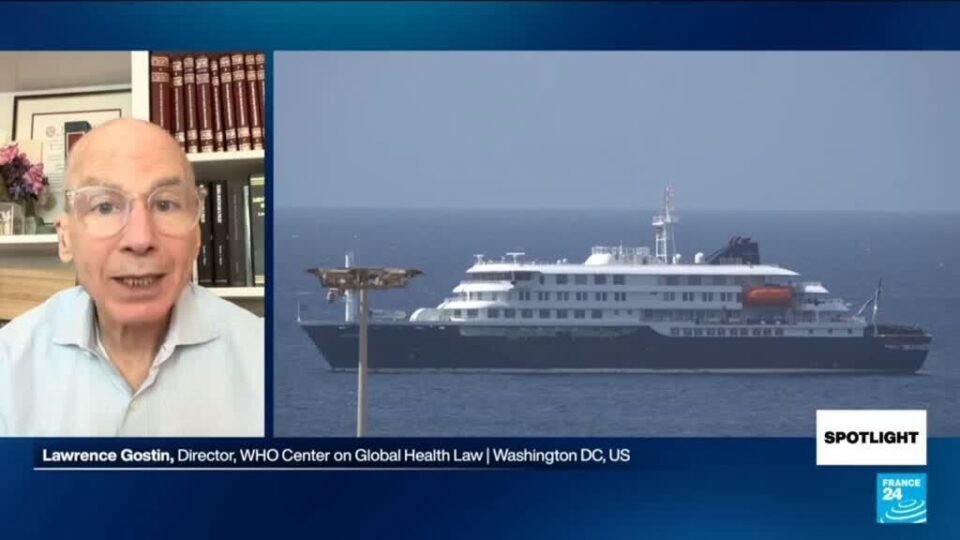

François Picard is pleased to welcome Lawrence Gostin, Author, Director of the WHO Center on Global Health Law and Distinguished University Professor, Georgetown University Law Center. His analysis offers historical context and perspective of the legal and ethical dilemmas surrounding a cruise ship carrying suspected hantavirus cases off the coast of Cape Verde. Drawing direct parallels with the traumatic memory of cruise ships stranded during the COVID-19 pandemic, Gostin argues that the international community has already learned, at enormous human cost, the dangers of confining passengers at sea without adequate medical care or disembarkation plans.
“You can’t really confine people on a ship,” argues Gostin, “especially if there’s a transmissible virus on board, and keep them there without medical care, without quarantine facilities. That’s unacceptable.”
At the heart of his intervention lies a sharp critique of political hesitation in moments of public health uncertainty. “You can’t really confine people on a ship,” he insists, calling it “unacceptable” and ultimately “unconscionable” to leave potentially infected passengers isolated without proper treatment or quarantine infrastructure. While acknowledging Cape Verde’s limited medical capacities, Gostin emphasizes that international law places obligations on wealthier jurisdictions capable of responding, arguing that international law would require Spain to let them in: “The Canary Islands, which is a Spanish jurisdiction, certainly has advanced medical care and should be able to provide the medical intensive services that these sick passengers need.”
Gostin refuses simplistic binaries between national protection and humanitarian duty. Instead, he frames the crisis within a broader framework of global health governance, scientific uncertainty, and the fragile lessons inherited from COVID-19. His remarks also expand into a broader critique of cruise ship public health standards, warning that modern maritime tourism remains deeply vulnerable to infectious disease outbreaks ranging from hantavirus to norovirus. Asked whether he himself would take a cruise, Gostin replies with understated candor: “I wouldn’t be afraid, but I wouldn’t put myself to that kind of exposure.”
Source link
