
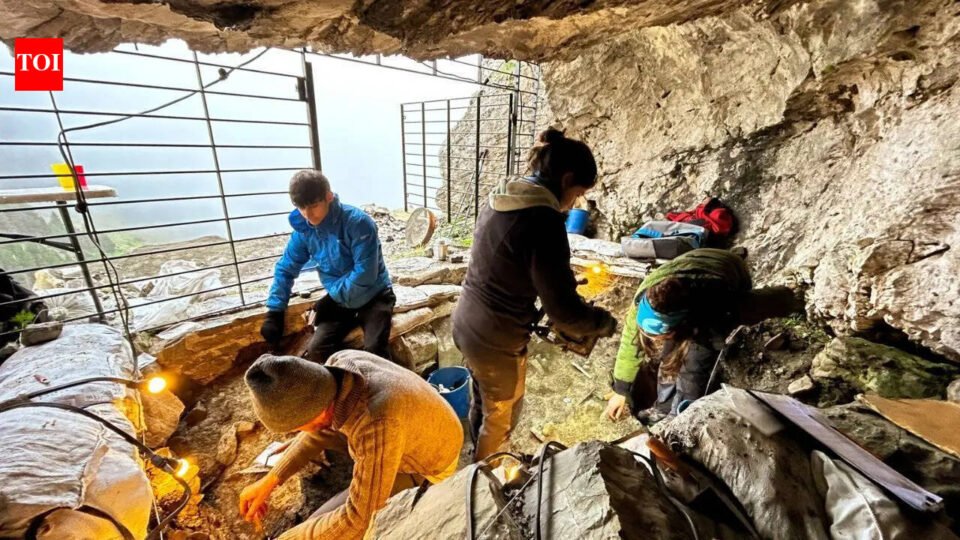
In the heart of the Pyrenees, archaeologists have stumbled upon an object that has left them excited but wary. In a cave high up in the mountains, there were unusual mineral pieces of a green color found among other signs of fire usage and human presence. It seems that evidence suggests early processing of copper that could have happened around 4,000 years ago. While the findings are still being analysed, they already give us a clue to a prehistoric civilization far more developed than we could have ever thought. According to experts, the cave could have been visited many times by ancient communities who used it for specific purposes involving fire and minerals.
Mysterious cave in the Spanish Pyrenees reveals ancient human presence
According to the study published in Frontiers titled, ‘Beyond 2,000 meters, first evidence of intense prehistoric occupation in the Pyrenees’, the cave is situated in the Spanish Pyrenees region in the Girona area at an elevation of about 7,333 feet. Access to the cave is not easy, and its surroundings are rugged, making life difficult for ancient people who might live in it.However, according to researchers, the cave was visited by human beings for several thousand years. Based on excavations in the area, scientists argue that there was continuity in the usage of the cave by humans, and they had specific purposes to visit the cave. This is because charcoal, broken rocks, and other artifacts found there indicate a continuous stay at the site by ancient human beings.The continuity is considered strange by archaeologists, considering that the location of the cave is too high for the said purpose.
Nearly 200 green mineral pieces found in cave raise archaeological mystery
Among the most exciting finds in the cave is the existence of almost 200 pieces of minerals of a vibrant green color. The minerals are not naturally occurring in the region, hence the puzzling question as to how they got there.It is speculated that the minerals could be malachite, a stone abundant in copper content, which has a greenish color. Malachite, when subjected to high temperatures, produces metallic copper, thus making it crucial for metallurgical purposes.The fascinating part is that while some of the mineral fragments have been subjected to high temperatures, others appear to be untouched. Thus, it is assumed that they were selectively chosen and subjected to processing procedures.While there is still research ongoing to ascertain their exact identification, preliminary findings tend to lean more towards malachite.
Ancient fire use in a cave may reveal Europe’s earliest metal processing attempts
In addition to the aforementioned findings, researchers discovered several sites of combustion within the cave, such as fire pits and burnt layers.According to experts, the green minerals were deliberately exposed to heat as part of the early attempts at extracting copper. In this case, the location might rank among the oldest cases of processing copper ore in Europe. The combination of burned and unburned mineral samples increases the likelihood that the process was conducted purposefully. It seems likely that people knew the effects of heating on the mineral and took them into account when using fire.Dr Julia Montes-Landa, who was a member of the research team, stated that there is evidence that supports the hypothesis of purposeful actions. At the same time, scientists emphasize that additional studies should be conducted to make definitive conclusions.
Shell pendants and artefacts reveal ritual and symbolic life in the Spanish cave
The cave has also revealed artefacts that go beyond industrial activity. Animal bones, broken pottery pieces, and even human remains have been found during excavation.Among the most interesting discoveries are two pendants. One is made from a shell, while the other is carved from a brown bear tooth. These objects suggest personal or symbolic use, possibly linked to identity, status, or cultural practices.Researchers believe the cave may have served multiple purposes at the same time. It may have been a workplace, but also for ritual or symbolic activity. The combination of practical and personal objects suggests a more complex social setting than expected.
Ongoing research in Spanish cave could rewrite prehistoric history
The excavation is still ongoing, and archaeologists have not yet reached the deepest layers of the cave. This means that the full story is still hidden beneath the surface.The identification of the green mineral is also still being confirmed through further laboratory testing by teams from Spanish universities. Until those results are finalised, interpretations remain cautious.Even so, the early findings are already reshaping how researchers view high-mountain sites in prehistoric Europe. Places once thought to be marginal may have played a far more important role in early technological development than previously believed.As more layers are uncovered, the cave may continue to reveal details about how ancient communities lived, worked, and experimented with materials that would eventually transform human history.
