


Car ACs are easy to take for granted until they stop working. One moment there’s a steady stream of cool air, and the next it’s reduced to a weak, warm breeze. Moreover, it always seems to happen at the most inconvenient times: peak summer, long drive, or when there’s no quick fix on hand.What’s frustrating is that AC problems rarely come out of the blue. There are often subtle signs, such as longer-than-usual cool-down times, a slight smell that wasn’t there before, or slightly weaker airflow. Most people overlook these small changes, only to realise later that the problem has been building up all along.A car’s AC system works harder than it gets credit for, especially in Indian conditions. Extreme heat, long hours on the road, dust, and frequent traffic halts all add to the strain. Without regular maintenance, performance is bound to drop. The upside is that with a few simple habits and timely upkeep, it can stay effective through peak summer and well beyond.Here’s a guide to do exactly that, covering everything from how you use the AC on a daily basis to what a proper annual service should include.
Understanding how the system works before taking up maintenance measure
You do not need a mechanical degree to understand your car’s AC at a useful level. The system compresses a refrigerant gas, which releases heat as it passes through a condenser, then rapidly expands through an evaporator inside the cabin, absorbing heat from the air in the process. The cooled air is then blown into the cabin via the blower. The cabin air filter is located in the path of that air flow to trap dust and particles before they reach the vents.
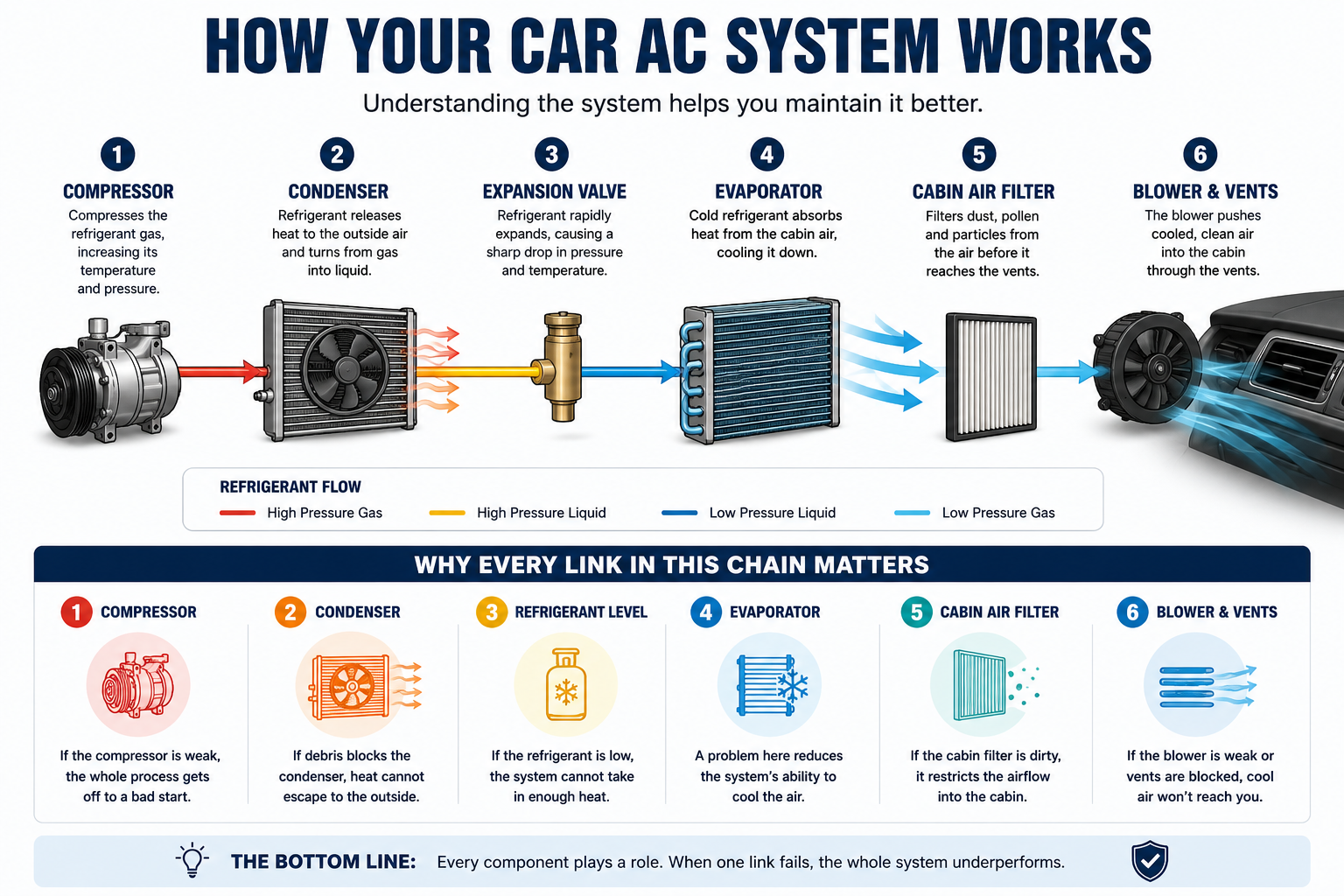
Every link in this chain matters. If the refrigerant is low, the system cannot take in enough heat. If the cabin filter is dirty, it restricts the airflow. If debris blocks the condenser, heat cannot escape. The whole process gets off to a bad start if the compressor is weak. Understanding this chain helps you understand why the tips that follow are not just suggestions but practical responses to how the system actually works.
Do not skip the ventilation step before switching the AC on
A car parked in the sun for several hours can reach interior temperatures of 50 to 60 degrees or more. When you get in and immediately switch the AC on at full blast, you are asking the system to cool an oven-hot cabin from scratch. This puts an enormous load on the compressor from the very start and takes significantly longer to reach a comfortable temperature.

A better approach takes only a minute. Open all the windows, including the rear ones, and if your car has a sunroof, open that too. Hot air rises, and a sunroof creates a natural escape path. Let the car move forward slowly, or simply let it sit with the windows down for a minute. The hot air trapped inside will be replaced by outside air, which, while still warm, is considerably cooler than the air baking inside the sealed cabin.Once the interior temperature has dropped, close the windows, set the AC to a lower fan speed, and let it build up gradually. This approach reduces the compressor’s load, cools the cabin faster overall, and is simply easier on the system over time.
Start at a lower fan speed and increase gradually
This is a counterintuitive point that most people get wrong. The instinct when you are hot is to turn everything to maximum immediately. But starting the blower at high speed before the system has had time to cool the air passing through the evaporator means you are pushing warm, uncooled air into the cabin at high volume. This actually delays the cooling process.

AI generated image for representation
Start the blower at a low or medium setting. Give the AC a minute or two to begin cooling the air properly. Once you can feel genuinely cold air coming through the vents, adjust the fan speed to whatever feels comfortable. The system will work more efficiently, the cabin will cool down faster, and the compressor will not have to work as hard against the heat.Modern cars with automatic climate control already do this by default. If your car has a manual AC, it is worth deliberately mimicking this behaviour.
What is recirculation mode and why you should use it once the cabin has been cooled
Your car’s AC has two settings for where it draws air from: fresh air from outside and recirculated air from inside the cabin. Fresh air mode is useful in certain conditions, but once the cabin has cooled down, switching to recirculation mode makes the system significantly more efficient.When recirculation is active, the system is working with air that is already cooler than the outside temperature. It takes less work to bring that air down to the set temperature, which means the compressor runs less hard, fuel consumption drops slightly, and the cabin maintains its temperature more easily.That said, recirculation mode should not be used indefinitely. It can cause the air inside to become stale, and in humid conditions, it can contribute to windshield fogging. A reasonable approach is to cool the cabin on fresh air mode, switch to recirculation once comfort is achieved, and then return to fresh air mode periodically or whenever you notice the air feeling stale.
Always keep an eye on the refrigerant level
Refrigerant is the substance that enables cooling. It is not consumed like fuel, but it can slowly leak through seals, connections, or small cracks over time. A system low on refrigerant will still blow air, but it won’t be as cold as it should be, and the compressor will run harder to compensate.The tricky part is that a slow refrigerant leak is not always obvious. The cooling might become slightly weaker over several months in a way that is easy to attribute to the heat or assume is normal. By the time the drop in performance is noticeable, the refrigerant level may be significantly low.Getting the refrigerant level checked at least once a year, ideally before summer begins, is a straightforward way to avoid this problem. If the level is low, a technician can determine whether a leak needs to be fixed before simply refilling. Refilling without addressing a leak means you will be back in the same situation within a season.
Cabin air filters must be replaced at right intervals
The cabin air filter does exactly what it sounds like: it filters the air coming into the cabin. In Indian conditions, with dusty roads and high levels of airborne particles, this filter can clog faster than the manufacturer’s recommended lifespan.A clogged filter restricts airflow through the system. Less air gets through, so the vents deliver weaker airflow even at higher fan settings, and the overall cooling effect is reduced. In bad cases, a heavily blocked filter can also cause unpleasant smells to enter the cabin.As a general rule, checking the cabin filter every six months is sensible in Indian driving conditions. If the filter appears blackened or visibly clogged, replace it. If it looks reasonably clean, it can wait. Replacement filters are not expensive, and the difference in airflow after a fresh filter is often immediately noticeable.
Ensure the condenser is cleaned regularly
The condenser is mounted at the front of the car, usually ahead of the radiator, and its job is to release the heat the refrigerant has absorbed from inside the cabin. It does this by passing outside air over a series of metal fins. If those fins are clogged with road dust, insects, dirt, or debris, the condenser cannot efficiently release heat, and the entire cooling process is compromised.Because the condenser is at the front of the car and constantly exposed to everything the road throws up, it tends to accumulate debris steadily. This is not something you can easily check or clean yourself without removing parts, but a service centre can do it with a high-pressure wash as part of an AC service. Including condenser cleaning in your annual AC maintenance is worth doing.
Always get a full car AC service before summer
This is the advice that most people hear but rarely follow, and it is the one that ends up costing them the most. AC service centres are overwhelmed once temperatures rise. Wait times are longer, appointment slots are filling up quickly, and in some cases, parts are on backorder because everyone is experiencing the same problems at the same time.If you get your AC serviced in February or March, before it gets hot, you should generally get shorter wait times and better pricing, plus the peace of mind that comes with heading into summer with a fully inspected and serviced system. A complete service should include checking refrigerant levels and pressure, inspecting the compressor, cleaning the condenser and evaporator, replacing the cabin filter if needed, and testing the system’s overall performance.If your car shows any signs of reduced cooling, unusual noises when the AC is on, or strange smells from the vents, getting those checked before summer is far better than dealing with a breakdown in the middle of a heatwave.
Keep an eye out for unusual smells
The smell coming from your car’s AC vents can tell you a lot about what is happening inside the system. A musty or damp smell is usually a sign of mould or mildew growing on the evaporator. This happens when moisture from the cooling process accumulates and doesn’t evaporate properly, especially if the car is used infrequently or the AC is shut off incorrectly.A chemical or faintly sweet smell can indicate a refrigerant leak. Refrigerant in its gaseous form has a distinctive odour, and detecting it inside the cabin is a sign that something in the system is leaking and should be checked immediately.A burning smell is more serious and can point to an electrical issue or an overworked component. This is not something to delay addressing.To prevent mould buildup, turn the AC off a few minutes before you reach your destination, but leave the fan running. This allows the evaporator to dry out before the system is fully shut down, significantly reducing the risk of mould growth.
Use the defrost setting occasionally, even in summer
The defrost mode in most cars runs the AC system alongside the heater to clear moisture from the windshield. In summer, it seems like an unlikely time to use it, but running defrost mode for five to ten minutes once a week has a practical benefit: it clears any moisture that has accumulated inside the AC unit and helps prevent mould and mildew from establishing themselves in the evaporator.This takes almost no effort and costs nothing beyond a small amount of fuel. For a system that can cost thousands of rupees to repair if mould gets established deep inside, it is a worthwhile habit.
Never park your car under direct sun any longer than necessary
Parking in shade is not just about comfort. Every hour a car spends under direct sunlight adds significantly to the thermal load that the AC has to overcome when you return. Dashboard temperatures in a sun-exposed car can reach extreme levels, and all of that heat has to be removed before the cabin is comfortable.Where shade is not available, a windshield sunshade can make a meaningful difference. It blocks direct sunlight from reaching the dashboard and front seats, which are among the cabin’s largest heat-absorbing surfaces. Cracking the windows slightly, where safe to do so, also allows some of the built-up heat to escape rather than accumulate. These are small habits, that significantly reduce cumulative strain on the AC.
Keep an eye out for engine temperature on long or uphill drives
The AC compressor draws power from the engine, and under certain conditions, that additional load matters. On long uphill stretches in hot weather with a full car, the engine is already working hard. Adding an AC load on top of that can push engine temperatures higher than normal.If you notice the engine temperature gauge moving toward the higher end of its range during a demanding stretch of road, turning the AC off briefly and switching to the heater at full blast for a few minutes will help bring the engine temperature down.This sounds like the opposite of what you want in hot weather, but it works because the heater draws heat away from the engine coolant. Once the temperature normalises, the AC can be switched back on.Try running the AC regularly, even in cooler weatherOne of the less obvious maintenance tips for car AC is simply to use it regularly, year-round. When the AC is left unused for months, the lubricant that keeps the compressor and other components running smoothly tends to settle and distribute poorly. Seals can dry out. The system can develop issues that would not have appeared if it had been kept active.Running the AC for ten to fifteen minutes every week, even in winter, keeps the components lubricated, the seals supple, and the refrigerant circulating. It also means that when summer arrives, the system does not have to come back from months of complete inactivity and is less likely to reveal problems at the worst possible time.The bigger pictureMaintaining a car’s AC is not complicated, but it does require consistency. The habits that make the biggest difference, such as ventilating before switching on, using recirculation mode appropriately, running the system periodically, and getting an annual service before summer, are all straightforward. The maintenance steps, such as checking refrigerant levels, replacing the cabin filter, and cleaning the condenser, are tasks any competent service centre can handle in a single visit.What makes the difference between an AC that lasts reliably and one that needs repeated attention is whether it gets that consistent care or only gets noticed when something has already gone wrong. A little attention before the season peaks is worth far more than repairs in the middle of one.
