
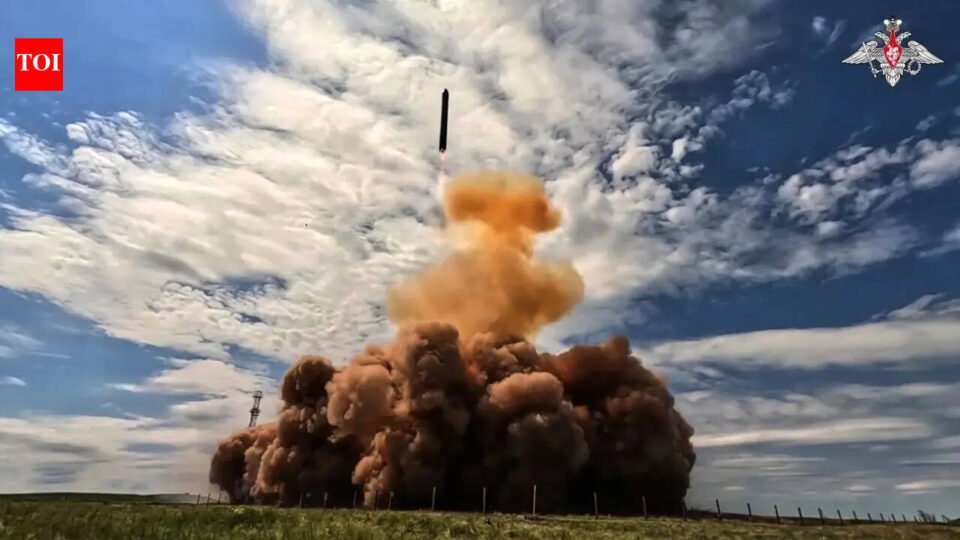
As fighting between Russia and Ukraine resumed after a brief three-day truce, Russian President Vladimir Putin announced the successful test of the RS-28 Sarmat, Moscow’s latest heavy intercontinental ballistic missile (ICBM), calling it the most formidable weapon in Russia’s nuclear arsenal.“It’s the most powerful missile system in the world,” Putin said after the launch. “The total yield of the delivered warhead is more than four times greater than that of any existing, even the most powerful, Western equivalent.”
The test comes as Moscow seeks to reinforce its strategic deterrence amid prolonged tensions with the West. First unveiled by Putin in 2018 as part of a new generation of advanced nuclear weapons meant to defeat US missile defences, the RS-28 Sarmat — dubbed ‘Satan II’ by NATO, is designed to replace the ageing Soviet-era R-36M2 Voyevoda missile.While the Kremlin has projected the Sarmat as a game-changing weapon, the programme has seen delays and failed tests over the years.
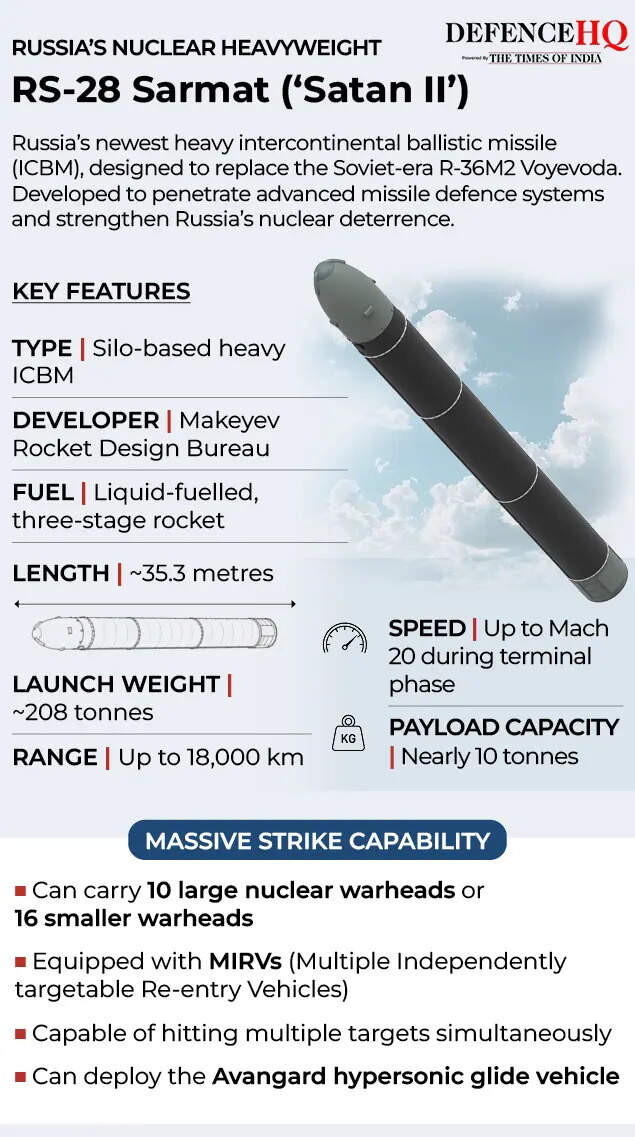
RS-28 Sarmat Features
10 features that make the RS-28 Sarmat a formidable weapon
- The RS-28 Sarmat is a silo-based heavy ICBM with an estimated launch weight of over 208 tonnes and a length of around 35 metres, making it among the largest operational ballistic missiles in existence.
- The missile can reportedly carry nearly 10 tonnes of payload, far more than most currently deployed ICBMs. Putin claimed its destructive yield is more than four times that of comparable Western systems.
- Sarmat can carry
MIRVs (Multiple Independently Targetable Re-entry Vehicles), allowing one missile to strike several targets simultaneously. Russian reports suggest it can be equipped with up to 10 heavy nuclear warheads or 16 smaller ones, depending on mission requirements. - The missile is believed to be capable of carrying the Avangard
hypersonic glide vehicle , a manoeuvrable nuclear-capable weapon designed to evade missile shields by changing course mid-flight at extreme speeds. - During its terminal phase, Sarmat is said to reach speeds of up to Mach 20, or roughly 24,000 kmph, making interception extraordinarily difficult.
- Russia says the missile has a range exceeding 18,000 km, while Putin on Tuesday claimed it could travel beyond 35,000 km depending on trajectory. That theoretically gives it the ability to strike targets anywhere in the world.
- Unlike traditional ICBMs that follow predictable Arctic routes, Sarmat is designed to use alternative trajectories, including potential sub-orbital or FOBS-like paths, allowing it to approach targets via the South Pole and complicate early-warning detection.
- One of the Sarmat’s primary missions is penetrating advanced US missile shields. It reportedly carries decoys, electronic warfare aids, and countermeasures designed to confuse radar and interceptors.
- The missile uses inertial navigation backed by Russia’s GLONASS satellite system, and is believed to be engineered to operate even under heavy jamming or satellite disruption.
- Work on the missile began in 2011, with the first successful test in 2022, shortly after Russia’s full-scale invasion of Ukraine. Despite delays and failed launches, Moscow sees Sarmat as a key pillar of its long-term nuclear deterrence strategy.
