
The war between the United States-Israel and Iran has entered its third week and shows no signs of slowing down. Despite taking heavy hits, Iran remains a strong adversary, using its military capabilities to strike Gulf states hosting US bases and civilian infrastructure in those countries, and Israel.According to The Wall Street Journal, Iran has launched more than 290 missiles and 500 drones at Israel alone since the conflict began, inflicting significant damage and forcing extensive use of air defences.
Here are some of the weapons Iran has used:Shahed-136Arguably the most talked-about weapon used by Tehran in the conflict, the Shahed‑136 is a one-way “kamikaze” UAV. Developed by the Iran Aircraft Manufacturing Industrial Company (HESA), a subsidiary of the state-owned Iran Aviation Industries Organization, it has been rebranded by Russia as Geran‑2 or Geranium‑2, reflecting Tehran’s alliance with Moscow.The Shahed‑136 is launched using a rocket mounted below its fuselage and can reach speeds of up to 185 km/h. It reportedly has a range of 2,000 km, can carry a warhead of up to 40 kg, and is portable enough to be launched from a military or commercial truck.
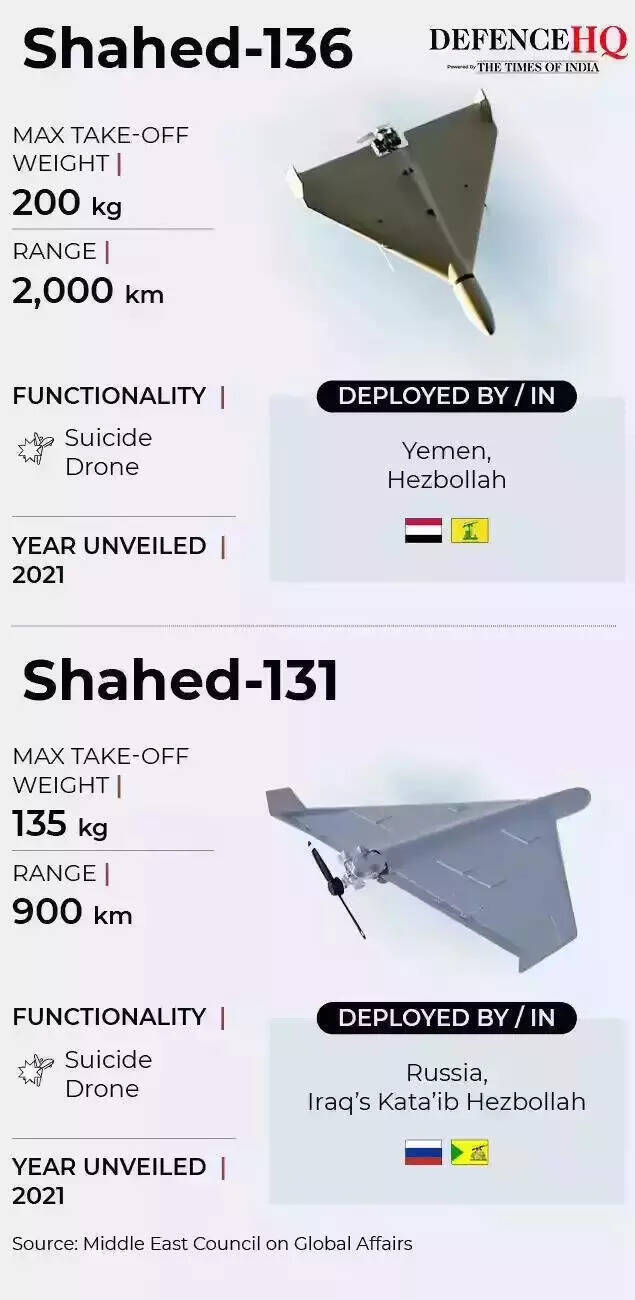
Shahed-136 and 131 drones
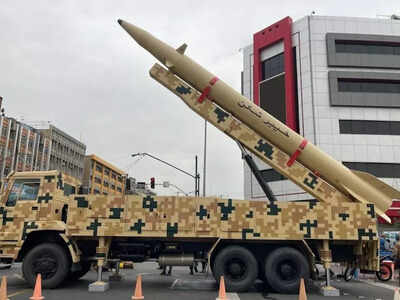
A smaller variant, the Shahed‑131, is known in Russia as Geran‑1 and is similarly used for precision kamikaze strikes. It has a range of 900 kilometres.Sejjil-2The Sejjil is one of Iran’s most advanced ballistic missile systems. It is a two-stage, solid-fuel medium-range ballistic missile (MRBM) developed domestically by Iran.The missile has a reported range of about 2,000 kilometres, allowing it to reach targets across much of the Middle East. It can carry a single warhead weighing around 700 kilograms, according to the Centre for Strategic and International Studies (CSIS). One of the key advantages of the Sejjil system is its solid-fuel propulsion.Unlike liquid-fuel missiles that need to be refuelled before launch, solid-fuel missiles can be launched more quickly, making them harder to detect or destroy before firing. The missile is also road-mobile, meaning it can be transported and launched from mobile platforms. Sejjil missile development and history.Kheiber ShekanAccording to Iranian media, the missile has a range of around 1,450 kilometres, enabling it to reach Israel from western Iran. It is equipped with satellite guidance and a manoeuvrable warhead, designed to improve accuracy.
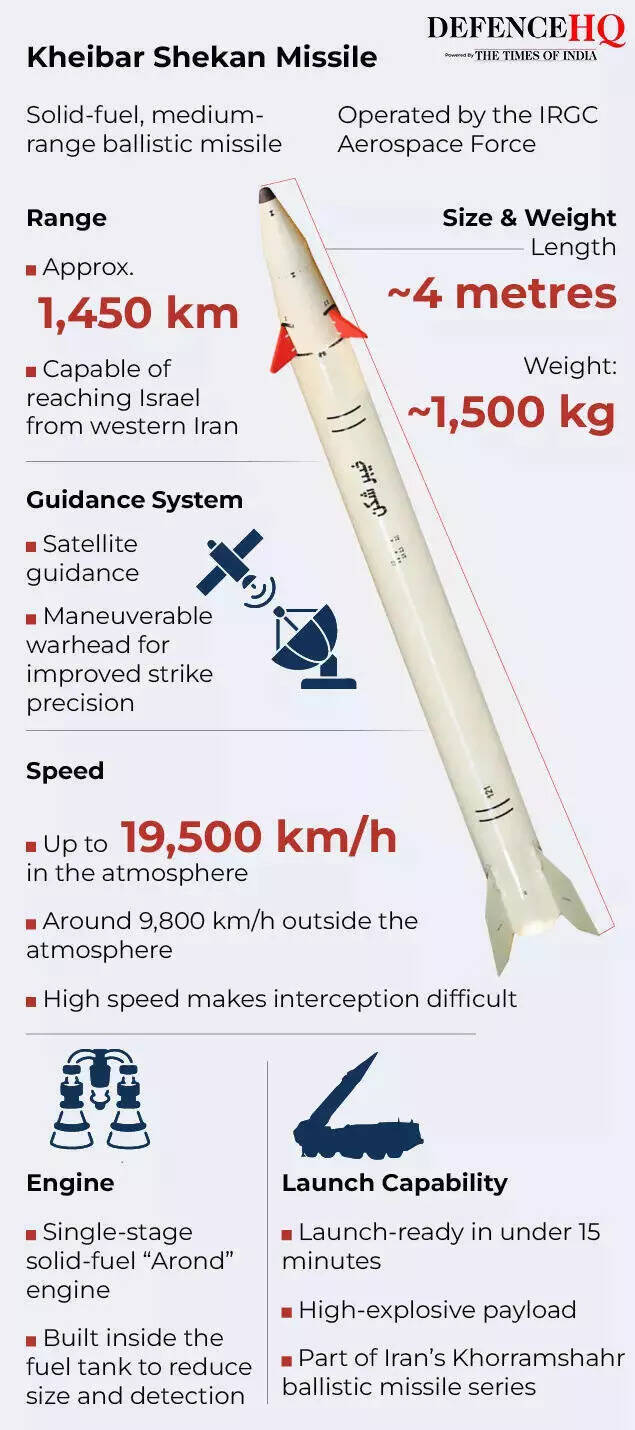
Kheibar Shekan missile
The missile is about 4 metres long and weighs roughly 1,500 kilograms, and is reportedly capable of reaching speeds of up to 19,500 km/h within the atmosphere and about 9,800 km/h outside it, making interception difficult even for advanced air defence systems.Khorramshahr-4Claimed by Iran to have been used to target Tel Aviv’s Ben Gurion airport, is a long-range missile, with an estimated range of about 2,000 kilometres and a warhead capable of carrying more than one tonne of high explosives. It is the fourth generation of the missile; the first generation was unveiled in September 2017.
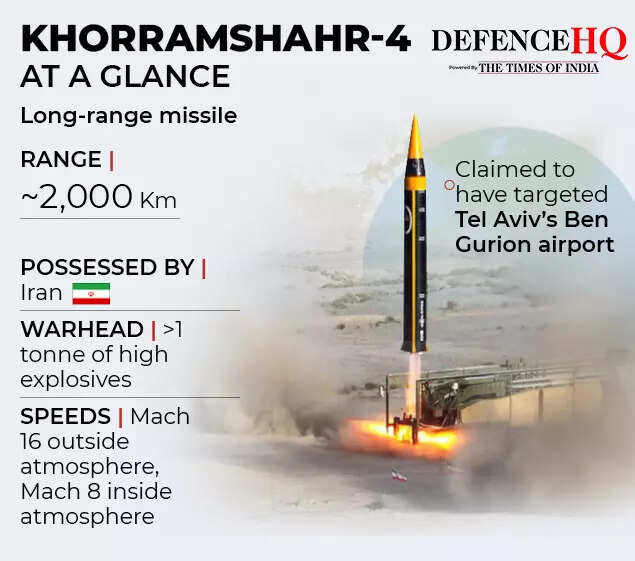
Khorramshahr-4
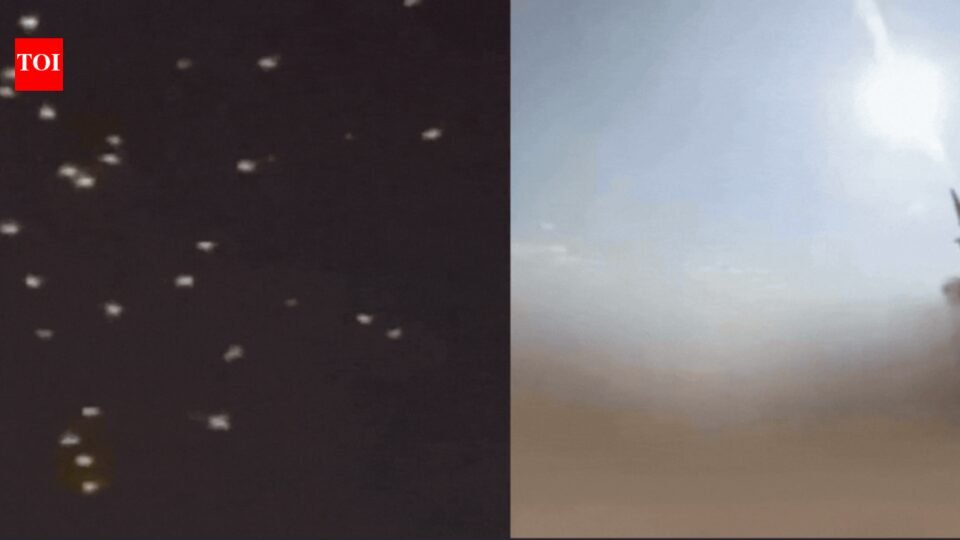
The missile gets its name from the city of Khorramshahr.Iranian officials say the missile can reach speeds of Mach 16 outside the atmosphere and Mach 8 within it.Cluster MunitionsBallistic missiles equipped with cluster munition warheads have also been used by Iran. Unlike conventional missiles that explode in a single blast, these weapons burst open mid-air, scattering dozens of smaller explosive bomblets across a wide area.
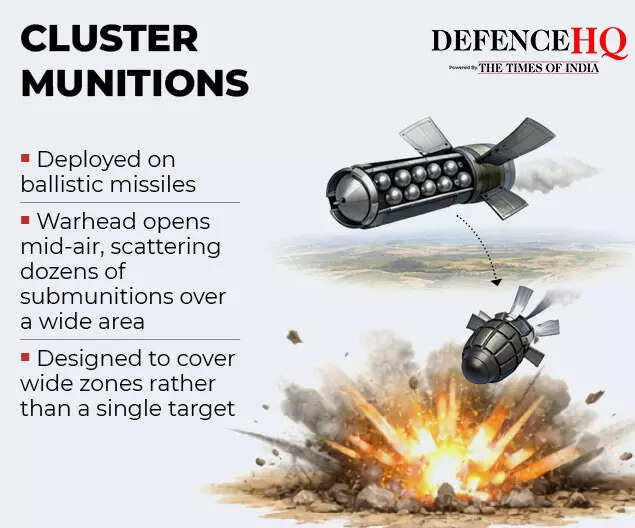
Cluster munitions
Cluster bombs are weapons designed to release many smaller explosive devices, known as submunitions or bomblets, from a single missile, rocket or aircraft bomb.Once the main warhead opens in the air, the bomblets spread across a large area and detonate on impact. Because they are designed to cover wide zones rather than strike a single target, cluster munitions are considered among the most controversial weapons used in modern warfare.Ghadr-110According to The Jerusalem Post, the Ghadr‑110 is the most advanced variant of the Ghadr missile family. It is a two-stage missile that uses a solid-fuel engine, which shortens launch preparation time and makes it harder to intercept before launch.
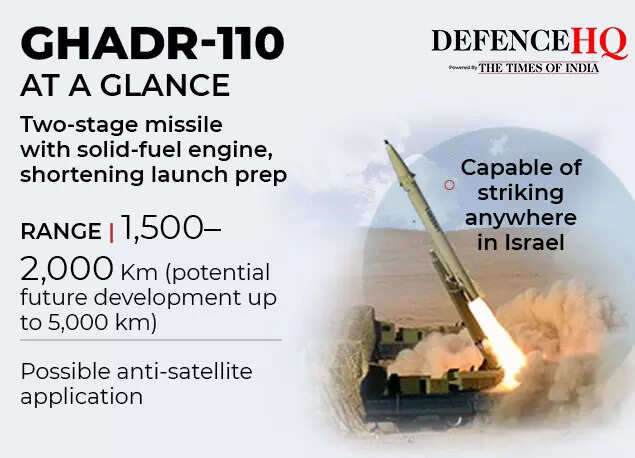
Ghadr-110
Its estimated range of 1,500–2,000 km makes it one of Iran’s longest-range ballistic missiles, capable of striking anywhere in Israel. Experts also believe that the Ghadr design could potentially be developed further for ranges up to 5,000 km and possibly adapted for anti-satellite operations.Fattah-2In what would mark its first operational use, Iran claims to have deployed the Fattah‑2 missile during the current conflict. Unveiled in November 2023, the Fattah‑2 is designed to use a hypersonic glide vehicle rather than a conventional ballistic missile re-entry vehicle.
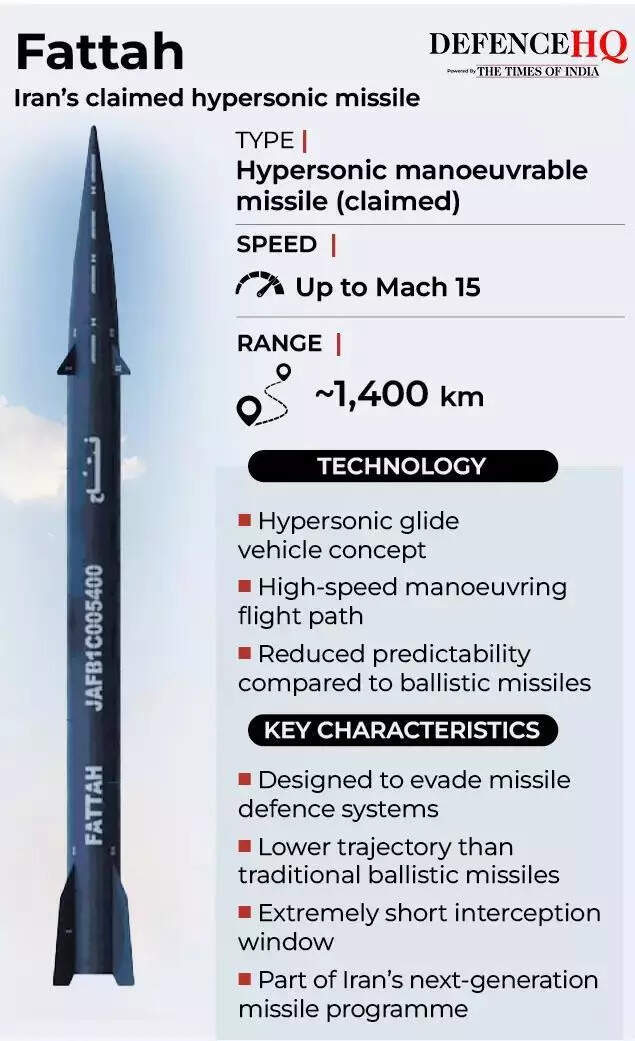
Fattah missile
Iranian officials assert that the missile can reach speeds of up to Mach 15 and strike targets at distances of up to 1,400 km. While analysts have expressed skepticism about these claims, a missile traveling at Mach 15 would theoretically be capable of evading conventional missile defence systems.The Fattah‑2 is reported to carry a 200 kg warhead, making it a highly potent strike weapon.EmadUnveiled in 2025, the Emad missile’s key feature is its manoeuverable warhead, which can adjust its course during re-entry to evade radar and interception systems. The missile has an estimated range of 1,700 km and uses liquid fuel.
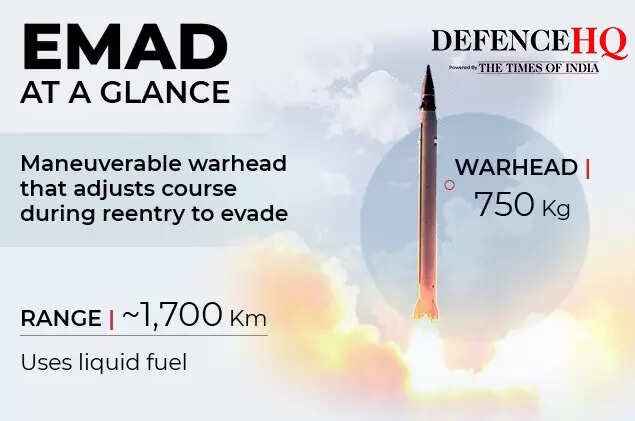
Emad missile
Although liquid propellant requires lengthy and corrosion-sensitive fuelling on the launch pad, it provides high energy efficiency, allowing Emad to carry a relatively heavy 750 kg warhead, giving it significant destructive potential against strategic targets.Middle East warThe conflict began on February 28, when the United States and Israel launched coordinated military strikes across Iran, marking the start of active hostilities. Ayatollah Ali Khameini, the Islamic Republic’s Supreme Leader was killed in one of the strikes and has since been succeeded by his son, Mojtaba, who himself is said to be in a serious condition.Tehran has also effectively blocked the Strait of Hormuz, a crucial waterway carrying about 20 % of global crude oil, prompting President Trump to urge allied nations to deploy warships to escort commercial vessels.
