
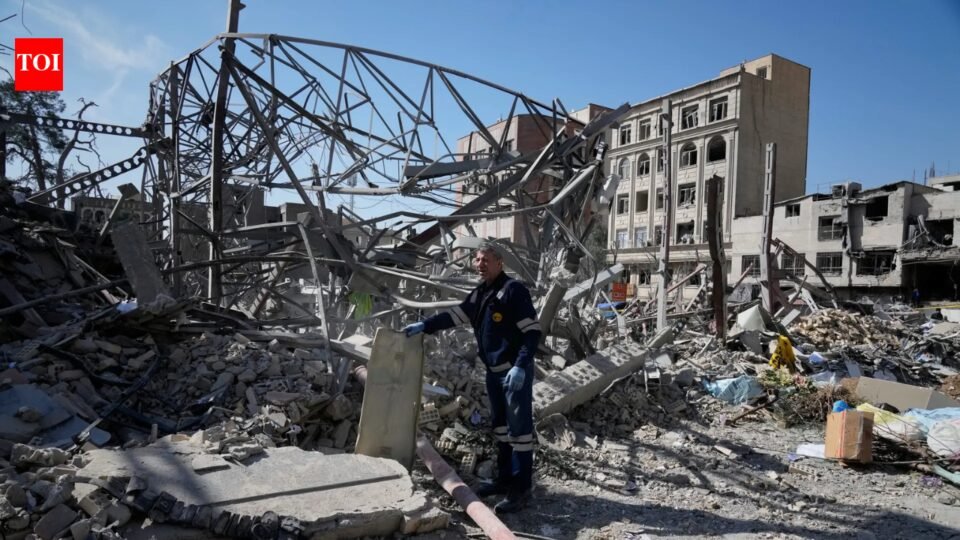
Explosions rocked Iran’s capital before dawn Wednesday as the country’s escalating conflict with the United States and Israel entered its fifth day, marking one of the most intense periods of fighting in the region in decades. The latest blasts in Tehran came after days of sustained US-Israeli airstrikes on Iranian military and nuclear sites and sweeping retaliatory attacks by Tehran on Israeli territory and US assets across the Gulf.Iran’s foreign minister, Seyed Abbas Araghchi, reiterated Tehran’s determination to defend itself and confront what it calls US-Israeli aggression. “Bombings in our capital have no impact on our ability to conduct war,” he wrote on X, highlighting Iran’s decentralised “Mosaic Defence” system that allows it to dictate when and how the conflict concludes. Senior adviser to the late Supreme Leader Mohammad Mokhber told state television that Iran “has no trust in the Americans and sees no grounds for negotiations with them,” adding, “We can continue the war for as long as we deem necessary.”Meanwhile, explosions were reported across Tehran as daylight broke, with Israel saying its air defenses had been activated against incoming Iranian missile fire. Israel described its operations as a “broad wave” of strikes targeting Iranian defense systems, missile launch sites, and underground nuclear research facilities. The Israeli military also struck a building in Qom associated with clerics where they were meeting on selecting Iran’s next supreme leader.Israel’s defense minister, Israel Katz, warned that the individual chosen as Iran’s next supreme leader would be “a target for elimination,” following airstrikes on the Assembly of Experts, the body responsible for selecting Khamenei’s successor. Earlier strikes had targeted Supreme Leader Ayatollah Ali Khamenei, who was killed in recent US-Israeli attacks. Iran is holding a three-day state funeral, with public memorials at the Imam Khomeini Grand Mosque in Tehran and burial planned in Mashhad, intensifying tensions across the region.
Iran retaliates across Israel and the Gulf
The Islamic Revolutionary Guard Corps (IRGC) launched 17th waves of Operation True Promise 4, deploying over 230 drones against multiple targets, including locations in the Occupied Territories, US military bases in Erbil and Kuwait. Iran reported significant damage to a US airbase in Bahrain and claimed more than 680 American casualties across various sites during the first two days of the conflict. The IRGC emphasised that “this operation will continue relentlessly until the enemy is decisively defeated,” asserting that all US assets in the region are legitimate targets.In addition to drone strikes, Tehran has fired dozens of ballistic missiles at Israel, most of which were intercepted, resulting in at least eleven Israeli fatalities since the conflict began. Iran also confirmed attacks on multiple locations in Bahrain, Kuwait, Qatar, and the United Arab Emirates—countries hosting US military airbases, according to the Fars news agency.Drone strikes have extended to US diplomatic facilities in the region. Two drones targeted the US Embassy in Riyadh, causing a limited fire, according to Saudi Arabia’s defense ministry. The embassy temporarily closed to the public and advised Americans to avoid the compound. Another Iranian drone struck a parking lot outside the US consulate in Dubai, sparking a small fire that was quickly extinguished, officials said. Additionally, a suspected Iranian drone hit the Central Intelligence Agency’s station at the US Embassy in Saudi Arabia on Monday, according to a source familiar with the matter.‘We’ve just begun’: US says it has bombed over 2,000 targets in Iran – top developments
US evacuations and regional fallout
The US State Department authorised non-emergency US government employees and family members to leave Pakistan consulates in Karachi, Lahore and Saudi Arabia, Oman “due to safety risks,” according to advisories from the US embassies in Riyadh and Muscat.The department also ordered the evacuation of non-emergency personnel and families in Kuwait, Bahrain, Iraq, Qatar, Jordan and the United Arab Emirates. US citizens were urged to leave more than a dozen Middle Eastern countries, though many were stranded because of airspace closures. The State Department said it is preparing military and charter flights for Americans wanting to leave the region.Oman, which had played a mediation role in talks between the United States and Iran, called for a ceasefire. Riyadh condemned Iranian salvos, including the attack on the US embassy in Riyadh.India’s Ministry of External Affairs announced the establishment of a Special Control Room and issued helpline numbers for Indian nationals in view of the evolving situation in West Asia and the Gulf region.
US military campaign intensifies
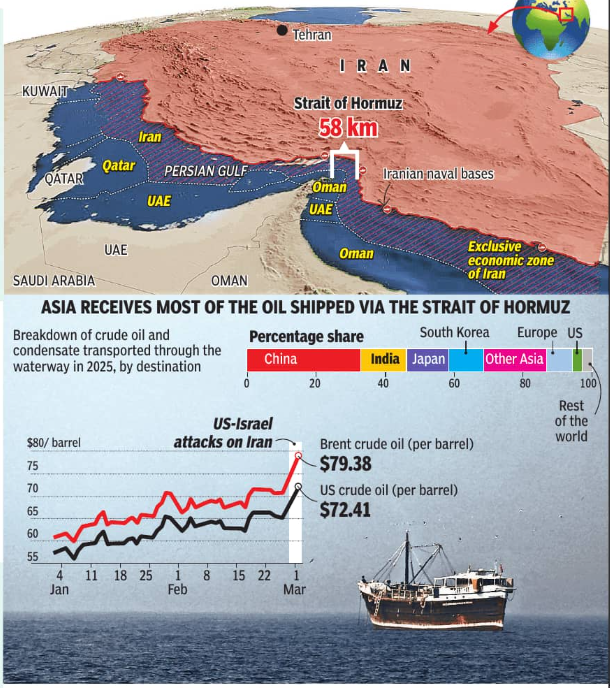
Admiral Brad Cooper, commander of US Central Command, said American forces have struck nearly 2,000 targets in Iran as part of what he described as the largest firepower buildup in the region in a generation.“In simple terms, we’re focused on shooting all the things that can shoot at us,” Cooper said in a video message posted on X.“We are also sinking the Iranian navy — the entire navy,” he added. “Thus far, we’ve destroyed 17 Iranian ships, including the most operational Iranian submarine that now has a hole in its side.”“For decades, the Iranian regime has harassed international shipping. Today, there is not a single Iranian ship underway in the Arabian Gulf, Strait of Hormuz or Gulf of Oman,” Cooper said. “And we will not stop.”He added, “We’ve already struck nearly 2,000 targets with more than 2,000 munitions. We have severely degraded Iran’s air defenses and destroyed hundreds of Iran’s ballistic missiles, launchers and drones.”“The first 24 hours of this operation were nearly double the scale” of the first day of shock-and-awe strikes on Iraq in 2003, “and we continue with 24/7 strikes into Iran,” he said.The US military said it has destroyed 17 Iranian ships, including a submarine.
The US-Israeli strikes have killed at least 787 people in Iran, according to the Red Crescent Society. Nearly 800 people have been killed in Iran since the conflict began, including some whom President Donald Trump said he had considered as possible future leaders of the country.In Lebanon, where Israel launched retaliatory strikes against Hezbollah militants, at least 50 people were killed, including seven children, according to Lebanon’s health ministry. Lebanon’s state-run media also reported that at least four people were killed in an Israeli strike that hit a residential complex in the city of Baalbeck.The US military confirmed six American service members have been killed. Four were identified as Capt. Cody A. Khork, Sgt. 1st Class Noah L. Tietjens, Sgt. 1st Class Nicole M. Amor and Sgt. Declan J. Coady, who were assigned to the Iowa-based 103rd Sustainment Command. The Pentagon said a drone strike Sunday at a command center in Kuwait killed four US Army Reserve soldiers and two other service members.Kuwait said an 11-year-old girl was killed by falling shrapnel as its forces intercepted “hostile aerial targets.” Three people were killed in the United Arab Emirates and one in Bahrain.
Uncertainty over Iran’s leadership
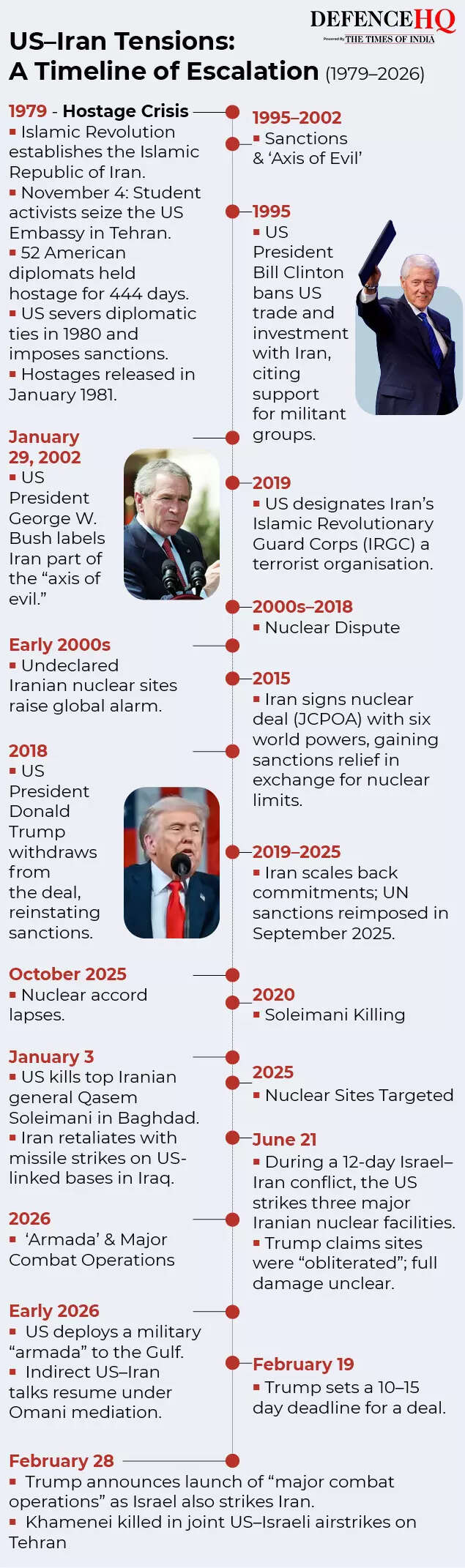
US President Donald Trump said Iran’s air force and navy had been “knocked out” and that new strikes targeted Iranian leadership. He suggested the war could last several weeks or longer.As far as possible leaders inside Iran, “the people we had in mind are dead,” Trump said.“I guess the worst case would be do this, and then somebody takes over who’s as bad as the previous person, right? That could happen,” Trump said. “We don’t want that to happen.”While the initial US-Israeli strikes killed Iranian Supreme Leader Ayatollah Ali Khamenei and Trump urged Iranians to overthrow their government, senior administration officials have since said regime change was not the goal. Trump later said that “someone from within” the Iranian regime might be the best choice to take power once the campaign is finished.Israeli media reported that Mojtaba Khamenei, the 56-year-old second eldest son of Ali Khamenei, had been chosen as successor and that the Assembly of Experts was expected to formally announce him. The New York Times reported he had emerged as the leading candidate and that the Assembly allegedly elected him under pressure from the IRGC. There has been no independent confirmation from Iranian state media.
