
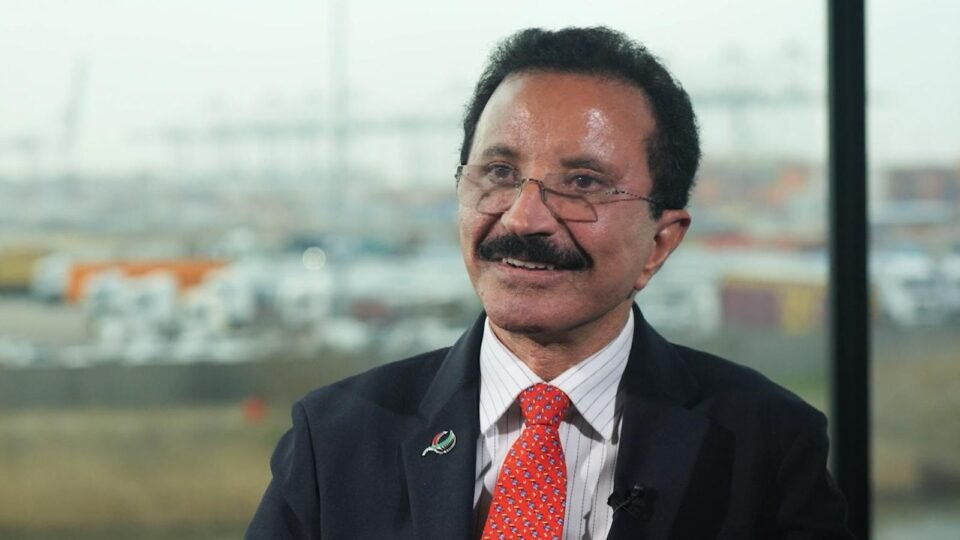
The Emirati businessman credited with turning DP World into a global logistics powerhouse has left the company amid questions over his links to the disgraced paedophile financier Jeffrey Epstein.
Sultan Ahmed bin Sulayem was the chairman and CEO of the Dubai based group and its earlier entities for more than four decades.
Its interests include 80 ports, including the London Gateway, equating to roughly 10% of the market.
It is also the owner of P&O Ferries – the UK operator that infamously sacked 800 seafarers in favour of cheaper agency staff in 2022.
Follow – Epstein files latest
THE BIGGEST CORPORATE SCALP OF EPSTEIN SCANDAL SO FAR

The publication of a string of lewd emails exchanged with Epstein, continuing long after the paedophile financier had been convicted, made Sultan Ahmed Bin Sulayem’s position untenable even for a company with a high tolerance for external pressure.
As the owner of P&O Ferries, DP World did not budge amid public outcry over the summary dismissal of more than 800 seafarers in March 2022, insisting it was a sound business decision.
And in late 2024 bin Sulayem was involved in a public row with Sir Keir Starmer after he threatened to withdraw a planned £1bn expansion of DP World’s London Gateway port after criticism from the then transport minister Louise Haigh.
That deal was patched up in-person, with bin Sulayem attending a government investment summit to shake hands. As recently as March last year he travelled to the UK to meet junior minister Poppy Gustafsson at London Gateway.
Interviewed by Sky News on that visit, he said DP World had been “discredited” by Ms Haigh’s comments. In the last fortnight he has found himself in that position.
DP World offered no comment following the first Epstein revelations but the threat to future business became tangible in recent days, with Canadian pension fund La Caisse and UK development finance arm British International Investment halting joint ventures.
The company may also have been alive to the impact on 115,000 staff around the world of continuing to be led by a man evidently close to Epstein and his excesses. Under new leadership it will hope to move on.
A statement announcing his successors did not mention bin Sulayem but it was later confirmed that he had resigned.
The, now former, CEO and DP World had come under pressure after new investment in the company was suspended by a number of international partners amid questions over his links with Epstein.
British International Investment (BII) and Canada’s second-largest pension fund withdrew funding following the publication of communications in the so-called Epstein files which showed bin Sulayem had allegedly discussed women with the late disgraced US financier.
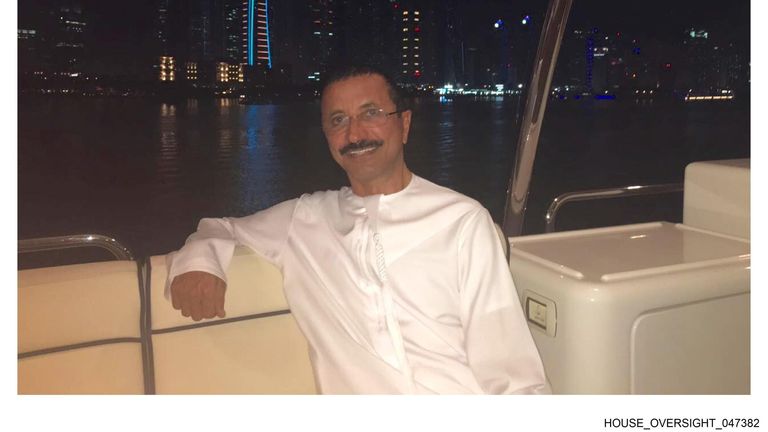
A picture of Sultan Ahmed Bin Sulayem released in the Epstein files. Pic: @OversightDems
Read more from Sky News:
FBI releases new details about suspect in disappearance of US TV host’s mother
Donald Trump agrees to end ICE operation in Minnesota
There has been no evidence of criminal wrongdoing by bin Sulayem.
DP World said on Friday: “DP World announced the appointment of His Excellency Essa Kazim as Chairman of its Board of Directors and the appointment of Yuvraj Narayan as Group Chief Executive Officer.”
It added: “DP World affirmed that the new appointments support its strategy for sustainable growth and reinforce its role in strengthening global supply chains and supporting Dubai’s position as a leading hub for trade and logistics.”
BII responded by saying that it had lifted the suspension of its investment with immediate effect.
A spokesperson said: “We welcome today’s decision by DP World and look forward to continuing our partnership to advance the development of key African trading ports to unlock the continent’s global trading potential.”
