
CHENNAI/ NEW DELHI: The changes in foreign direct investment (FDI) rules for China and other land bordering countries (LBCs) are expected to fast track investment by global investment firms, such as Blackrock and Carlyle, as they were feeling the heat of approvals required, even if there was a very small Chinese shareholding.On Wednesday, the Union cabinet allowed for tweaks in Press Note 3, which in 2020 had kept all FDIs from China, Hong Kong and other LBCs out of the automatic route. Now, companies can get automatic approval for investment in India, where beneficial ownership of Chinese entities are under 10% and they do not exercise control.“We are opening up in a strategic and calibrated manner… It’s a changing world and the opening up doesn’t mean that concerns with regards to security have gone away,” Amardeep Singh Bhatia, secretary for department of promotion of industry and internal trade, told reporters.He said that a detailed SOP, along with a list of product categories for faster approvals in strategic sectors will be released “as soon as possible”. For sectors such as capital goods, electronic capital goods, electronic components, polysilicon and ingot-wafer, proposals will be cleared within 60 days, while ensuring that majority shareholding and control remains with resident Indian citizens or entities controlled by them. Rare earth and rare earth magnets are expected to be among the list of productions that will be notified by DPIIT.“In the expedited process, some steps have been done away with… but broadly, as far as the security clearances are required, political clearance is required, that process will remain in place,” Bhatia said.Easing of rules are expected to remove regulatory uncertainties that had stalled Indian joint ventures with Chinese partners since 2020, although it is not going to be easy for the Chinese majors, including BYD, to enter the market. With this, Indian companies are expected to easily access capital and process technologies, which are crucial for building a domestic ecosystem, as China currently dominates the global electronic manufacturing landscape.
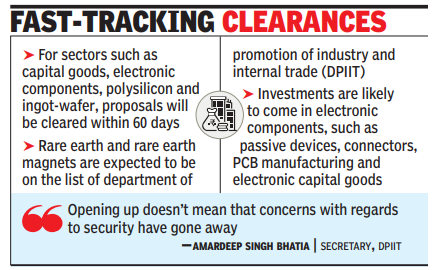
J S Gujral, MD of Syrma SGS, an electronics manufacturing services provider to global players, said: “Easing rules will enable technology partnership and bridge certain gaps in the domestic availability of components, specialised materials and advanced manufacturing know-how.”The investments are likely to come in electronic components, such as passive devices, connectors, PCB manufacturing, and electronic capital goods, where India has large demand but limited domestic manufacturing capacity, said Ashok Chandak, president of IESA. The move is also expected to help India in electronics capital goods, including SMT assembly lines, chip materials, such as Polysilicon and silicon ingots and even assembly materials, such as enclosures and mechanical parts.Shardul S Shroff, executive chairman of Shardul Amarchand Mangaldas said an expedited approval timeline for investments will bring greater certainty in processing timelines but will have limited applicability due to stringent requirements. Some experts said to make this meaningful BIS reforms are needed, including faster approval timelines, simplification and expanding testing infrastructure.
