
Scientists in the UK have created the first lab-grown oesophagus and implanted it in pigs, which have been able to use it to swallow food.
In the study, scientists from Great Ormond Street Hospital (GOSH) and University College London (UCL) demonstrated that a pig donor oesophagus can be de-cellularised, repopulated with a recipient’s own cells, and implanted in the recipient to restore oesophageal function.
It represents a major step towards personalised regenerative treatments for children born with life-threatening oesophageal conditions and could pave the way for translation to other disease areas.
Other studies have previously shown parts of this technology, but this is the first time the full process has been completed with such success, the study’s authors said.
In the study, eight recipient animals recovered well and developed working swallowing muscles to squeeze food towards the stomach with full integration of the engineered tissue within three months.
The study was published on Friday in Nature Biotechnology
Immunosuppression was not required as the implant was developed using the recipient’s cells, and the tissue grew with the animals.
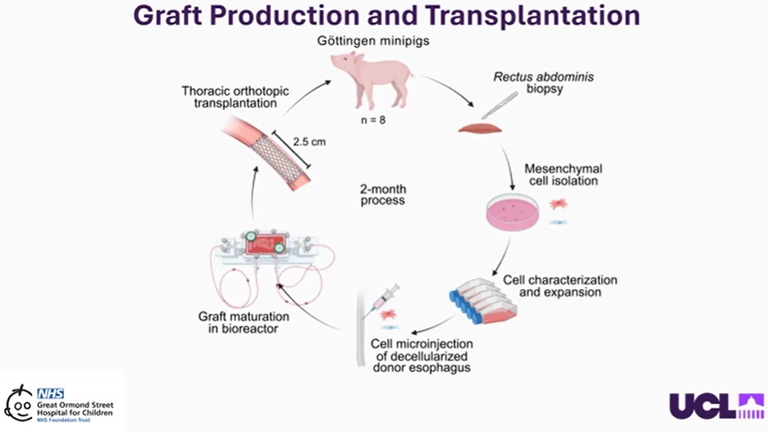
The first step in this new technology is to create a scaffold, which acts as a tube-shaped base for the new organ.
Scientists use a donor pig’s oesophagus, which is very similar to a human’s.
Through a process called decellularisation, the donor tissue is carefully stripped of all the pig cells, while keeping the underlying support structure intact.
Next, the scaffold is repopulated with a recipient pig’s muscle cells, taken from a small biopsy.
These cells are multiplied in a lab and then injected directly into the scaffold.
Read more from Sky News:
NHS ‘came close to collapse’ during pandemic, inquiry finds
Teenage boy dies after blaze in flat next to fire station
The graft is then placed in a bioreactor, a special container that pumps vital growth fluids through the tissue for one week.
During this time, the cells settle and spread, and they adapt to their new home.
Overall, the process takes two months to complete.
Research with pigs has shown very encouraging results, providing a blueprint for human treatment. All eight animals survived the critical first 30 days after transplant.
By the six-month mark, the lab-grown grafts had developed functional muscle, nerves, and blood vessels.
This allowed the transplanted oesophagus to contract and move food like a native food pipe.
The transplanted animals could eat normally and grow at a healthy rate.
For the first time ever, this research team were able to map the genes in the structure of the implanted tissue, using a technique called spatial transcriptomics, to show that the genes turned on in the new oesophagus were in line with what would be expected in ‘natural’ tissue.
The engineered oesophagus was shown to contract, producing movement and pressure with sufficient strength and co-ordination to allow normal swallowing.
If this technology is adapted for use in humans, different sizes of scaffold, derived from donor pigs, could be stored ready to be developed and personalised for newborns or children of varying sizes and age, whenever needed.
Sean, father of Casey Mcintyre, two, from London, who has undergone multiple operations, said: “People can never tell Casey has spent half of his life in hospital, and hopefully he won’t remember, but the memories will never leave us.
“We’ve had to learn things as new parents that we never considered would be part of our family life, from feeding him through a stomach tube to what to do if the hospital call with an urgent update in the middle of the night.
“To look at him, he’s just amazing, and we are very proud of him. Whatever the team did for him was really a miracle, but the idea that there could be one operation early in your child’s life, that could transplant a working piece of oesophagus, and then we could move on, would be life-changing.”
Aoife Regan, GOSH charity’s director of impact and charitable programmes, said: “We are thrilled to see the success of this research, which is offering more hope to children with a highly complex and rare condition, which can significantly affect their quality of life and childhood.
“At GOSH Charity, we want every child treated at GOSH to have the best chance, and best childhood possible, and providing funding for key projects like this one, demonstrates the impact innovative research can have on those that need it most.”
The study was published on Friday in Nature Biotechnology.
