
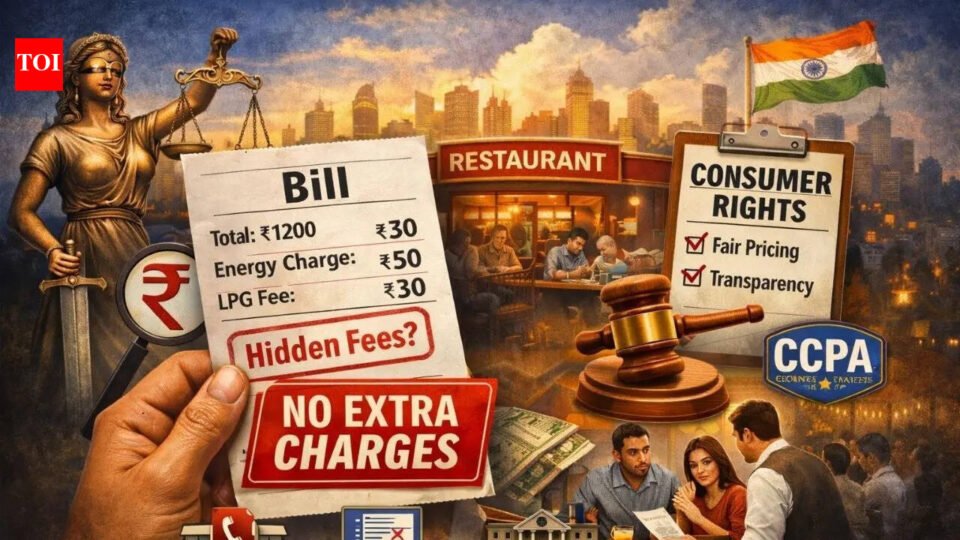
In an era where transparency is not just expected but demanded, the recent intervention by the Central Consumer Protection Authority (CCPA) marks a decisive step towards restoring fairness in everyday transactions. What may appear as a few extra rupees on a restaurant bill is, in truth, a deeper question of consumer rights, trust, and legality.Acting under the Consumer Protection Act, 2019, the CCPA has unequivocally clarified that levying additional charges such as “LPG charges”, “fuel surcharge”, or “energy recovery fee” is not merely questionable, it is unlawful.
This comes in response to a growing number of complaints across India, where diners were confronted with unexplained additions at the time of billing, charges that were neither disclosed upfront nor voluntarily agreed upon.
What You See Should Be What You Pay
At the core of this issue lies a simple yet powerful principle of consumer law: price transparency.The menu is not a tentative estimate; it is a representation of the final payable amount, subject only to statutory taxes. Any additional charge, imposed without explicit consent, amounts to an unfair trade practice under Section 2(47) of the Consumer Protection Act.The CCPA’s reasoning builds upon its earlier 2022 guidelines on service charges, where it had already clarified that the cost of service is inherently included in the price of food. Extending this logic, it has now firmly stated that operational costs i.e. be it LPG, electricity, or fuel, are part of the business model and must be factored into menu pricing, not added later.
The Problem of Rebranded Charges
What makes the issue particularly troubling is not merely the existence of such charges, but the manner in which they have evolved.Following regulatory scrutiny on mandatory service charges, several establishments appear to have adopted a workaround by introducing similar levies under different labels such as:
- “Gas surcharge”
- “Fuel adjustment fee”
- “Energy cost recovery”
This is not reform; it is relabelling. The CCPA has rightly clarified that substance prevails over form. A charge does not become lawful merely because it is renamed. If it is imposed compulsorily and not disclosed upfront, it remains unlawful.A widely reported instance involved diners in metropolitan cities like Delhi and Bengaluru finding “energy charges” added to their bills without prior notice. In several such cases, consumers raised objections only to be told that the charge was “standard practice.” It is precisely this normalisation of unfair conduct that the CCPA seeks to dismantle.
Industry Concerns Do Not Override Consumer Rights
The restaurant industry has, understandably, expressed concerns. Rising input costs, particularly LPG price volatility and supply disruptions owing to the ongoing US – Isreal war with Iran, have strained margins. Some establishments argue that these surcharges were introduced as a means of cost recovery and transparency.However, the law is clear and uncompromising. Businesses are free to revise their pricing structures. What they cannot do is impose post facto charges that alter the agreed price at the point of billing.Transparency once compromised is trust forever questioned. What is hidden breeds distrust. One cannot claim transparency while ambushing the consumer with concealed costs. If operational expenses have increased, the correct legal approach is simple: revise the menu price. The burden cannot be shifted onto the consumer through opaque billing practices.
Consumer Rights and Remedies
One of the most empowering aspects of the CCPA’s advisory is the clarity it provides to consumers. Diners are not helpless, they are legally protected. If confronted with such charges, a consumer can:
- Demand immediate removal of the charge from the bill
- File a complaint through the
National Consumer Helpline (1915) - Use the e-Jagriti portal to approach consumer commissions
- Report the matter to district authorities
Recent enforcement trends indicate that authorities are increasingly willing to act swiftly. In earlier cases involving service charges, restaurants were directed to issue refunds and, in some instances, faced penalties.This signals a shift from advisory to enforcement.
A Broader Shift in Consumer Law Enforcement
This development must be seen as part of a broader regulatory trajectory. Over the past few years, consumer protection in India has undergone a transformation:
- Crackdown on misleading advertisements
- Regulation of e-commerce practices
- Action against mandatory service charges
- Strengthening of digital complaint mechanisms
The CCPA’s latest stance reinforces a central theme: Consumer rights are no longer passive, they are enforceable.This is a significant shift in legal culture. Earlier, such issues may have been dismissed as trivial or routine. Today, they are recognised as systemic practices affecting millions of consumers.
Why This Matters More Than It Appears
At first glance, a ₹20 or ₹50 surcharge may seem inconsequential. But law does not operate on the magnitude of harm alone, it also addresses principles.If such practices are permitted:
- Pricing loses credibility
- Consumers lose trust
- Markets lose fairness
A small illegality, if normalised, becomes a systemic flaw. This is precisely why the CCPA’s intervention is both timely and necessary. It draws a line, not just against hidden charges, but against a culture of opacity.
Transparency as Strategy, Not Compliance
For the hospitality industry, this is not a constraint, it is an opportunity. Transparent pricing:
- Builds trust
- Enhances brand credibility
- Encourages repeat business
In a competitive market, trust is often the decisive factor. Hidden charges may yield short-term gains but result in long-term reputational loss.Forward-looking businesses will recognise that compliance is not merely legal, it is strategic.
No More Hidden Surprises
The CCPA’s intervention is a reaffirmation of a simple truth: A bill must reflect honesty, not ingenuity.By addressing the issue of hidden charges, the authority has reinforced the foundational principles of consumer law i.e. fairness, transparency and accountability.This is not merely about LPG charges or fuel surcharges. It is about ensuring that commerce remains grounded in trust. Because ultimately, in the marketplace, as in law, what you see should be what you pay.
