
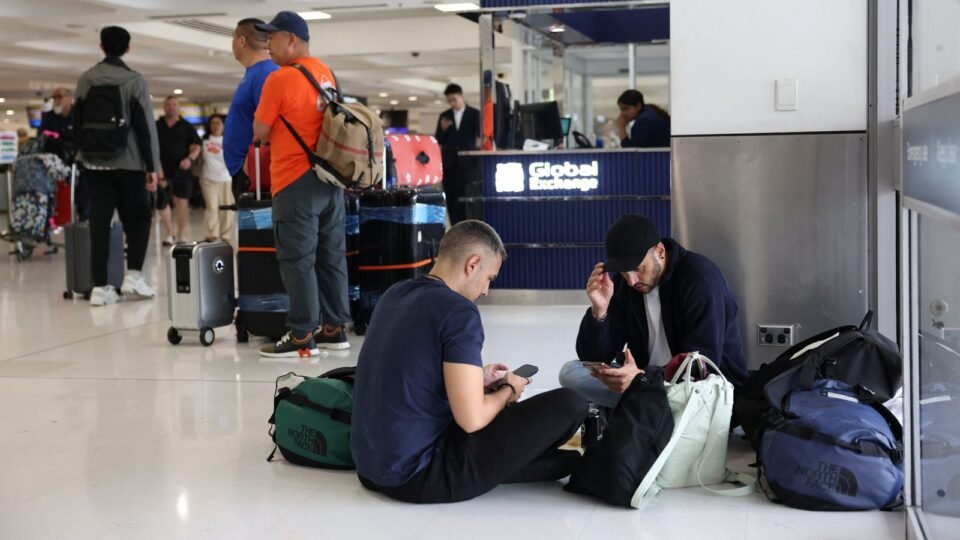
Travellers have been left stranded across the Middle East and further afield as missile and drone fire continues in the Iran war leaving thousands of flights cancelled and airspace closed.
One travel industry expert has called it “one of the worst shutdowns in aviation history”. The UK’s Foreign Office has warned against all but essential travel to several popular tourist destinations.
Hundreds of thousands of travellers planning on flying via Dubai, Abu Dhabi and Doha – some of the world’s busiest travel hubs – have had to change their plans because of the war.
Follow the latest updates on the conflict in the Middle East
What areas are now no-fly zones?
According to Flightradar24, most of the airspace in the region remains closed.
While some flights have resumed, the airspace above Iran, Israel (although there are some repatriation flights operating), Iraq, Kuwait, Bahrain, Syria (with the exception of Aleppo) and Qatar remains shut.
Stranded travellers at Sydney Airport after their standby flight to Switzerland via Doha was cancelled earlier this week. Pic: Reuters
Doha in Qatar, with an airport that 54 million passengers travelled through last year, has been one of the worst hit by the airspace closure.
Flightradar24’s head of communications Ian Petchenik told Sky News that “on a normal day, Doha would see between 720-730 flights”, adding “that’s nearly all of Qatar Airways capacity”.
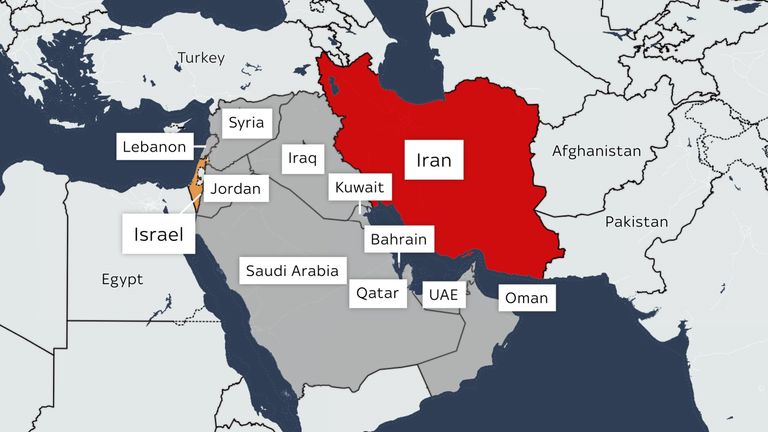
Map showing the Middle East
Dubai in the UAE, through which 92.3m people travelled in 2024, isn’t entirely shut but operations remain limited.
Mr Petchenik said that at this time of the year Dubai usually sees about 1,250 flights a day. But that number dropped to 161 on Thursday.
“The overall numbers that we’re talking about are approximately 3,500 to 4,000 flights per day that are being cancelled,” Mr Petchenik said. “That’s slowly trending downwards.
“The impact to the larger airlines – so Emirates, Etihad, Qatar Airways – those are being felt in a much wider region. But that’s not to discount airlines like Jazeera, Kuwait Airways, and Gulf Air, which are operating out of Kuwait and Bahrain, that are also completely shut down.”
What solutions are airlines coming up with?
According to global travel industry expert Paul Charles, some airlines are coming up with new routes to get people to their destination.
He told Sky News: “For example, British Airways, due to capacity constraints, are having to fly passengers who would normally go non-stop from Singapore to London and flying west from Singapore… They’re now flying some of them east from Singapore, routing them via America to come back to London.”
Mr Charles, who is founder of the PC Agency, a luxury travel PR and trade marketing consultancy, said: “The airspace closures have obviously caused some turmoil among airlines because a lot of their planes are out of place, cabin crew, pilots are in the wrong locations.
“And as a result, the airline planning teams are having to make substantial changes to how they fly passengers around the world.”
Read more:
Starmer could learn a useful lesson from Tony Blair
The Royal Navy’s destroyer will arrive too late for Cyprus
Mr Charles described the latest events as “one of the worst shutdowns and most unexpected shutdowns in aviation history”. He added: “It shows the importance of the Middle East.”
Why are some flights allowed to operate?
Mr Charles said some “safe corridors” are opening up, especially out of Dubai.
“It’s worth saying that airlines would never risk flying a plane with passengers in an area if it wasn’t 100% safe,” he said.
“These corridors are guaranteed, they’re agreed by all parties in a conflict zone, and there is no way any airline would put at risk its passengers, its crew, or the aircraft itself unless they were absolutely certain that that corridor was 100% safe.”
What are the risks if the conflict escalates further?
The industry is also concerned with airspace compression – the impact that closing airspace has on the availability of safe, usable air corridors. This can force aircraft into more congested and less efficient routes.
“If for some reason, Azerbaijan needed to close its airspace or felt that there was a risk to the safety of flight, that would be a major concern,” Mr Petchenik said.
“If for some reason, Saudi Arabia felt it needed to close its airspace, that would be a major concern, not necessarily of safety for these aircraft, because they’re not operating in an unsafe area anymore, but because there’s no way to get from point A to point B without these corridors being open.”
