
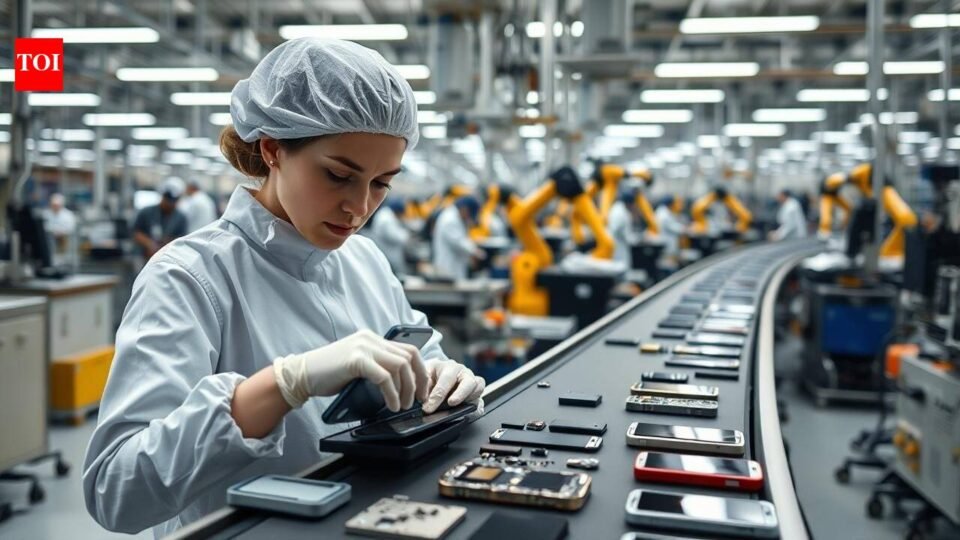

With the production-linked incentive (PLI) scheme now over, India’s electronics industry has pitched a fresh expansion plan, seeking continued government support as it eyes a strong jump in manufacturing and exports over the next five years. During discussions with the ministry of electronics and IT (MeitY), the industry said that by FY31, India could capture 30–35% of global mobile production. This would take annual output to $110–130 billion, with exports estimated at $55–70 billion. At present, according to ET, India accounts for about 15% of global mobile phone production, with manufacturing output exceeding $64 billion. Industry executives said the current production-linked incentive (PLI) scheme has played a key role in this growth. With the scheme set to end on March 31, companies are pushing for a new version to keep the momentum going. Talks are underway on a proposed PLI 2.0 scheme, which is likely to run from 2026 to 2031. Government officials said a new incentive programme is being considered, though details have not yet been finalised. The industry has also shared a roadmap with the government to meet production and export targets by FY31. “With a strong foundation, we have an opportunity to achieve 30-35% of global mobile production in the next five years,” Pankaj Mohindroo, chairman of India Cellular and Electronics Association (ICEA), told ET. “To realise this ambition, it is critical to sustain the current momentum and continue investments. We are actively engaging with the government to shape the next phase of this growth journey.” Industry players said increasing India’s global share would help strengthen the supply chain, deepen the manufacturing ecosystem and support research and development at scale. One executive said scale is more important than value addition alone for long-term sustainability. The government is also examining how much domestic value addition should be required for incentives and how exports can be increased without breaching World Trade Organization norms. Experts said the growth in production will depend largely on exports, as domestic demand is expected to weaken. India’s smartphone market could shrink by more than 13% this year due to rising memory costs, which may push device prices up by 15–40%, according to an earlier report. Data from the commerce ministry showed smartphone exports rose 47.4%, from $20.44 billion in 2024 to $30.13 billion in 2025. The United States accounted for $19.7 billion, or 65% of total exports. Meanwhile, China’s smartphone exports fell from $132.6 billion to $120.6 billion during the same period, with shipments to the US declining sharply due to fentanyl-related tariffs. India’s tariff advantage in the US market has narrowed after the US Supreme Court struck down sweeping global tariffs imposed by the Trump administration. China continues to have an advantage due to its strong supply chain and advanced manufacturing capabilities, while India is still developing these.
