
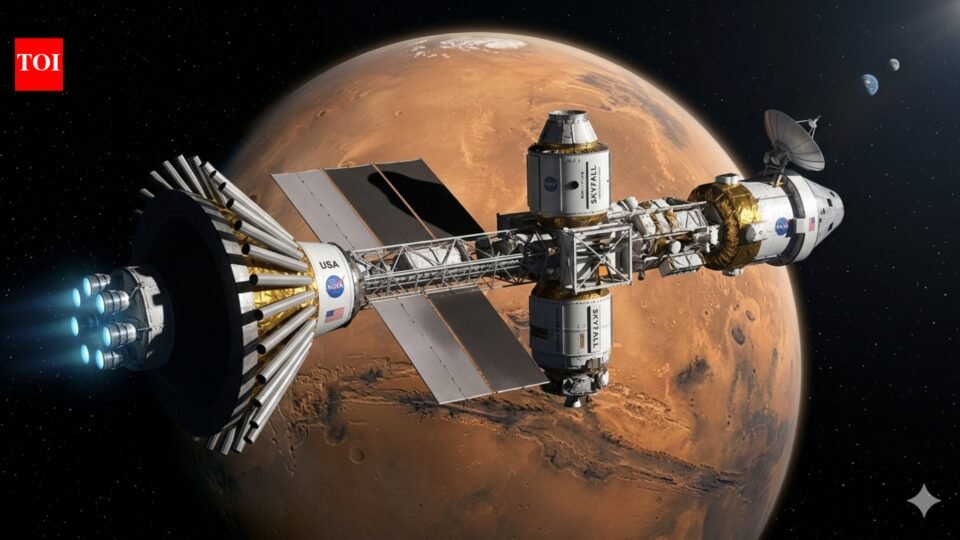
The announcement that NASA plans to launch a nuclear-powered mission to Mars by 2028 signals a new era in the exploration of space by the human race. Over the years, Mars exploration has largely involved the use of chemical power, as well as solar power, which has its limitations in terms of speed and efficiency. However, the fact that nuclear power is about to be introduced signals a new era in the exploration of space, as scientists are already contemplating a future where the human race can explore space faster, carry more equipment, and explore space independently of the sun.This is not just a mission to Mars; it is a foundation for the exploration of space by the human race, which can reduce the risks involved in the journey to Mars.
What is NASA’s nuclear-powered Mars mission
The upcoming NASA mission revolves around a spacecraft that will be used for Nuclear Electric Propulsion (NEP). This propulsion system works by using a small nuclear reactor to produce electrical power. This power can then be used to power efficient propulsion systems, allowing the spacecraft to travel vast distances without using a lot of fuel.The upcoming NASA mission, which may be associated with the Space Reactor-1 (SR-1) concept, may be used to show the effectiveness of using nuclear power in space. In addition to this, the spacecraft may be used to deploy other robots, like helicopter drones, to explore Mars. This can be useful for exploring Mars, as these drones can travel to locations that other robots may not be able to reach.The upcoming missions are important, according to NASA, as they will be used to help power future missions to Mars.
How nuclear propulsion works in space
Nuclear propulsion provides a completely different alternative to traditional rockets. Unlike traditional rockets, which rely on rapid bursts of chemical fuel, nuclear propulsion provides a steady and highly efficient source of power.There are two key technologies currently being developed:NASA explains that nuclear thermal propulsion is capable of being two to five times more efficient than traditional chemical propulsion systems. The greater efficiency allows for faster travel or heavier payloads without needing large amounts of fuel. Nuclear propulsion is also not reliant on sunlight, making it more suitable for deep space missions where traditional propulsion methods become less effective.
Why this Mars mission matters for human exploration
One of the major challenges associated with the mission of sending humans to Mars is the long period of time it currently takes to make the trip, which can range between six and nine months.The nuclear propulsion technology has the potential to reduce the time taken to make the trip, and this will also have the effect of reducing the health and financial risks.NASA and DARPA have already begun the process of testing the nuclear rocket engine in space, and this will be done with the intention of proving the technology before using it in the mission.As stated by the Deputy Administrator of NASA, Pam Melroy, “This demonstration will be a crucial step… to send humans to Mars.”In addition to the speed of the mission, nuclear technology has the ability to generate power.
What makes this mission a technological breakthrough
The mission is also unique in the sense that it brings together propulsion, power, and exploration. Unlike other previous missions, which relied on solar power and batteries, nuclear power has the ability to generate power in any environment.The advantages of nuclear power are:
- The ability to generate power without any interruption, irrespective of the distance from the Sun
- The ability to conduct long-duration missions
- The ability to explore the harsh environment
According to NASA, the development of “flight-heritage nuclear hardware” is needed for missions beyond Mars, including Jupiter and Saturn.
The future of space travel with NASA
The NASA mission to Mars in 2028 with nuclear power is not only about doing a single experiment; it is about opening a new era of space exploration. If the mission to Mars is successful, nuclear power can become the new standard for space exploration, which can lead to faster and more fruitful space expeditions, and finally, human settlements on other planets.In simple words, the NASA mission to Mars is about bringing the world closer to the day when Mars is no longer a distant planet but a planet we can access.
