


Many people feel reassured when their daily phone usage drops. It feels like a win. Less scrolling should mean better sleep and a calmer mind. But the modern workday tells a different story.From morning emails on laptops to back-to-back video calls, the eyes rarely get a real break. Even office lighting, often bright and cool-toned, mimics daylight. So the body stays in “alert mode” longer than it should. The result is subtle but real. Sleep feels lighter, the mind stays busy at night, and mornings feel heavier than they should.
This is not about obvious overuse. It is about exposure that slips under the radar.
The invisible hours of screen exposure at work
A typical desk job today involves six to ten hours of screen time. Much of it does not feel optional. Documents need reviewing. Meetings happen on screens. Notifications demand attention.Unlike phone scrolling, this exposure feels productive. So it rarely raises concern.But the brain does not separate “work screens” from “leisure screens.” It reacts to light and stimulation in the same way. Blue-enriched light from screens signals the brain to stay awake. Constant task switching keeps mental activity high.Over time, this creates a state where the body never fully winds down.
Why less phone time doesn’t guarantee better sleep
The assumption is simple: reduce phone use, sleep improves. But sleep depends on more than just one device.Dr. Neha Kapoor, Associate Director & Head-Neurology, Asian Hospital, explains it clearly, “People think that using their phone less will keep them safe from health problems caused by screens.. That is not the whole truth. At work we are around laptops and desktops for a time and even the light in the room can affect our bodys natural clock. This kind of exposure to screens that we do not even notice can hurt our brain at night when it is time to sleep. It can stop our body from making melatonin, which’s the hormone that helps us sleep.”Melatonin is the body’s sleep signal. When its release is delayed, sleep gets pushed back. Even if someone goes to bed on time, the brain may not be ready to switch off.That is why some people lie awake despite feeling tired.

Even without heavy phone use, prolonged exposure to laptops, artificial lighting, and constant digital engagement can disrupt melatonin and keep the mind alert.
What research and public health bodies are saying
Government-backed research has been pointing to this pattern for years.A report by the US National Institutes of Health (NIH) found that exposure to blue light in the evening can delay melatonin release and reduce sleep quality.Similarly, the Centers for Disease Control and Prevention (CDC) highlights how electronic device use before bed is linked to shorter sleep duration and poorer sleep outcomes.These are not fringe ideas. They reflect a growing concern in public health: modern light exposure is reshaping sleep patterns.
The mental load: always slightly “on”
It is not just the light. It is also the way screens keep the brain engaged.Emails arrive late. Messages need replies. Meetings demand attention. Even after work hours, the mind replays conversations or unfinished tasks.Dr Kapoor adds, “Also when we are always checking our emails or in meetings our brain is always a little bit awake so it is hard to relax.”This low-level alertness builds quietly. It does not feel like stress in the usual sense. But it prevents deep rest.
What it does to the brain and mood over time
When sleep gets disrupted regularly, the effects start to show in small ways first. Focus becomes inconsistent. Memory feels less sharp. Mood shifts more easily.Dr Kapoor notes, “If this keeps happening we might not sleep well feel tired all the time have trouble focusing and even feel sad or upset.”Sleep is not just rest. It is when the brain resets, clears waste, and processes emotions. Without it, even a healthy routine during the day cannot fully compensate.
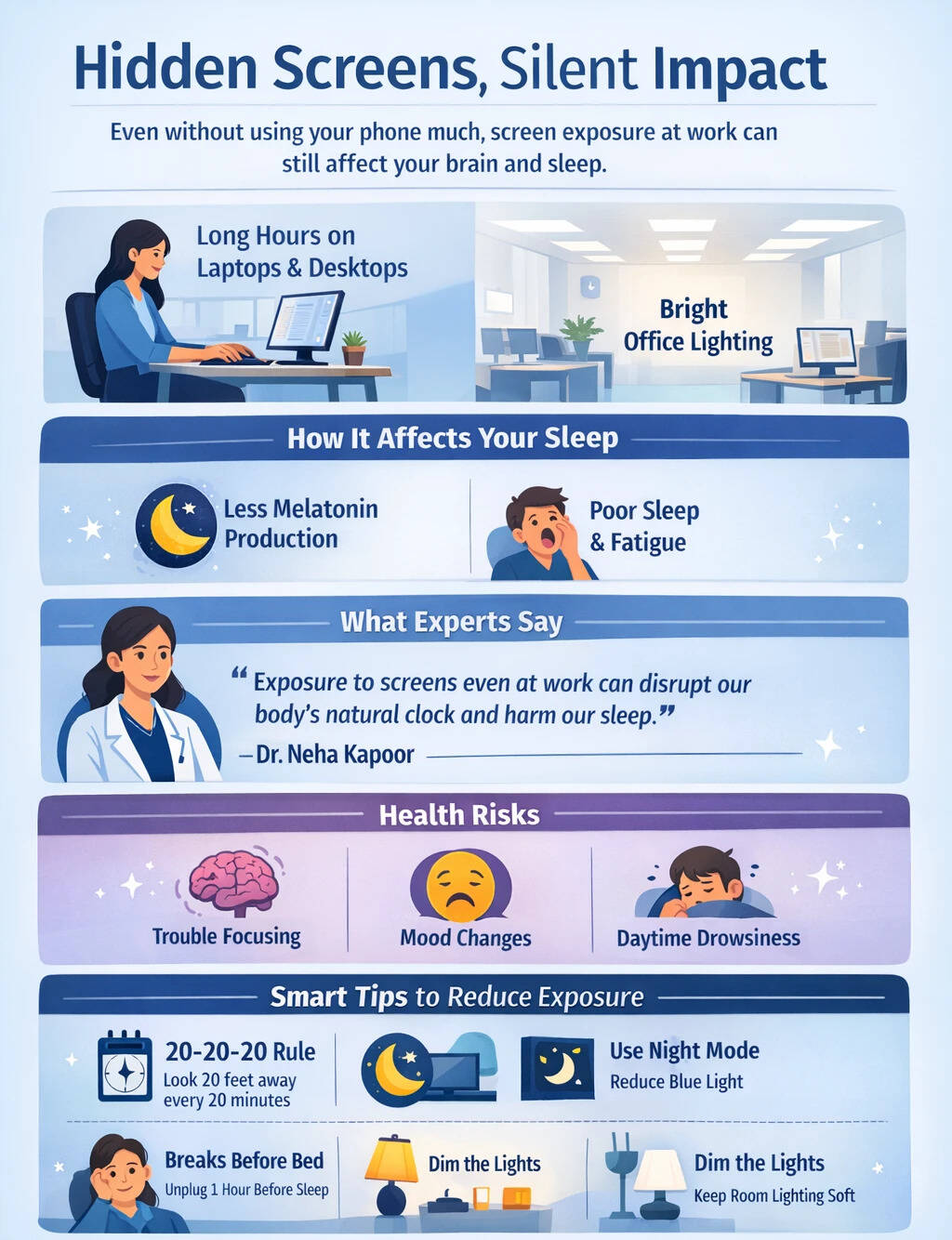
Research from global health bodies supports this link. Simple habits like taking breaks, reducing evening light, and creating screen-free time before bed can help restore natural sleep rhythms.
Practical ways to reduce hidden exposure
Reducing this kind of exposure does not mean quitting work or avoiding screens completely. It means creating boundaries where possible.Start with small shifts:
- Follow the 20-20-20 rule: every 20 minutes, look 20 feet away for 20 seconds
- Lower screen brightness in the evening
- Use warm light settings or night mode after sunset
- Keep a gap of at least 45–60 minutes between screens and sleep
- Dim room lights in the evening instead of using bright white lighting
- Avoid checking emails right before bed
Dr Kapoor puts it simply, “We need to take breaks from screens look away from them every twenty minutes and do things that help us calm down before we go to bed.”The goal is not perfection. It is consistency.
The bigger picture: protecting sleep is protecting the brain
Sleep is often treated as flexible, something that can be adjusted or sacrificed. But the brain treats it as essential.Dr Kapoor emphasizes, “Taking care of our sleep is very important for our brain and mental health in the run. Protecting our sleep is essential, for maintaining term cognitive and mental health…”Even small changes in daily habits can shift how the body responds at night. The difference may not show immediately, but it builds over time.Medical experts consultedThis article includes expert inputs shared with TOI Health by:Dr Neha Kapoor, Associate Director & Head-Neurology, Asian Hospital.Insights were used to explain how hidden screen exposure at work can impact brain function and sleep patterns, and why it is important to recognize these risks and adopt healthier screen habits.
