
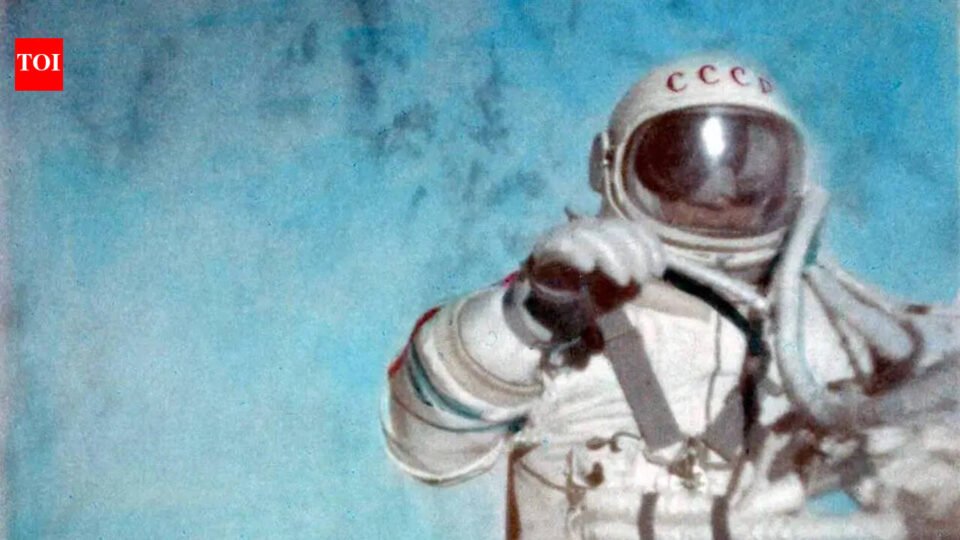
On the 18th of March, 1965, the Soviet Union achieved a historic milestone in the race for space dominance when Alexei Leonov became the first man to ever walk in space. The mission was dubbed the Voskhod 2 mission and was a major milestone in the history of space exploration, with the USSR beating the United States once again in the space race. Leonov stepped out of the spaceship and spent about 12 minutes outside the vessel while attached by a tether. As Leonov recollects the moment, “I floated in space, marvelling at the beauty of the Earth beneath me.” However, the success was marred by an oxygen crisis and a perilous return to Earth that put the human spirit to the test.
‘Oxygen Crisis’ during the spacewalk: Reason for Russia’s defeat
Although Leonov’s spacewalk may be remembered as a success, it was a near-disaster. Leonov’s spacesuit inflated unexpectedly in space, becoming rigid. This made it hard for him to return to the airlock. According to NASA’s archives, “the pressure of the suit gases caused it to balloon. This limited Leonov’s mobility and control.” Leonov’s brave move was to let out some oxygen from his suit to make it smaller. This was despite the risk of decompression sickness. Leonov commented, “I was standing there drenched in sweat… I had to reduce the pressure inside my suit, or I would not get back in” (Leonov, 2004). This brave act saved Leonov’s life. This was a moment of quick thinking. This was a demonstration of the unpredictable dangers faced by space travellers in those days. NASA states, “The technology for Extravehicular Activity (EVA) was still in its experimental stages.” This was a remarkable feat by Leonov.
What happened while returning to Earth
As recorded in the Presidential Library, his challenges did not end when Leonov safely re-entered the spacecraft. When the Voskhod 2 was re-entering the Earth’s atmosphere during the spaceflight, the automatic landing system failed to function properly. The pilot had to manually guide the spacecraft back to Earth, a feat that had never been done before.Instead of landing in a designated area for a safe recovery, the spacecraft landed in the Siberian wilderness, with the cosmonauts being isolated in the midst of a thick forest and freezing temperatures. According to the European Space Agency’s records, the cosmonauts were isolated with wolves around the area and a drastic drop in temperature during the night.
Survival in the Siberian wilderness
Leonov and Belyayev had to endure a stay of almost two days in the wilderness before help could reach them. The two cosmonauts survived by making do with the emergency equipment. Leonov said, “This was a true test of survival after the mission itself had already tested us beyond limits.” The delay in the rescue mission was caused by the fact that the capsule had landed in an unexpected location. A team of rescuers finally managed to reach the cosmonauts by skiing through the forest.
Legacy of the Voskhod 2 mission
The events of 1965 serve as a reminder that space exploration in the early years was as much a matter of survival as it was of scientific progress. Leonov’s spacewalk has opened the doors to modern spacewalks, now a normal feature of International Space Station missions. “Leonov’s spacewalk demonstrated both the possibilities and the risks of human activity in space,” something NASA would later concede. It serves as a reminder of human ingenuity and determination, a triumph not only for the Soviet Union but for space exploration in general.
