
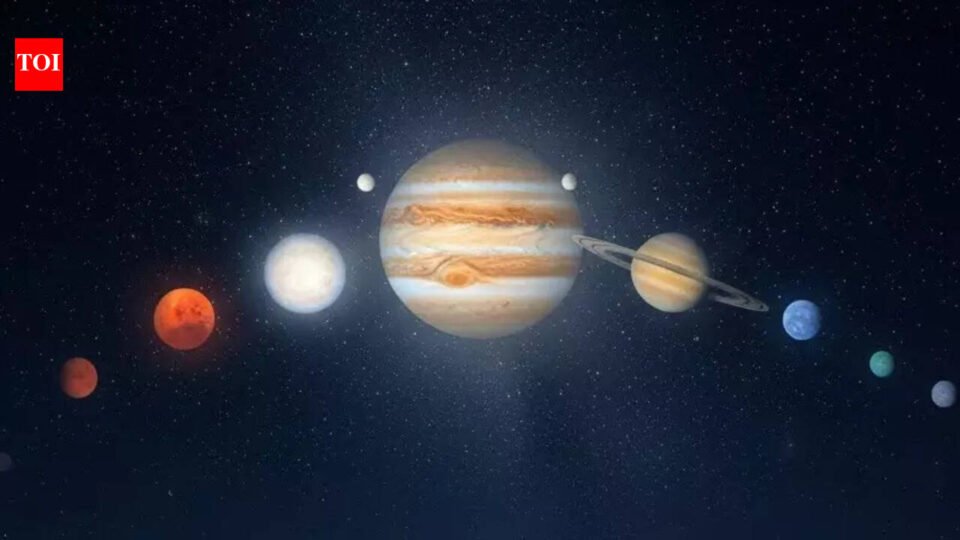
This Ramadan, the heavens offer a gift that requires no telescope, just a clear view of the horizon. On Saturday, February 21, 2026, residents of the UAE are in for a rare treat as six planets align in a “planetary parade” across the night sky. While Dubai’s city lights are famous, the real show will happen far above the skyscrapers, with the Al Qudra Desert serving as the ultimate front-row seat for this astronomical event.
Which planets can you see?
Venus and Jupiter will anchor the show, serving as the easiest planets to find as they shine like brilliant white beacons in the twilight. Mars will be equally recognizable, standing out with its distinct and steady reddish-orange hue that separates it from the flickering stars nearby. While these brighter planets are visible to the naked eye, the “Hidden Giants”—Uranus and Neptune—are tucked much farther away in the depths of the solar system. To glimpse these icy distant worlds, experts recommend bringing a pair of basic binoculars or a small telescope to pull their faint light into view. Adding to the night’s beauty, the Moon will also join the party, perfectly positioned near the alignment to act as a natural guidepost, helping you trace the planets’ path across the sky.
Precise timings across the UAE
While the planets won’t wait for anyone, there is a “golden window” to catch them at their clearest. The parade officially begins shortly after the sun dips below the horizon.
- Between 6:40 PM and 7:30 PM.
- Venus and Jupiter will be the first to “ignite” in the sky as twilight fades.
- At 7:10 PM, the sky will be dark enough to see the fainter planets, but the alignment will still be high enough above the horizon to avoid being blocked by buildings or distant dunes.
- By 8:15 PM, Saturn and Neptune will begin to set in the west, meaning the “full parade” will be over for the night.
Viewing beyond Dubai
You don’t have to be in the Al Qudra desert to enjoy the show. If you are outside of Dubai, here are the prime viewing spots where the “Planetary Parade” will be just as spectacular:
Abu Dhabi (Al Ain): Head to the base of Jebel Hafeet. The elevation provides a crisp, clear view of the eastern horizon, perfect for spotting Mars as it rises.- Sharjah: The Mleiha Archaeological Centre is a designated dark-sky area. They often host specialized astronomy pop-ups during events like this, offering professional telescopes to the public.
Ras Al Khaimah : If you can make the drive, Jebel Jais is arguably the best spot in the entire country. At nearly 2,000 meters above sea level, you are literally above much of the atmospheric haze, making the planets look like sharp diamonds.- Fujairah: The Al Hajar Mountains provide excellent silhouettes for photographers. Just ensure you find a spot with a clear, unobstructed view toward the West.
A planetary alignment occurs when the planets’ orbits bring them to the same side of the Sun from Earth’s perspective. While it looks like they are standing in a line, they are actually millions of miles apart in space, it is simply a beautiful trick of geometry. This specific six-planet parade is considered rare because of the number of planets involved and their high visibility in the northern hemisphere. For many in the UAE, this event is more than just science; it is a moment of reflection and wonder during a holy month dedicated to looking toward the heavens.
