
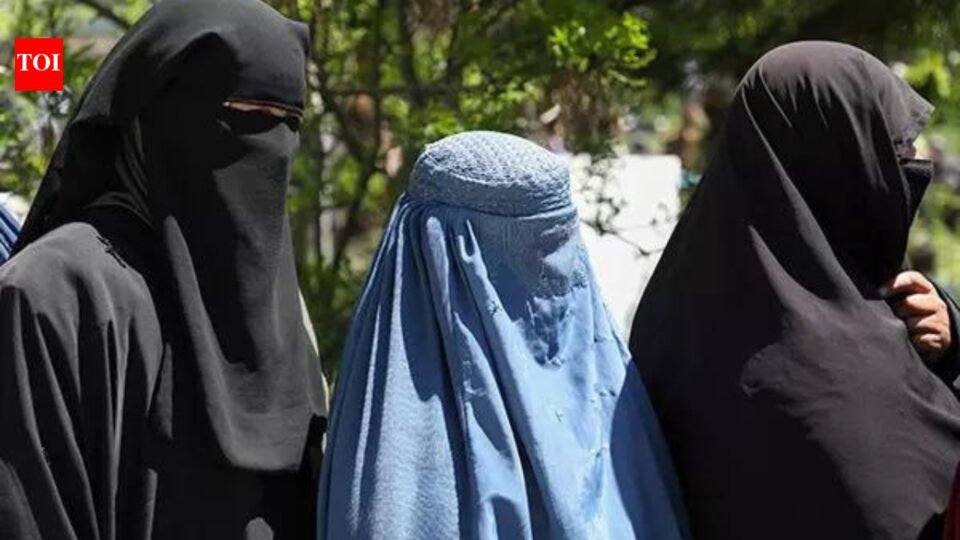
The Taliban has issued a new penal code in Afghanistan that codifies some of its most restrictive practices, raising alarm among rights groups over its impact on women and children.Signed by supreme leader Hibatullah Akhundzada, the 90-page criminal code permits husbands to physically abuse their wives and children, provided it does not cause “broken bones or open wounds.”
Citing Islamic scripture, the 90-page code prescribes different penalties depending on whether an offender is considered “free” or “a slave,” formalising inequality within the justice system, as cited by the Independent. The code does not explicitly prohibit psychological or sexual violence against women, leaving significant gaps in legal protection. Violators face a maximum penalty of 15 days in prison, and only in cases involving what the code describes as “obscene force,” such as visible fractures or serious injuries.Even when abuse meets that threshold, a conviction depends on the wife proving it in court by presenting her injuries to a judge, a process that is nearly impossible under Taliban restrictions. Women are required to remain fully covered in public and must appear in court with a husband or male guardian, even when the alleged abuser is the husband.The regulations also allow a married woman to be jailed for up to three months if she visits relatives without her husband’s permission, including when she is seeking refuge from violence.A legal adviser in Kabul, speaking on condition of anonymity, said that women face an “extremely lengthy and difficult” process to obtain justice for assault under Taliban law.She cited a recent case in which a woman was beaten by a Taliban guard while visiting her husband in prison. When the woman filed a complaint, authorities told her it would not be considered unless she appeared with a male chaperone, her husband, who was incarcerated.The woman responded that if she had been accompanied by a mahram, the guard would not have assaulted her, the legal adviser said. “She cried and shouted in the public that death is better [than the process she is going through],” she was quoted as saying by The Independent. “It is impossible for women to get any justice for an assault that happens to them.”The law effectively treats wives as the “property” of their husbands and removes earlier legal protections, including the Elimination of Violence Against Women (EVAW) law introduced in 2009 under the former US-backed government. That legislation criminalised practices such as forced marriage, rape and other forms of gender-based abuse.Campaigners from the exiled human rights group Rawadari warned that the new penal code legitimises the “abuse, maltreatment, and punishment” of women and children, exposing them to “continued domestic violence.” The group has called for the “immediate halt of the implementation of the criminal procedure code” in Taliban courts, as cited by The Sun.Women’s lives plagued by restrictionsAlmost five years after the Taliban seized power in Afghanistan for the second time, the country’s de facto authorities have issued dozens of decrees stripping women and girls of fundamental rights, from education and employment to freedom of movement and participation in public life.Education bans and early dropoutsGirls are banned from secondary schools and universities, effectively ending formal education for most Afghan girls after grade six. Nearly 30 per cent of girls never begin primary school due to poverty, safety concerns and restrictive social norms, while child marriage is rising as families grapple with economic hardship.Restrictions on work and public lifeWomen are barred from most jobs and public spaces, including parks, gyms and sports clubs. Taliban decrees have also closed off sectors that once employed women, such as civil service roles, NGOs and beauty salons, contributing to one of the world’s largest gender gaps in workforce participation.Healthcare access under strainAccess to healthcare has become increasingly difficult for women, as mobility restrictions and the ban on treatment by male doctors in some areas coincide with a shortage of female health workers. Fear and systemic discrimination continue to prevent many women and girls from receiving essential medical care.
