
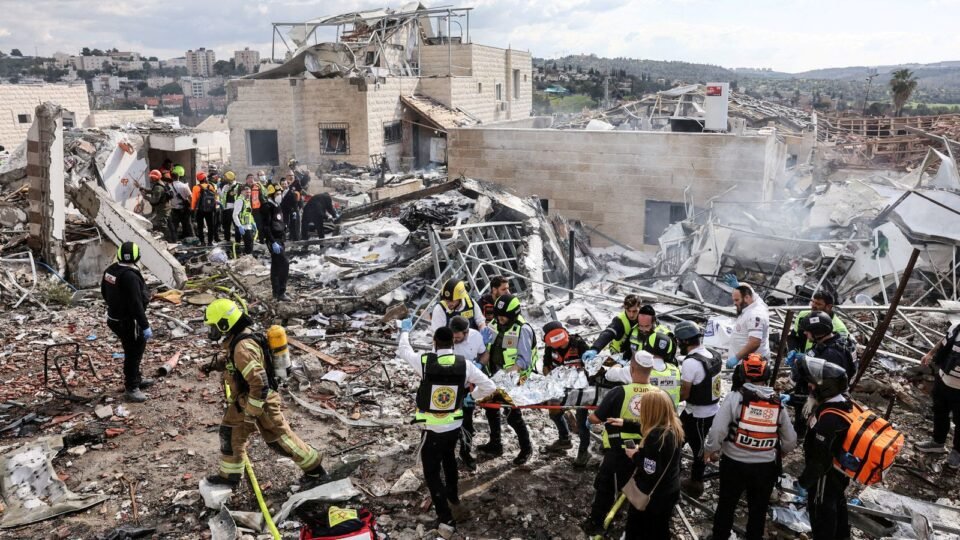
It is an image that will haunt very many people across Israel. A corner of Beit Shemesh, flattened by an Iranian missile; a synagogue destroyed; people killed while they sought refuge in a bomb shelter.
If you wanted proof that war, even this war, is not just about aerial defences and surgical strikes, this was it. A ghastly vista of sudden death.
Live updates on strikes
When we arrived on the scene, we were told, repeatedly, that this was just a place where people lived, prayed and got taught. No military base, no hardware, not even a government office.
“Why would this be a target,” said one person. “There is no excuse.”
What we saw when we arrived was a chaotic aftermath. What we heard was a horror story.
Dozens of residents had gone to the bomb shelter after receiving an alert on their phone and then hearing an air raid siren. It is the sort of behaviour that is, at once, disconcerting and also normal.
Thanks to previous conflicts, including the 12-day war just eight months ago, Israelis are accustomed to getting such warnings.
The shelter was supposed to be their sanctuary. Instead, it became a tomb in a matter of moments.
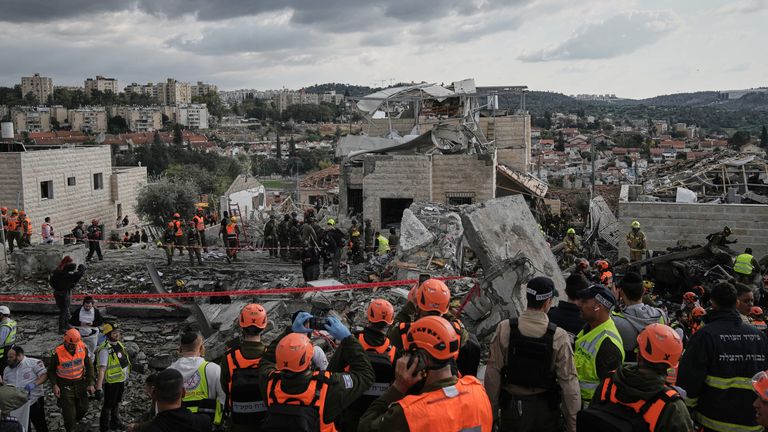
The aftermath of the strike in Beit Shemesh, Israel. Pic: AP
The missile somehow evaded Israel‘s formidable air defences.
“Nothing can be one hundred percent effective,” said one Israeli military official to me. “We cannot stop every single missile. We can try, but we know that eventually one will get through.”
And so it did, devastatingly. We watched as huge diggers were brought in to try to clear the rubble, and as search and rescue teams worked out how to look for survivors. There were soldiers, emergency workers, local residents, police and politicians.
We spoke to one of them, Amichai Eliyahu, Israel’s outspoken culture minister. He was surveying the destruction, his head shaking. This, he said, was an embodiment of why Israel needed to fight Iran.
“What did these people here ever do to them? What did these babies do to harm them?” he said to me.
“They have never done anything bad to Iran, we don’t even share a border with Iran. This was done for no reason at all, except pure hatred for the sake of hatred. So I’m asking all those who defend them in the world, who are you defending? Monsters, Monsters want to kill us.”
Read more:
What we know so far about the strikes
Which Iranian officials are dead?
Attacks close Middle East airports
Lieutenant Colonel Yochay Manoff was more sanguine, when we spoke on a ridge overlooking the scene. He is a company commander in Israel’s National Rescue Unit, accustomed to difficult situations and traumatic problems.
But, for him, this one was difficult to accept.
“Just for reference, this is one missile that hit and affected so many buildings and so many lives,” he told me. “Think about the amount of missiles that were on the way from Iran to Israel over the last two days. The damage could be immense.”
Could be, but hasn’t been. Israel puts so much store by its aerial defence systems that sometimes its citizens can appear complacent, so confident are they in the military technology.
But this was proof that nothing works perfectly, all of the time.
Every now and then a missile will get through the array of defence systems that guard Israel’s airspace, and sometimes they strike with horrific impact. This corner of Beit Shemesh offered grim evidence of that.
