
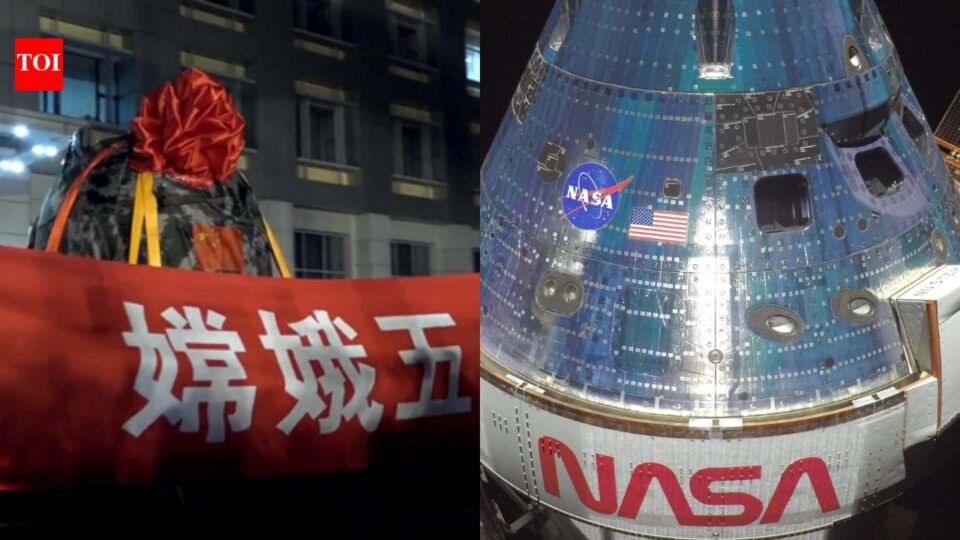
Nowadays, the Moon has become the focus of worldwide aspirations once again, but this time it is not only about exploring but also about occupying it. The recent launch of NASA’s Artemis II has sparked new interest in lunar missions, being the first manned flight to the Moon in more than half a century. Meanwhile, China is actively working on sending its astronauts to the Moon by 2030. Such developments have fueled the current competition between countries, which is viewed by many analysts as the twenty-first-century space race.
NASA Artemis programme and lunar exploration milestones
The Artemis programme of NASA is considered a long-term project that is meant to ensure a sustainable human settlement on the Moon. In particular, ongoing Artemis II, launched on April 1st 2026, successfully brought four astronauts on a historic journey around the Moon, going farther from Earth than any human has done before. It should be noted that NASA claims that Artemis missions are aimed at sending humans to the Moon as well as preparing for Mars exploration in the future.
The mission allowed assessing life support systems and crew performance in deep space, as it can be claimed. Thus, the launch of such missions will allow for the gradual creation of an infrastructure for sustaining life on the Moon.
China’s 2030 crewed Moon landing plan
Conversely, China has embarked upon an audacious goal to deploy its astronauts to the Moon by 2030. As per the China National Space Administration records, in June 2024, China became the first country to recover lunar samples from the moon’s far side after sending the Chang’e-6 spacecraft to the South Pole-Aitken basin.Two more missions, Chang’e-7 and Chang’e-8, will be carried out before 2030 and give Beijing a chance to gather further information on the part of the moon where China hopes to send an astronaut and eventually establish a permanent human presence.The country will be developing advanced technology like Long March-10 rockets, Mengzhou crewed spacecrafts, and Lanyue lunar landing craft, among others, which will enable it to carry astronauts from Earth to the Moon and back to Earth orbit.The Chinese Lunar Exploration Program is built on a long history of robotic exploration. Indeed, its Chang’e missions have scored several achievements, particularly in collecting material from the Moon’s far side, a historic achievement in itself. While these accomplishments do not stand alone, they are part of a larger plan by China to build the International Lunar Research Station (ILRS) by 2035.According to expert opinion, although China does not publicly present its activities in terms of a “space race,” there can be no doubt that it believes in the significance of making technological advancements for strategic purposes. As one analyst puts it, China sees such accomplishments as essential for achieving strategic dominance in space capabilities.
The new space race and global implications
The revival of interest in the lunar surface can be explained by a transition from mere symbolic explorations to sustainable presence and use of available resources on the Moon. While there was a contest between two powers during the Cold War era, now the number of countries involved in lunar explorations is growing steadily and includes even some private companies.In its efforts to promote international collaboration, NASA initiated the Artemis Accords, a set of principles that will govern space exploration activities and guarantee transparency and peaceful use of celestial objects. Simultaneously, China and its partners are working on developing ILRS, which will also provide certain conditions for future collaborations.Thus, this situation indicates that NASA’s recent success has raised the stakes, setting the tone for further interactions and developments related to space exploration. Given that the Moon’s southern pole, according to various sources, has water ice, this area becomes important for future missions.Indeed, while NASA has successfully landed its vehicle on the Moon, China’s target year for lunar landing is 2030, making the coming decade very significant for space exploration.
