


Have you ever felt a strange, almost eerie familiarity in a place you’ve never been to before, as if you’ve stood there at that exact moment, feeling the very same thing, as though it has all happened once before? You turn a corner in a new city, one you know you’re visiting for the first time, and yet the moment feels uncannily known. Or you find yourself in the middle of a conversation that suddenly feels unsettlingly familiar, as though every word has already been spoken and the scene is somehow replaying itself, trapping you in a fleeting loop of experience.And sometimes, this experience is so vivid that you don’t just feel like you’ve been there or done this before, but as if you have already lived the moment at some point in the past and are now stepping into it again, much like a scene from a sci-fi movie.At times, it feels as if memory is playing tricks on us, the present unfolding like a chapter from a past we don’t quite remember, yet we believe a version of it already exists, almost like a glitch in the mind, where you know it shouldn’t be possible, and yet it feels undeniably real. There is an overwhelming sense of having somehow experienced the moment before, a familiarity so strong it feels convincing, yet remains entirely unsupported by reality. Some may even see it as a mystical hint of destiny, though it is just as often dismissed as a curious illusion.When we linger on it, strangely convincing yet completely irrational, we can’t help but wonder how something so momentary can feel so real. Is it a trick of the mind, a brief misfire in the brain, or something more deeply rooted in the way we perceive reality?This fleeting, eerie sensation we know as déjà vu has not just puzzled us for generations, but has also intrigued psychologists and neuroscientists for more than a century, with science now beginning to unravel why it happens.
What is déjà vu, and where does the term come from?
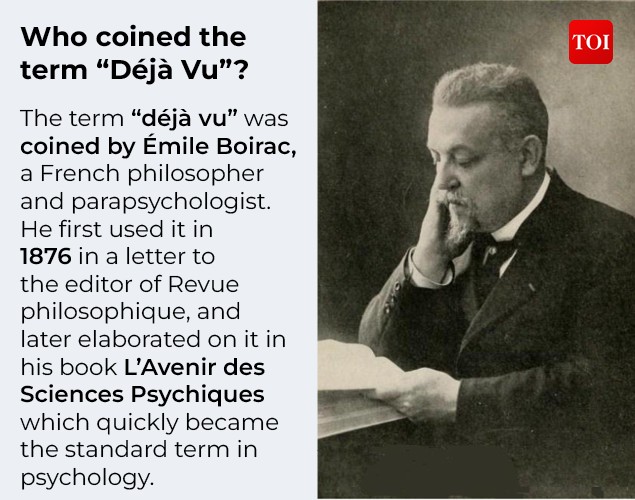
Déjà vu, a French term meaning ‘already seen,’ describes the unsettling sensation of familiarity in a situation that is objectively new. The phrase was first coined by French philosopher Émile Boirac in the late 19th century, who sought to capture this peculiar overlap between memory and perception, describing it as a fleeting sensation of familiarity when encountering something new, an overlap between present experience and past, forgotten experiences.

–
Today, psychologists describe déjà vu as a mismatch within the brain’s memory systems, where a present experience is mistakenly flagged as familiar even when it shouldn’t be. Though common and usually harmless, the experience continues to intrigue researchers for what it reveals about how we process time, memory, and reality itself.
The brain’s mismatch and memory glitch
While déjà vu is often described as a memory glitch, research suggests it may be more complex than a simple replay of the past. A study by Akira R O’Connor and Chris J A Moulin found that déjà vu experiences in healthy individuals do not directly relate to how well people perform on standard memory tests. In other words, those who experience déjà vu more frequently do not necessarily have better or worse memory. Instead, scientists believe the phenomenon arises from a mismatch within the brain, when a sense of familiarity is triggered without any actual memory to support it. One part of the brain signals that something feels known, while another recognises that it shouldn’t be, creating the uncanny sensation associated with déjà vu. Interestingly, the study also found that people who travel more tend to report it more often, suggesting that unfamiliar environments may increase the chances of such mental mismatches.However, the findings also highlight a gap between laboratory memory tests and real-world experience, suggesting that controlled experimental conditions may not fully capture the complexity of how memory operates in everyday life.
A healthy brain at work
Offering deeper insight into the phenomenon, Christopher Moulin, professor of cognitive neuropsychology at Grenoble Alpes University, in conversation with the American Psychological Association’s Speaking of Psychology podcast, suggested that déjà vu may not be a flaw in memory, but evidence of a healthy system at work. On being asked why such experiences occur, he explained that déjà vu acts as a kind of internal “fact-checking” mechanism, a moment where the brain detects a mismatch, something feels familiar, yet we are simultaneously aware that it should not be.
–
Moulin emphasised that this tension, between a strong sense of familiarity and the knowledge that the situation is new, lies at the heart of the experience. Rather than being a simple memory error, it reflects our brain’s ability to monitor and question its own processes, a function psychologists refer to as metacognition.He also pointed out that déjà vu is often unpredictable, appearing suddenly in everyday situations, from conversations to unfamiliar places, making it difficult to study in controlled settings. However, patterns do emerge: the sensation is reported more frequently by younger people and tends to occur during periods of fatigue, stress, or while travelling, suggesting that novelty and cognitive load may increase the chances of such mental mismatches.Interestingly, Moulin notes that as people age, they tend to experience déjà vu less often, not necessarily because memory improves, but because their relationship with memory changes. Older individuals may be less certain about whether something has happened before, making them less likely to register the sharp conflict that defines déjà vu.
Medical conditions that can aggravate Déjà Vu
Déjà vu is typically harmless in healthy individuals, but certain medical conditions can trigger or intensify it. Most notably, temporal lobe epilepsy is well-documented for causing déjà vu, often occurring just before a seizure. Migraines with aura have also been associated with increased experiences of déjà vu, indicating overlapping neural pathways involved in sensory processing and memory
Scientific theories that may explain Déjà Vu
One of the most widely discussed explanations for déjà vu is the memory-based theory. As noted by Alan S. Brown (2003, 2004), déjà vu can occur when the brain senses a feeling of familiarity without a corresponding conscious memory. In other words, certain cues in the environment or conversation may trigger implicit memories, those we cannot consciously recall, leading the mind to mistakenly interpret the moment as something already experienced. This theory captures the classic “I’ve been here before” sensation that is so eerily convincing, yet entirely unsupported by reality.Another perspective, known as the dual-processing theory, suggests that déjà vu occurs when two cognitive processes that usually work in harmony temporarily fall out of sync. Neurologist Robert Efron proposed a physiological basis for this: the brain sometimes receives the same signal twice with a millisecond delay, creating a sense of reliving the experience. In practical terms, information traveling along separate neural pathways can reach conscious awareness at slightly different times, so seeing a new place via a fast, unconscious pathway may trigger a feeling of familiarity before the slower, conscious pathway confirms it is actually new. Brown (2003, 2004) highlights this as one of the key cognitive explanations for the phenomenon.The neurological theory offers a more physiological explanation. Brief misfires in neural circuits, particularly in the temporal lobes and the hippocampus, the brain’s memory hub, can create the illusion of familiarity. Individuals with epilepsy, for instance, often experience déjà vu just before a seizure, highlighting how disrupted brain activity can induce this sensation. Even in healthy brains, subtle disruptions in neural transmission may momentarily trick the mind into “remembering” something it has never truly experienced (Brown, 2003, 2004).Finally, attentional theory emphasizes the role of focus and awareness. Déjà vu can occur when an initial momentary lapse of attention prevents the brain from fully registering an experience, only for it to be noticed moments later. This delayed recognition produces a sense of repetition or familiarity, as if the mind is saying, “I’ve seen this before,” even though the situation is new. Brown (2003, 2004) identifies this attentional mechanism as another explanation for why déjà vu feels so convincingly real.Taken together, these theories suggest that déjà vu is not a single, simple glitch, but rather a complex interplay of memory, perception, attention, and neural processing. While researchers like Alan S. Brown (2003, 2004) have categorized the phenomenon into these four broad explanations, ongoing studies by cognitive scientists such as Chris Moulin are exploring how familiarity detection, conflict monitoring, and metacognitive awareness contribute to this strange and fleeting experience.
The Déjà Vu-premonition connection
Recent research has also highlighted a link between déjà vu and the sensation of prediction. In a laboratory study, Anne M. Cleary and colleagues (2018) found that participants often experienced stronger feelings of “premonition” during moments of déjà vu, even though they had no actual ability to predict outcomes. The study showed that déjà vu accompanied by this predictive feeling was associated with a higher intensity of familiarity, suggesting that the strength of the familiarity itself may fuel the illusion of having foreseen an event. While not every instance of déjà vu involves a sense of prediction, Cleary et al. revealed that this connection accounts for just over half of reported déjà vu experiences, further illustrating the complex interplay between memory, perception, and consciousness in these fleeting yet compelling moments.
How your brain tricks you
Dr. Akira O’Connor, a Professor in School of Psychology and Neuroscience at St Andrews University, in conversation with BBC Bitesize, explained that déjà vu arises from an interplay between different brain regions. “There’s a part of the brain in the medial temporal lobe… that is associated with laying down memories and giving you the feeling of remembering things,” he revealed. During déjà vu, this area can trigger a false sensation of familiarity, which is then evaluated by the frontal cortex, the brain’s higher-order cognition center responsible for reasoning and fact-checking. Once the frontal cortex determines that the experience is unlikely to have occurred before, the brain recognizes the sensation as an error, completing the déjà vu cycle.O’Connor also noted that the frequency of déjà vu varies with age. Children as young as five begin reporting the experience, which peaks in early adulthood before gradually declining in middle age. Far from being a flaw, experiencing déjà vu may signal that the brain’s fact-checking mechanisms are functioning properly. “On the whole, I would say it’s a sign of a good, healthy brain and mind,” O’Connor stated.In addition, he discussed jamais vu, the opposite of déjà vu, where familiar situations or words suddenly seem strange or unfamiliar. His 2023 research, recognized with an Ig Nobel Prize, demonstrated that repetition of commonly used words can induce this sensation, particularly for words like “the” that are highly familiar. This highlights how the brain’s processing of familiarity and novelty can create subtle, fascinating memory illusions.As Tennessee Williams famously illustrates in his memory play The Glass Menagerie, memory is a slippery, selective construct. The play’s narrator, Tom, admits that he shapes and reshapes the past, blurring fact and feeling: “Memory is unreliable,” he confesses, a reminder that our recollections, and the familiarity they trigger, are often more a constructed impression than reality. Déjà vu taps into that same tension that the mind insists a moment is known, yet rationally we recognize it cannot be. Just as Tom reconstructs his own past, our brains can momentarily misattribute familiarity to the present, creating the eerie sensation of having “already lived” a moment. In the end, the experience of déjà vu isn’t merely a quirk of cognition but a complex phenomenon that offers a window into the mysterious, sometimes unreliable workings of memory, perception, and familiarity. How these processes unfold can vary from person to person, making the phenomenon fascinating both in terms of our lived experience and the intricate workings of the brain.
