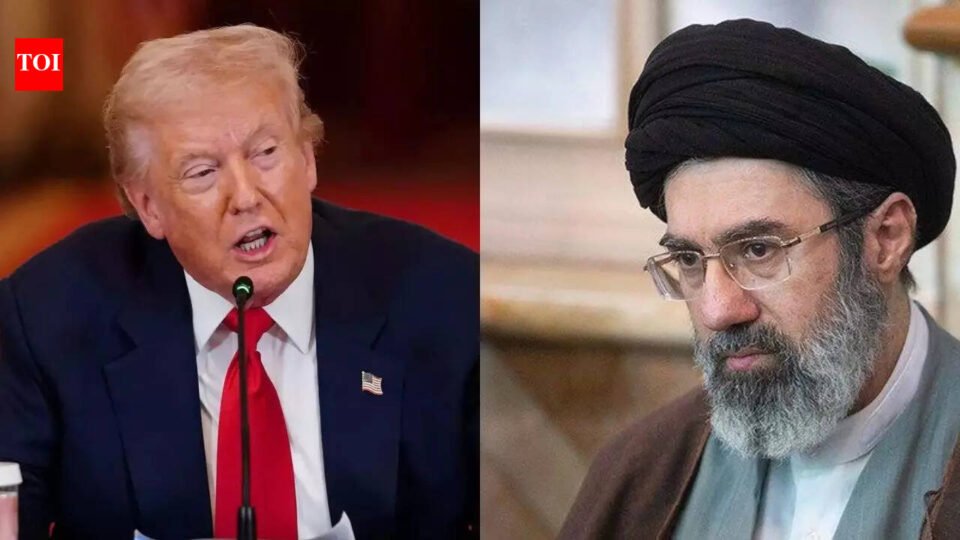
On the war’s 19th day, the numbers still flatter the US and Israel. More Iranian officials are dead. More launchers are wrecked. More command nodes have been hit. Israel says it has penetrated deep into Iran’s security structure and is now going after the machinery that keeps the Islamic Republic in power at home as well as abroad. From the air, it looks like the operation “Epic Fury” is going on in “cruise control” mode.Driving the newsAnd yet wars have a way of humiliating arithmetic.The war is no longer just a US-Israeli air campaign against Iran. It is now a broader regional confrontation touching Lebanon, the Gulf, global shipping and energy markets.That matters because the core question has shifted. The issue is no longer whether the US and Israel have inflicted severe damage. They plainly have. The question now is whether President Donald Trump can turn that military dominance into a political outcome that looks like victory – or whether Iran is succeeding in making the war longer, wider and more costly than Trump expected.
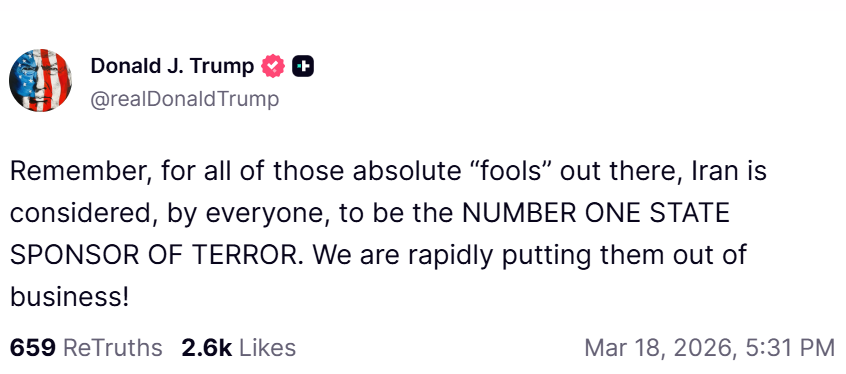
Why it mattersOn the battlefield, Trump has a case. Iran’s top leadership, including Supreme Leader Ayatollah Ali Khamenei, was obliterated on Day 1. Since then, US-Israeli forces have killed many other important political and military figures too. Israel and the US have degraded Iranian military infrastructure, targeted the internal security forces that suppress dissent, and pushed Tehran onto the defensive.But wars are not scored only by body counts, destroyed launchers or command bunkers. They are also scored by endurance, economic pain, alliance cohesion and the ability to shape the terms of peace.That is where Trump’s position looks shakier.Reuters reported that the Strait of Hormuz remains largely closed, that oil prices are up around 45% since the war began on February 28, and that Gulf Arab states have been hit by more than 2,000 missile and drone attacks on US diplomatic missions, military bases, oil infrastructure, ports, airports and residential buildings. Reuters also cited the International Energy Agency saying the conflict has caused the worst oil crisis since the 1970s. Global airlines, Reuters reported, have warned of soaring fuel costs, higher fares and route cuts.Those are not side effects. They are central to Iran’s strategy.According to an FT analysis by Emile Hokayem, Iran “has taken a beating” but still retains three major advantages: “geography, time and asymmetry.” The FT’s argument is that Tehran does not need to win conventionally. It only needs to impose enough cost on everyone else to turn apparent military success into strategic ambiguity.That is the danger for Trump. He may be winning the opening phase of the war while losing the ability to define its ending.Between the linesPolitico reported that Trump has been enraged by the refusal of many allies to join the effort to restore shipping through Hormuz. After publicly pressing allies for help, he swung back to insisting he never needed them in the first place. “Because of the fact that we have had such Military Success, we no longer ‘need,’ or desire, the NATO Countries’ assistance – WE NEVER DID!” he wrote on Truth Social, “WE DO NOT NEED THE HELP OF ANYONE!”That rhetorical reversal matters. It suggests Trump is confronting one of the central limits of his Iran campaign: the US can dominate the skies and still struggle to assemble a coalition for the consequences.Politico reported that Germany’s defense minister said, “We did not start this war,” while Luxembourg’s deputy prime minister described Trump’s push for European help as “blackmail.” British Prime Minister Keir Starmer said the UK “will not be drawn into a wider war,” according to Politico. Sen Lindsey Graham, after speaking with Trump, wrote on X that he had “never heard him so angry in my life.”Trump’s problem is not only Iran. It is also the optics of isolation. If Washington cannot persuade allies to share the burden, the war starts to look less like a coalition campaign and more like a unilateral gamble with global costs.The big pictureThe most persuasive argument that the war may be backfiring on Trump comes from Foreign Affairs, where Nate Swanson wrote that “Trump likely wants to declare victory soon,” but “he cannot force surrender on a government that refuses it.” In Swanson’s telling, the war’s first phase has badly damaged Iran, but the second phase may still favor Tehran because the regime has incentives and enough residual capability to sustain a war of attrition.That is the strategic paradox. Trump and Netanyahu may have destroyed much of Iran’s immediate capacity. But unless they can force capitulation, install a new deterrent order or engineer a stable ceasefire, Iran can still shape the peace by refusing to lose on Washington’s timetable.Swanson’s central point in Foreign Affairs is that Tehran does not need daily military success. It only needs to keep regional partners, global markets and the American public nervous. A few drone attacks on tankers, enough missile strikes to keep Gulf states on edge, and enough disruption in Hormuz to keep oil elevated may be sufficient to turn Trump’s “little excursion” into a politically draining war with no clean off-ramp.The FT makes a similar case from a more operational angle. Hokayem argues that “good strategy is the alignment of ends and means,” and by that standard, “the Iranians haven’t done badly.” Tehran, in the FT’s view, has sensibly prioritized vulnerable regional targets and energy chokepoints over trying to break Israel directly. For Iran, success is not conquering territory. It is keeping everyone else off balance.There is another way the war may be backfiring. In Foreign Affairs, Akbar Ganji argued that the assassination of Ali Khamenei and wartime pressure from the US and Israel may have solved Iran’s succession crisis in favor of Mojtaba Khamenei. Ganji wrote that Trump’s interventions and Israeli threats made Mojtaba “the only viable option for regime survival.” In other words, a campaign partly justified as a blow against the regime may also have hardened it.Zoom inIsrael’s hope, according to a New York Times report by Adam Rasgon, Ronen Bergman and David M Halbfinger, is that strikes on the Basij, the Ministry of Intelligence and other coercive institutions can weaken the regime enough to open space for a popular uprising.That is one of the biggest unresolved bets in this war.The New York Times reported that some former Israeli officials think the strategy is unrealistic because Iran’s internal security services remain deeply entrenched. Vali Nasr told the Times, “There’s enormous hatred of the Islamic republic,” but also “considerable hatred of the United States and Israel and considerable worry about the future of the country itself.”That gets to the central political reality inside Iran. Many Iranians may despise the regime and still refuse to rise up while under foreign bombardment. National humiliation can unify even fractured societies. War can suppress dissent as effectively as repression can.If that is true, then the regime-change theory behind part of the Israeli and US strategy is weak. And if regime change is not coming, Trump is left with a narrower set of choices: keep bombing, negotiate a cease-fire, or accept a murky partial victory.What next: Trump now faces a scoreboard that cuts in two directionsOn one side, the US and Israel are clearly ahead militarily. Iran’s leadership has been decapitated. Its security apparatus has taken severe hits. Its missile operations are under pressure. Its proxies are being pulled into a fight from a position of weakness, not strength.On the other side, Iran may still be doing enough to deny Trump the one outcome he most wants: a quick, unmistakable victory that reinforces deterrence, calms markets and proves his judgment.So, who is winning so far?In an opinion piece for the Greek newspaper eKathimerini, Endy Zemenides aptly described Operation Epic Fury as an “Epic Failure.”The honest answer is this: Trump is winning the war’s first chapter. Iran may still be writing the ending.That is why the war is not clearly backfiring on Trump in military terms. But in strategic, diplomatic and economic terms, the warning lights are flashing. If the conflict drags on, keeps oil high, leaves Hormuz contested and shows Trump unable to rally allies or force Tehran to fold, the question will stop being whether the war is backfiring.It will be how much.(With inputs from agencies)
