
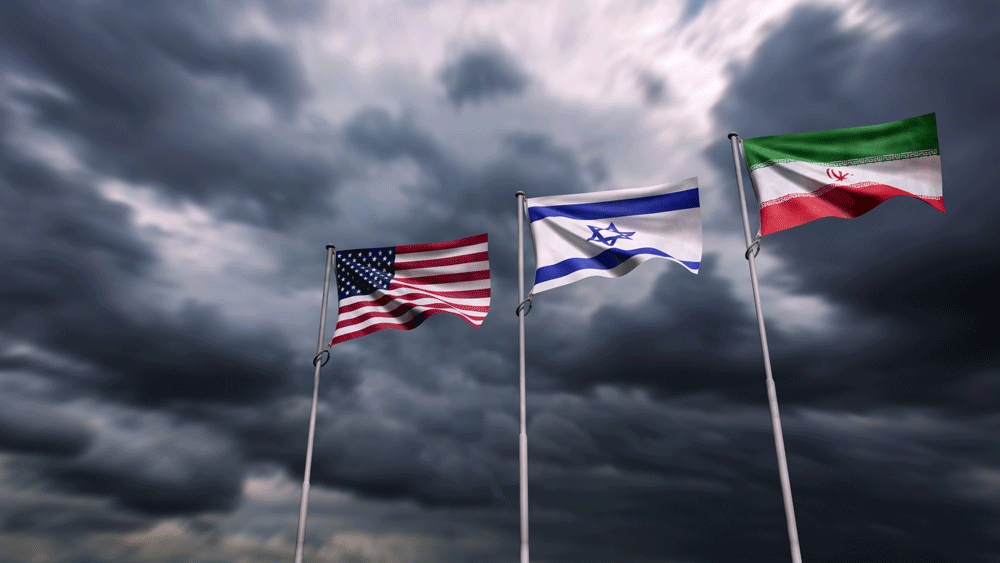
Senior official says Iran views economic pressure as a crucial factor in bringing the war to an end
A senior Iranian official has said that Iran is committed to the war and that negotiations need economic pressure to ensure the US and Israel end the conflict.
“What is important for us is the end of this game, and we are ready to continue that game,” said Kamal Kharazi, foreign policy adviser to the office of the Supreme Leader, in an interview with CNN.
Kharazi also said that Iran is not ready to negotiate an end to the hostilities, which are now in their third week. “I don’t see any room for diplomacy anymore, because Donald Trump has been deceiving others and not keeping his promises,” said Kharazi when asked about the possibility of a negotiated ceasefire.
A key part of Iran’s strategy is to disrupt the global economy so that the US and Israel are forced to end their military campaign. “There’s no room [for negotiations] unless the economic pressure is built up to the extent that other countries would intervene to guarantee this termination of aggression of Americans and Israelis against Iran,” he added.
Ongoing war
Iran also says that it remains capable of continuing the war. Responding to a question about the US saying it has drastically degraded Iran’s military capabilities, Kharazi said: “That is one of the false narratives that the United States government is producing. Iranian military is quite strong, as you see, because they have the motivation, they have the arms that they need, which are produced in Iran.”
In a post on social media platform Truth Social on 15 March, US President Donald Trump highlighted the damage done to Iran’s economy and military and stressed the need for other countries to act to limit the global economic impact of the conflict.
“The United States of America has beaten and completely decimated Iran, both Militarily, Economically, and in every other way, but the Countries of the World that receive Oil through the Hormuz Strait must take care of that passage, and we will help — A LOT! The U.S. will also coordinate with those Countries so that everything goes quickly, smoothly, and well. This should have always been a team effort, and now it will be — It will bring the World together toward Harmony, Security, and Everlasting Peace!”
The main way that Iran has disrupted the global economy is by forcing a spike in oil prices by effectively closing the Strait of Hormuz. The UKMTO, a UK-operated maritime security information service, says that it has received 20 incident reports affecting vessels operating in and around the Gulf, the Strait of Hormuz and the Gulf of Oman since the conflict began on 28 February and 12 March. The majority of reports related to attacks, with 16 incidents classified as attacks and four logged as suspicious activity, underscoring ongoing security risks for commercial shipping in the region.
The disruption to shipping has driven the price of Brent crude to over $100 a barrel, its highest levels since Russia’s invasion of Ukraine, when prices reached $119 a barrel. To help cool oil prices, the International Energy Agency has announced a record-setting release of 400 million barrels of oil from emergency strategic petroleum reserves.
In addition to closing the Strait of Hormuz, Iran has also attacked oil and gas infrastructure across the Gulf to further hamper energy exports from the region and damage the economies of the GCC countries.
Global travel
Iran has disrupted global aviation with attacks on international airports across the GCC. Dubai International airport was most recently attacked on 16 March. In a statement on X.com, the Dubai Media Office said: “Dubai Civil Aviation Authority announces the temporary suspension of flights at Dubai International Airport as a precautionary measure to ensure the safety of all passengers and staff.”
It added that some flights were diverted to Al-Maktoum International Airport (DWC).
Economic pressure has also been applied to Dubai with attacks on Dubai International Financial Centre, as well as attacks on port facilities.
The tourism sector across the Middle East has also been impacted. According to the latest analysis from the World Travel & Tourism Council, the conflict is costing the Middle East’s travel and tourism sector at least $600m a day in lost international visitor spending.
