
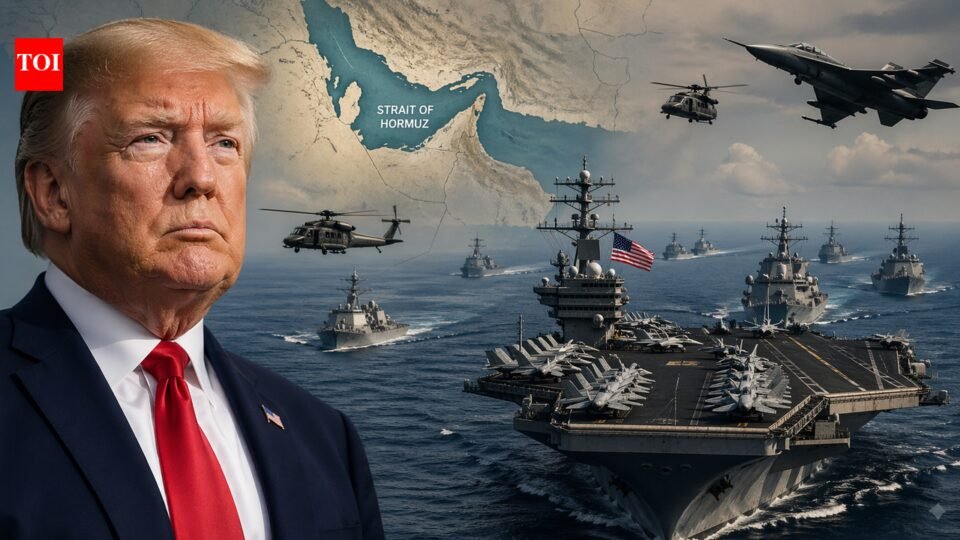
US President Donald Trump has extended the fragile ceasefire with Iran, but fresh military deployments to the Middle East are raising new questions over whether Washington is preparing for a possible escalation if diplomacy collapses.Even as Trump announced he would prolong the truce until talks are concluded, reports from the Financial Times and other outlets said the US is moving major naval and ground assets into the region, including the aircraft carrier USS George HW Bush, additional destroyers, amphibious assault groups and thousands of troops trained for rapid-entry operations.
The simultaneous pursuit of diplomacy and military reinforcement has fuelled speculation that Trump is preserving the option of military pressure, including limited ground action, if Iran refuses new terms on nuclear activity, maritime access or regional security.
Ceasefire extended, but pressure remains
Trump said he had directed the US military to remain ready while extending the ceasefire after mediation efforts involving Pakistan. He said the pause would continue until Iran submits a proposal and discussions are completed.However, the ceasefire extension came only hours after Trump reportedly said he had expected renewed bombing and that US forces were ready to act if negotiations failed.That contradiction reflects the broader US strategy now taking shape: offer diplomacy publicly while building overwhelming force privately.
USS George HW Bush heads to region
According to the Financial Times, the USS George HW Bush is heading toward the Middle East alongside three destroyers. If fully deployed, it would create a third US carrier strike group in or near the theatre and bring roughly 5,000 more personnel.Such a concentration of naval power would mark the largest US maritime build-up in the region since the 2003 Iraq War.Aircraft carriers provide the ability to launch sustained airstrikes, enforce sea control, defend shipping lanes and support amphibious operations. Their arrival significantly broadens Trump’s military options if the ceasefire breaks down.
10,000 additional troops and Marine units moving in
Alongside the carrier group, the Pentagon is reportedly deploying about 10,000 troops specially trained for expeditionary operations.These include Marine Expeditionary Units, among the most flexible rapid-response formations in the US military. The Financial Times reported that approximately 3,500 sailors and Marines, including members of the 31st Marine Expeditionary Unit, had already arrived aboard the amphibious assault ship USS Tripoli and accompanying vessels.
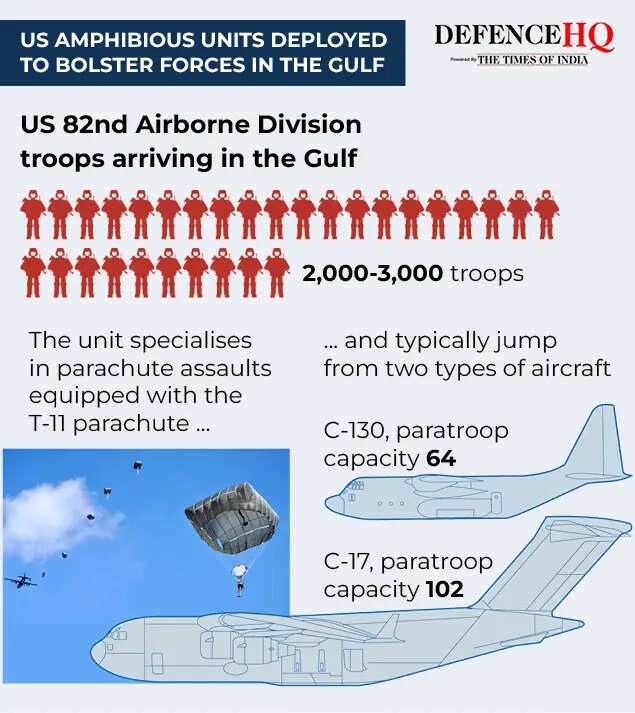
Another 4,500 Marines and sailors, including the 11th Marine Expeditionary Unit, are reportedly en route aboard the USS Boxer Amphibious Ready Group.The Pentagon has also reportedly ordered up to 3,000 troops from the 82nd Airborne Division to the region.These forces are designed for fast insertion by sea or air, seizure of terrain, evacuation missions, raids, and limited-duration combat operations.
Is Trump considering boots on the ground?
The scale and type of US deployments have intensified speculation that President Donald Trump wants to preserve a ground-war option against Iran if ceasefire talks collapse. While there is no public confirmation of an invasion plan, the forces now moving into the region are not limited to defensive naval assets. They include Marine Expeditionary Units, amphibious assault ships and elements of the 82nd Airborne Division, all formations designed for rapid deployment, seizure of terrain and short-notice coambat missions.Military analysts say these troop movements suggest Washington wants a broader menu of options beyond airstrikes and naval pressure. Those options could include securing strategic islands near the Strait of Hormuz, raiding missile launch sites, evacuating US personnel, rescuing hostages, or conducting limited-duration operations against coastal infrastructure tied to Iranian military activity.
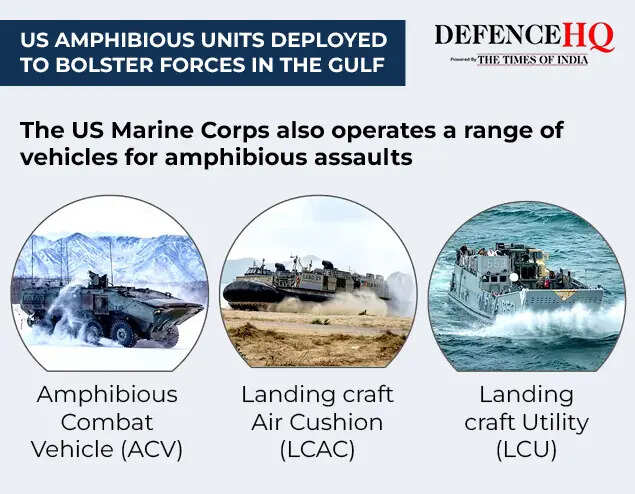
The arrival of amphibious groups led by the USS Boxer and USS Tripoli is especially significant. These ships can launch helicopters, tilt-rotor aircraft, landing craft and Marines directly onto shorelines, giving the White House a fast strike or occupation capability without relying immediately on regional bases. The deployment of airborne troops provides a second route, allowing rapid insertion by transport aircraft into selected targets.Former senior commanders have suggested such deployments are often about leverage as much as warfighting. By assembling credible ground forces, Trump can pressure Tehran in negotiations while signalling that the US is prepared to escalate if necessary. This fits his broader strategy of using maximum pressure to force concessions while keeping adversaries uncertain about his next move.However, a full-scale invasion of Iran would be vastly more complex than limited operations in smaller states. Iran’s size, terrain, missile arsenal and decentralised military structure would make any occupation costly and risky. US troops on the ground would immediately become targets for drones, ballistic missiles, artillery and proxy attacks. Protecting them would require major air cover, logistics, intelligence and reinforcement capacity.That means the more realistic scenario, if Trump chooses escalation, is not a conventional invasion but a limited boots-on-the-ground mission with tightly defined objectives. Even then, the political and military risks would be substantial, especially if casualties mount or the operation expands beyond its original scope.
Why the Strait of Hormuz matters
A key flashpoint remains the Strait of Hormuz, through which a major share of the world’s oil and gas shipments pass.Iran has used the strait as leverage during past crises, while Washington wants uninterrupted maritime traffic. US amphibious and airborne forces could theoretically be used to secure islands or positions affecting the waterway.But experts caution that even if the US seized coastal points or islands, Iran could still launch missiles or drones from inland positions.That means boots on the ground may not guarantee control of the strait, while exposing US troops to sustained attack.
Iran signals readiness
Iranian officials have publicly rejected threats and signalled they are prepared if fighting resumes.Senior figures in Tehran have said the country has “new cards on the battlefield,” while Foreign Minister Abbas Araghchi said Iran does not fear a US ground invasion.Iran’s military doctrine relies heavily on layered defence, missile forces, drones, naval harassment tactics and decentralised units of the Islamic Revolutionary Guard Corps.Analysts note that unlike Iraq in 2003, Iran is larger, more mountainous, more populous and has spent decades preparing for a potential US confrontation.
Missile stockpiles add another pressure point
Even as forces move in, questions are growing about how long the US can sustain a larger war.A recent analysis by the Center for Strategic and International Studies, cited by CNN, said the US has significantly depleted several missile stockpiles during the Iran conflict.The report estimated that Washington has used at least 45% of its Precision Strike Missiles, around half its THAAD interceptors and nearly 50% of Patriot air defence missiles. It also cited substantial use of Tomahawk, JASSM, SM-3 and SM-6 missiles.Mark Cancian, one of the report’s authors, warned that high munitions expenditure has created “a window of increased vulnerability in the western Pacific.”That matters because any prolonged Middle East war could weaken US readiness for a future crisis involving China.Trump now faces a difficult balancing act. Domestically, he has long campaigned against costly foreign wars. Strategically, he wants Iran to accept limits on nuclear enrichment, reopen maritime routes and reduce regional threats.Deploying forces may help pressure Tehran without immediate combat. But once assets are in place, the risk of mission creep rises sharply.Even a limited landing operation could require air superiority, logistics chains, casualty evacuation plans and constant force protection. Any US casualties could rapidly shift domestic political opinion.
What happens next?
For now, the ceasefire holds, but only narrowly. Diplomacy continues, military assets keep moving, and both sides appear to be preparing for either talks or renewed conflict.Trump’s latest move suggests he wants maximum leverage: negotiate from a position of strength while keeping military options on the table.Whether that remains a bluff or becomes boots on the ground may depend on what happens when ceasefire talks end in coming days.
