
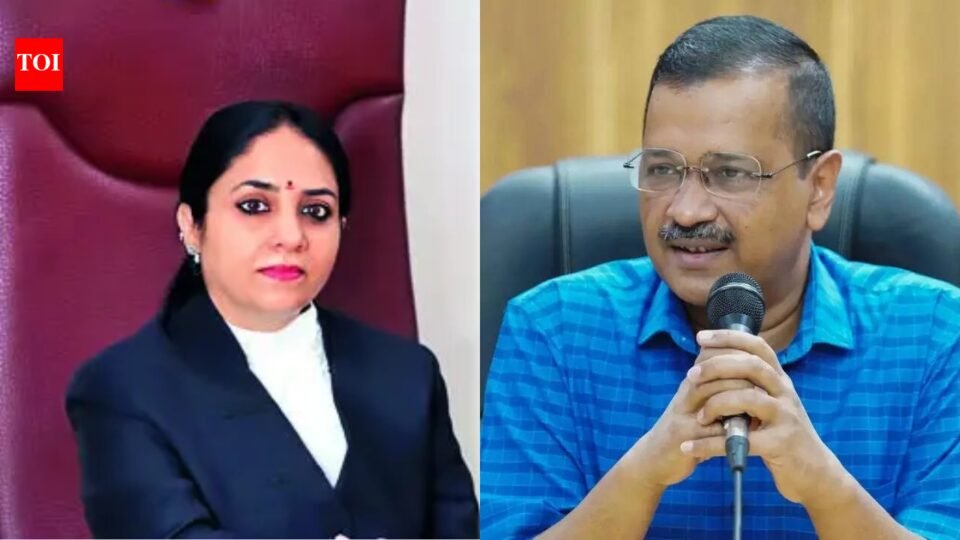
NEW DELHI: A politician can’t be allowed to judge judicial competence merely based on “personal perception”, the Delhi high court said on Monday, dismissing petitions by AAP netas seeking recusal of Justice Swarana Kanta Sharma in the liquor policy case.“This court will stand up for itself and institution…. I will not recuse,” the judge said, as she read out parts of the order from the dais itself for over an hour, taking a pause only when video links went down briefly. After the video link was re-established, she explained in Hindi key points from her verdict, including why recusing from the case would set a “disturbing precedent” as a “judge can’t recuse to satisfy a litigant’s unfounded suspicion”.The HC was clear that the courtroom cannot become a “theatre of perception” and underlined that competence “of a judge is decided by the higher court, not the litigant…a politician cannot be permitted to cross the boundary and cannot judge judicial competence…A litigant may not always be successful, and only higher court can determine whether judgment is contrary or one sided. General unease of litigant that this court may not grant relief, that can’t be a ground to allege bias against the judge”. Rebutting points raised by ex-CM Arvind Kejriwal and others in their plea for her recusal, Justice Sharma said if she were to agree to their demand, it “would be an act of surrender and a signal that institution, including the judge and the court, can be bent, shaken and changed”, adding that the file seeking her recusal “did not arrive with evidence but it arrived on my table with aspersions, insinuations and doubts cast on my integrity”. Terming it a “defining moment for the court”, the judge stressed that a “litigant cannot be permitted to create a situation that lowers the judicial process. A lie, even if repeated a thousand times in court or on social media, does not become the truth”. Justice Sharma said a judge can’t be “intimidated by a litigant” while noting that personal attacks on a judge “are attacks on institution itself…. threat would travel to higher courts but also to district courts…Today, it is this court; tomorrow it will be another court.” The HC also pointed out that Kejriwal by seeking her recusal had created a “catch-22” situation for the court and a “win-win situation” for himself. Even if opted out, it would seem to validate the allegations; if she hears the matter, the outcome could still be questioned, HC noted, making it clear the court will not bend to a “media-driven narrative”. The judge highlighted that none of the allegations raised by Kejriwal had any material to substantiate claims of bias, including those relating to her participation in events organised by the Adhivakta Parishad or the professional engagements of her family members. “Speakers were invited to speak on legal issues. In the past, many judges of this country have been participating in them. Merely because I was invited to deliver lecture, cannot be basis to insinuate political bias. How can anyone say that just because I attended an event of some lawyers’ organisation, my mind must have been closed that I will not decide the cases fairly. The applicant (Kejriwal) has selectively placed on record events of Adhivakta Parishad. This court routinely attends functions of NLUs, colleges, hospitals, lawyers forums, etc.” Justice Sharma added that “relationship between Bar and bench is not confined only to courtrooms. It is not uncommon for Bar associations to organise functions”, which can’t be “curtailed” based on a litigants’ perception. Justice Sharma also gave instances involving AAP netas being granted interim relief at the first hearing or without awaiting the stand of the probe agency. “A judicial practice accepted without objection when the order is in favour of a party cannot be objected to when it goes against them,” HC observed, cautioning that accepting such grounds for recusal would have “deeper constitutional ramifications” and could erode public confidence in the judiciary as it would not be justice administered but “justice managed”. The judge also dealt with the issue of her relatives practising on central govt panels. “Even if relatives are empanelled on govt panels, the litigant has to show relevance and impact on this case. No such nexus has been shown. Their empanelment or relationship has no connection with this dispute,” the court said. Justice Sharma emphasised that a “litigant can’t dictate how children of judge have to live their lives, in absence of any proof that office of judge was misused”. She pointed out if “children of politicians can enter politics, how will it be fair to question when children or family of judge enter legal profession and struggle and prove themselves like others…Relatives of this court have no connection with this dispute…if such allegation is accepted, then the court will not be able to hear any matter in which Union of India is a party.” The HC will now hear the matter next on April 29.
