
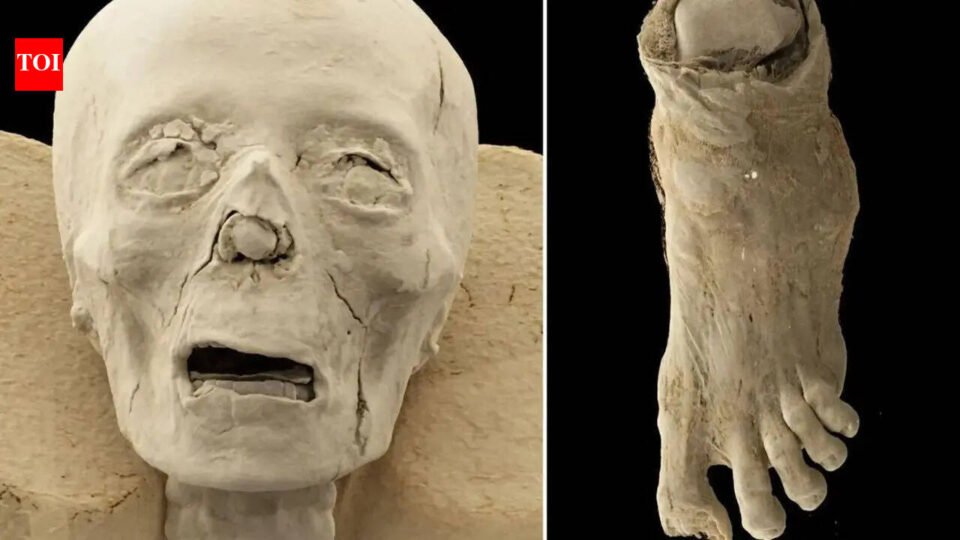
The latest imaging work on ancient Egyptian remains has brought unusual clarity to mummified body parts that were sealed for over two millennia. Scientists using advanced CT and 3D scanning technology have examined limbs, skulls, and a foot that dates back more than 2,300 years. The remains, reportedly from between 401 and 259 BCE, were preserved in museum collections for decades but had never been studied in such detail. What appears now is a clearer internal view of bones, bandages, and structural damage that was previously hidden. Experts say even small features, like missing bone sections and disease traces, are now visible without unwrapping or damaging the mummies. It’s a rare look inside ancient preservation methods that still aren’t fully understood today.
Egyptian mummy scans reveal skulls, feet, and limbs in high-resolution detail
The CT scan focused on multiple body parts, including two skulls, two lower limbs, a hand, and a single foot wrapped tightly in linen bandages. Each item was scanned using high-resolution imaging systems. The results were sharper than earlier attempts. Researchers reportedly say earlier examinations missed several internal details.One of the most striking finds is the foot. It still carries its wrappings. The bones inside are clearly visible through the scans. A portion of the big toe appears missing. It looks like damage that happened either before or after mummification. No one is fully certain yet.At one point, the same foot was thought to belong to a bird. That idea has now been ruled out.
Egyptian mummy bone analysis reveals signs of disease and mixed age remains
Some of the bones show signs of disease. One lower limb appears affected by osteoporosis. That condition weakens bone structure and can make fractures more likely. In ancient times, it might have caused serious mobility problems. Possibly even fatal injury.Another limb seems to belong to a younger individual. The bones are less developed. Growth patterns suggest a different age group, though exact details are still under study.The hand remains more uncertain. Researchers are still trying to determine whether it belonged to a child or an adult. Size alone is not enough. Bone structure and development markers are being analysed more closely.Nothing is confirmed completely yet. But early findings point to multiple individuals rather than a single burial set.
What the scans actually showed
The imaging work was carried out at a medical research centre linked with Semmelweis University. Scientists used CT scans and 3D reconstruction methods to see inside the wrappings.The images reveal layered bandages pressed tightly around bones. No cutting. No unwrapping. Just digital reconstruction.Skulls appear intact in structure, though slightly deformed due to time and pressure. Some facial bone outlines are still visible. Teeth positions can be traced in one of the heads.A few scans even show internal gaps between bandage layers. These spaces may have been intentionally created during mummification, though experts are still discussing this.
Ancient preservation techniques still unclear
Ancient Egyptian mummification remains one of history’s more complex preservation practices. Bodies were treated using drying agents and wrapped carefully in linen. The goal, it seems, was preservation for the afterlife.Some researchers think specific materials were used to slow decay. Others suggest ritual methods played a role too. The latest scans add more questions than answers. The internal structure of the remains shows careful wrapping, but also variation between individuals.
