
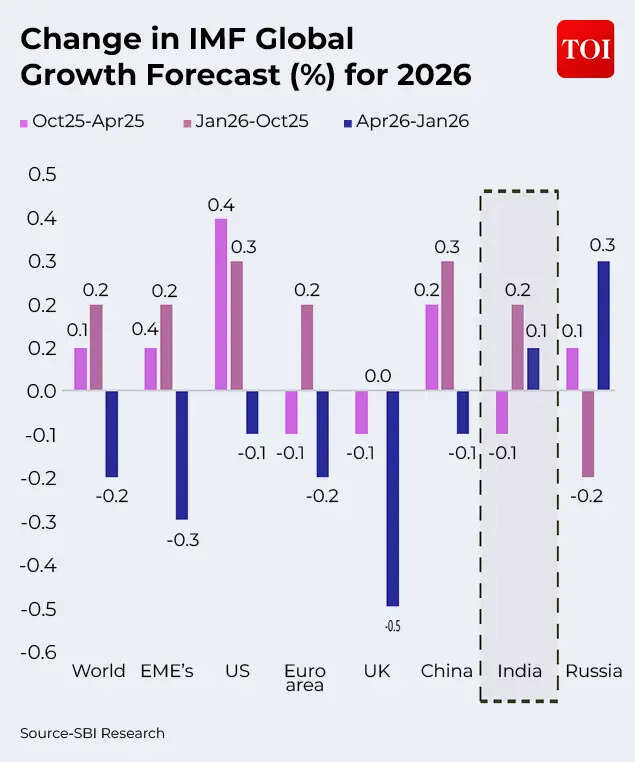
India, backed by its strong domestic growth story, is the world’s fastest growing major economy. Which is not to say it is without its vulnerabilities. The US-Iran war has brought home industry-wide supply disruptions, oil and LPG supply restrictions, and fear of imported inflation in the form of higher crude and raw material prices. But the domestic consumption story holds strong, say economists.So much so that the International Monetary Fund (IMF) has actually raised India’s GDP growth forecast for this fiscal to 6.5% while downgrading most other economies. Yet India is faced with the fresh risk of less than normal monsoons. Will this stoke inflation further, adding another chink in India’s growth armour?
The India Meteorological Department has forecast the possibility of El Nino conditions during the South West monsoon season. The seasonal rainfall in India is likely to be at around 92% of the Long Period Average. According to an SBI Research report, the forecast is the lowest since 2002!Economists and experts note that a weak monsoon will add to the woes caused by higher crude oil prices, and fertilizer supply disruptions. While the exact impact of the Middle East conflict will depend on its duration, the supply chain issues will not be immediately resolved even if the US and Iran agree to end the war.If a weaker monsoon impacts the output of crops, then higher food prices will feed quickly into inflation, a risk that is too real to be ignored.
What is El Nino and how does it feed into inflation?
First, let’s understand what El Nino is – it’s the warming of sea-surface temperatures, which happens periodically, in the central and eastern Pacific Ocean. This disrupts global weather patterns, and the impact is felt differently depending on what part of the world you are in.For India, it can weaken the Southwest monsoon, hence leading to below-normal rainfall and sometimes raising the risk of drought.
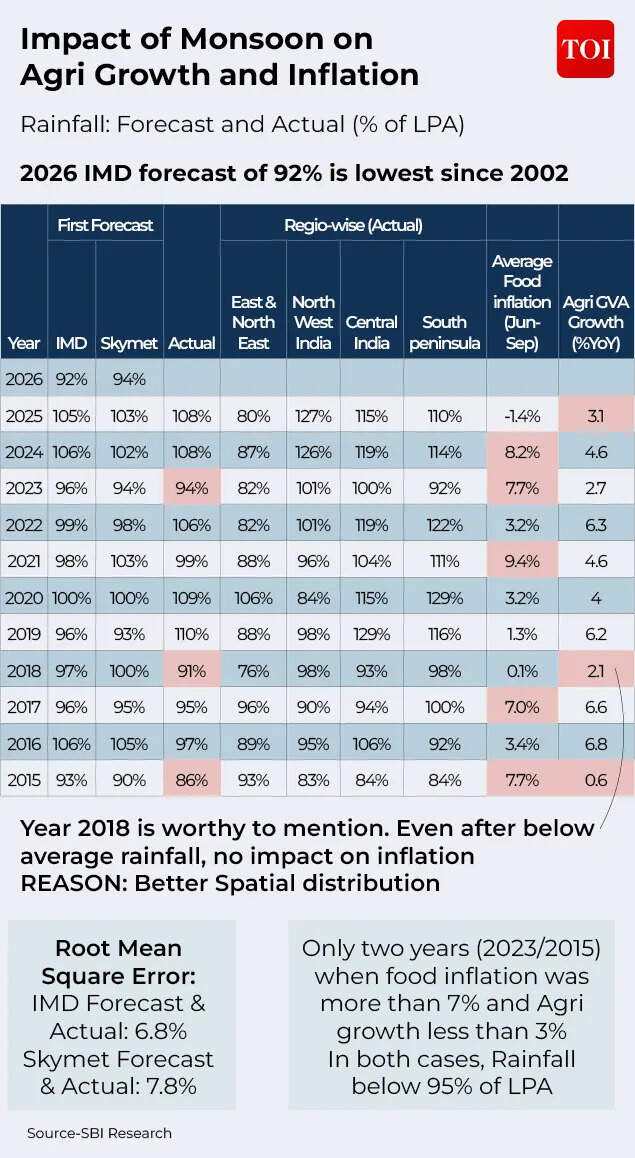
According to the Ministry of Earth Sciences: In general, during the El Nino event, the Indian summer monsoon is weaker than normal, and the intensity of the event also decides the amount of impact on the monsoon. Since 1950, there have been 16 El Nino years, out of which 7 years had impacted Indian monsoon rainfall when rainfall was below normal. Yuvika Singhal, Economist at QuantEco explains that the while El Nino around August could mean a timely onset of monsoon and its initial progress, and thus a near normal sowing for the upcoming Kharif season, a shortfall in rainfall over Aug-Sep-26, could materially weigh on quality as well quantity of Kharif crop production. “This downside in production may get amplified by inadequate stocks of fertilizers amidst the Middle East crisis. Eventually, this could lead to an upside in food prices in the second half of FY27, especially those of perishables, pulses and oilseeds,” she tells TOI. Government’s offloading of buffer stocks of rice and wheat via open market sales, may keep a lid on cereal prices, she adds.A summer El Nino may pose a greater threat to Indian monsoon, says SBI Research in its latest report. Among tomatoes, onions and potatoes, SBI Research expects the prices of tomatoes to shoot up due to El Nino. No impact on potato prices is seen, while onion prices tend to trouble the common man even in case of a normal monsoon year.
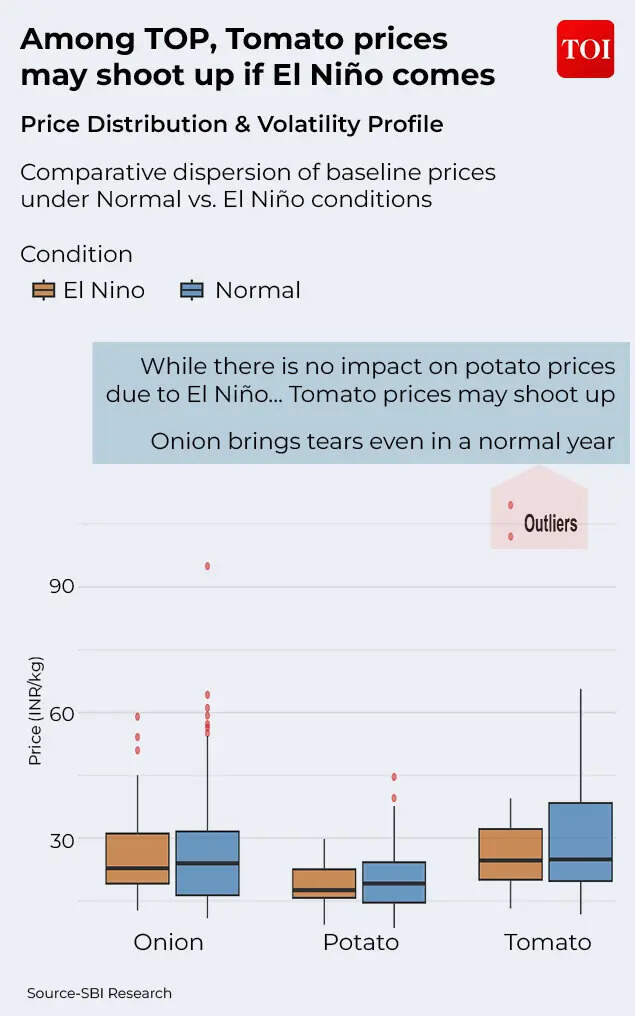
Apart from tomatoes, which items are likely to be impacted?Sachchidanand Shukla, Group Chief Economist at Larsen & Toubro says, the commodities most likely to see the sharpest price rise from El Nino are food-linked crops among domestic ones and cocoa, coffee, sugar, palm oil among global ones. High crude prices add a second layer of pressure to energy-linked items such as fuel, fertilizers, and logistics costs, he tells TOI.SBI Research notes that the contribution of allied activities in agricultural (Gross Value Added) GVA has been constantly expanding from 35% in FY12 to around 46% by FY24. This implies that the impact of El Nino is likely to be contained, it says.
What does it mean for inflation numbers and GDP?
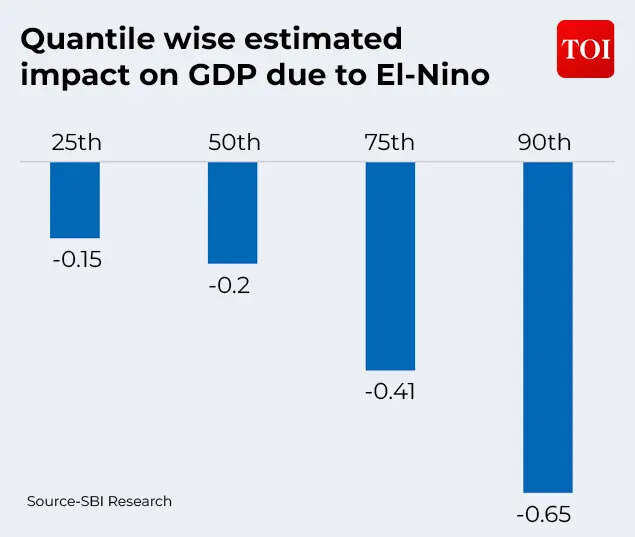
Back to back supply shocks in the form of crude oil, gas, fertilizers, and now possibly crops may imply a situation of higher than expected inflation, and lower than projected GDP growth.SBI Research estimates that only El Nino is likely to have a negligible impact on India’s GDP growth. However, a condition of El Nino plus drought is estimated to bring down GDP by around 20 bps in the median estimate and around 65 bps in the extreme scenario, it says.
Ranen Banerjee. Partner and Leader, Economic Advisory Services, PwC India says that if a full El Nino effect comes in, the IMD has forecasted around 8-10% shortfall in monsoon rains from the long term average. The impact this year of a shortfall in monsoon rains could be exacerbated by the fact that the reservoir levels are running below half their capacities, he warns.This will lead to a spike in food inflation for the Kharif crop. If the elevated fertiliser prices and their lower availability continues from a prolonged conflict induced disruption in supplies, then there could be adverse impacts on the Rabi output too, Banerjee explains.“With a very low base of food inflation, the headline inflation is likely to go higher and breach 5% but it is likely to be still within the 6% higher tolerance band of the RBI in Q3 and Q4,” he tells TOI.Yuvika Singhal is of the view that inflation will also depend on the intensity as well as duration of the conflict in the Middle East. She points out that even in the best-case scenario, if the ongoing negotiations between US and Iran were to lead to an end of war immediately, the damage to oil infrastructure in the Gulf as well as normalisation of energy supplies could take at least a few weeks.
- Keeping in mind the high dependency of India on imports of crude oil, LNG as well as LPG, as also the sharp escalation in energy prices, the pass-through to inflation especially WPI is already underway.
- We saw a near doubling of WPI inflation in March to 3.88% from 2.13% in February, led by rise in cost of energy as well as other crude derivatives used in a variety of industries (Rubber, plastic, Chemicals etc.).
- In comparison, upside in CPI has been restrained, as the government continues to insulate consumers.
- Having said that, if the Middle East conflict does not de-escalate soon, the high under-recoveries on both petrol and diesel may compel the government to pass the cost burden to consumers partially.
- A hike of Rs 5 each in petrol and diesel price, could add 20-25 bps to headline CPI inflation directly, with 90% of this increment coming from petrol. For now the government has clarified that there are no plans to raise petrol or diesel prices.
- Topping this would be back loaded pressure on food prices in the second half of FY27 owing to the anticipated below normal performance of Southwest monsoon, she says.
Singhal says it is prudent to await the second long-range monsoon forecast from IMD, to assess fully the upside risks to food inflation. “Assuming an average crude oil price of $85 per barrel and a below normal monsoon, we forecast FY27 CPI inflation at 4.5% and India GDP growth at 6.6%. Needless to add, risks to inflation and growth are stacked on the upside and downside respectively,” she says.Sachchidanand Shukla believes that more than a weaker monsoon, persistently high crude oil prices would have an impact on inflation.“A weaker monsoon can hurt kharif output and lift prices of staples and edible oils. However, the key risk is if crude oil remains persistently higher than it can feed into fuel, freight, and input costs, which then spill over into broader inflation. That may pose a risk to RBI’s 4.6% estimate for FY27,” Shukla told TOI.
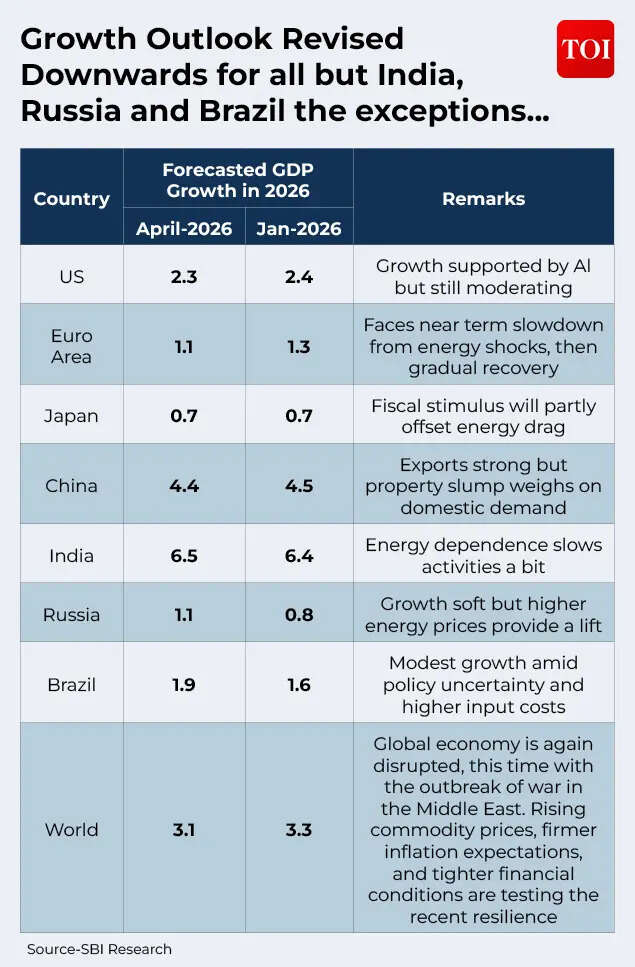
With this combination (weak monsoon + high crude prices) one can expect some pressure on real income and consumption if inflation rises faster than wages. Growth can be a tad slower in the first half of the fiscal, if rising inflation constrains consumer spending, he says.“Net-net we are likely to face a period of firmer inflation and softer growth risks in the first half but that will still be much better than peers or global average,” he concludes.SBI Research exudes confidence: India continues to demonstrate resilience with GDP likely to grow in the range of around 6.8%-7.1%, despite global uncertainties and regional conflicts. Its report lists strong domestic consumption, investment in infrastructure, and robust services sector as drivers of economic growth. On the flip side, geopolitical issues, oil prices, supply chain disruptions, and now El Nino pose a risk to the outlook.
