
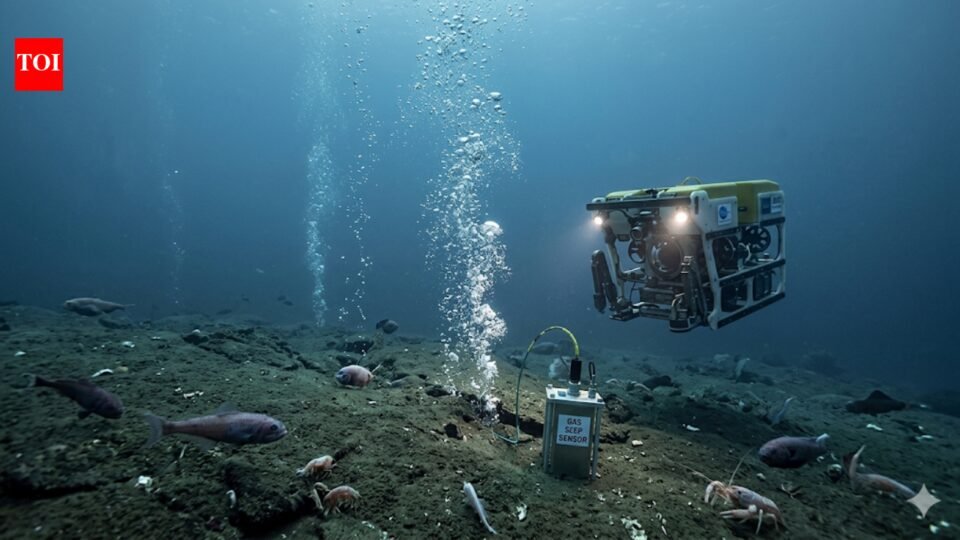
There is evidence of a phantom gas leak occurring in the middle of the sea, which could contribute to a rapid increase in the destruction of the Earth’s climate. This is a newly discovered oceanic gas leak, which largely consists of methane leaking out of the ocean floors. Experts who study the phenomena of oceanic methane emissions, sub-sea emissions, and feedback loops associated with climate change have expressed their worry about how fast it could contribute to global warming in a way that could not have been anticipated earlier. The discovery underscores the need for improved ocean surveillance, climate modelling, and emission tracking technologies worldwide.
Phantom gas leaks explained: scientists detect mysterious methane emissions in open oceans
“Phantom Gas Leaks” can be described as the release of gases whose origin is not clearly traceable. In this instance, scientists have found unusually high levels of methane escaping into the atmosphere from areas of the open sea distant from any identifiable industrial operations like oil and gas drilling sites. The discovery was made using satellite-based technology together with deep-ocean sensors.A research paper authored by the School of Chemistry and Chemical Engineering, University of Surrey, Guildford, United Kingdom states that “unusual methane plumes have been reported from areas believed to be geologically stable.” Based on the researchers’ analysis, these phantom emissions could be due to the breakdown of methane hydrates under the sea floor.The scientists who conducted the research said during their presentation:“We are now witnessing methane bubbling up from the ocean floor in locations that we did not expect. This indicates that environmental factors, such as rising ocean temperatures, might be causing such emissions.”
Why methane leaks in the ocean matter for climate change
Methane is a powerful greenhouse gas, and its global warming potential is more than 25 times higher than that of CO2 over 100 years, as stated by the University of Southampton. The leakage of methane from the ocean bed into the atmosphere can substantially increase the effects of global warming.The issue with these ghost emissions is their unpredictability. While industrial greenhouse gas emissions can be monitored, managed, and quantified, natural emissions caused by warming seas form a self-sustaining cycle. The more the oceanic waters warm, the more methane hydrates become unstable and release methane, contributing even further to global warming.An article called “Quantification of undersea gas leaks from carbon capture and storage facilities, from pipelines and from methane seeps, by their acoustic emissions Available to Purchase” states that:“Warming of the ocean could cause hydrate stability to be exceeded, resulting in abrupt and hard-to-quantify methane emissions.”
Gaps in monitoring and the risk of hidden emissions
One of the worrying factors about this development is the amount of time that the leakage was not detected. The current system employed to monitor the planet’s emissions is largely centred on observing land-based and industrial emissions.The scientists have therefore recommended the improvement of the observation system, particularly with satellites and underwater drones. Otherwise, such occurrences can go undetected and continue to contribute to the increase in greenhouse gases.Leakage of this magnitude in the middle of the ocean might imply that the global carbon budget may be underrepresented.
What this means for the future of climate action
The detection of the phantom gas leak has become even more critical in terms of global climate policies. This situation illustrates the difficulty and complexity of the planet’s climate system and how unknown variables could hinder efforts to reduce the adverse effects of climate change.This problem will need global cooperation, financial investment for studies on the oceans, and the inclusion of marine emissions in climate policies. In addition, this event proves that the limitation of temperature increase is crucial, since even a slight rise can have significant impacts.In this case, as further scientific analysis unfolds, one thing becomes apparent: the oceans, which act as protectors from climate change, may also contain hazards.
