
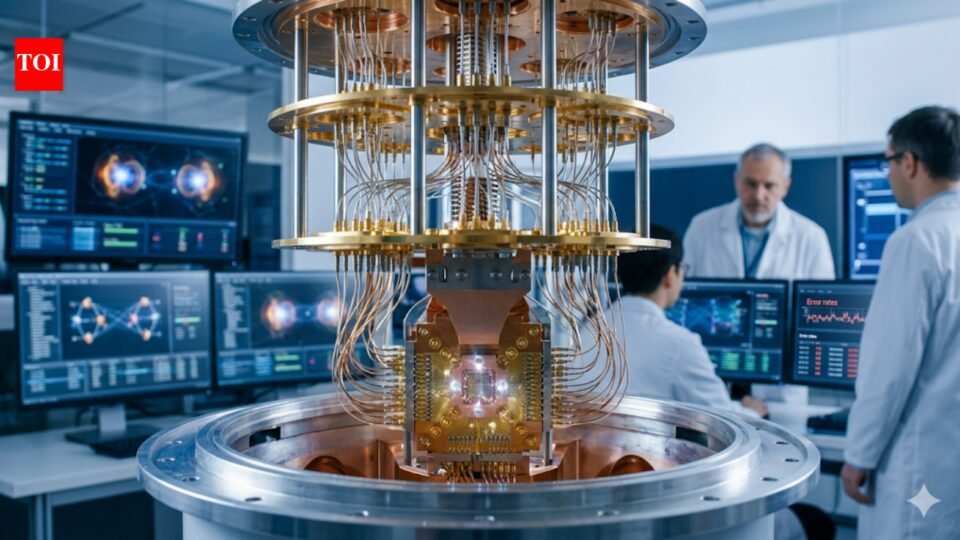
Physicists have modelled a quantum mechanism that can result in the end of the universe through the mechanism of false vacuum decay, which is a process based on the theories of quantum field mechanics and cosmology. Scientists have examined how an unstable vacuum condition called a false vacuum can be transformed to become a true vacuum, resulting in a catastrophic occurrence that leads to the destruction of the universe. Scientists have used quantum computing, Rydberg atoms, and quantum annealing techniques to study the processes of bubble nucleation, vacuum instability, and cosmic phase changes.
What is false vacuum decay in quantum physics
Central to this investigation, therefore, is an almost metaphysical-sounding notion: the belief that empty space is, in reality, anything but empty. The quantum theory of fields suggests that the vacuum, while being the state of lowest energy, is certainly not the ground state.In the study, “False vacuum decay in quantum spin chains”, scientists argue that our universe might find itself in a “false vacuum”, a state of stability that isn’t really the most stable state.However, should another, more stable condition, or the “true vacuum,” exist, the transition from one state to another is called false vacuum decay.As scientists describe this phenomenon, it will happen suddenly, originating in a minuscule bubble, which propagates outward at the velocity of light.
How scientists simulated a universe-ending quantum process
The latest success in simulating this concept was achieved recently in an article entitled ‘Stirring the false vacuum via interacting quantised bubbles on a 5,564-qubit quantum annealer’. In this study, researchers managed to simulate the formation of false vacuums using Rydberg atoms in a ring-like configuration, which they excited using lasers. This resulted in creating two different energy states, namely the false vacuum and the true vacuum. The scientists then managed to observe the decay process from the false vacuum state towards a lower energy state as predicted theoretically. Another group of researchers from the University of Leeds used a quantum annealer with thousands of qubits for simulating the process of forming vacuum bubbles, their growth, and interaction with each other. According to a Professor of Particle Physics at the university, the consequences of such a simulation are disastrous:“The universe will fundamentally change its structure…collapse like a house of cards.”
Could this process really end the universe
Sure, but certainly not in an instant or easily predicted manner. The concept of the false vacuum decay implies that the change might take place anywhere at any time.But in case it happened, the expansion of the newly formed bubble would proceed at the speed of light, giving no possibility to detect it or get away from it. As one scientist put it:“Whatever was… would disappear immediately.”But it is important to stress that this process is considered to be very unlikely. Existing theories claim that if this phenomenon takes place, it will happen within millions or even billions of years.
Why this research matters for understanding the cosmos
While such simulations may seem to portend the coming apocalypse, these experiments are actually very useful in that they investigate one of the most difficult problems in physics today: the unification of quantum mechanics and general relativity.False vacuum decay is right in the middle of this problem. Using simulations for false vacuum decay helps scientists study how basic physical laws operate when pushed into extreme environments. The results could provide insights into the nature of our universe.It can even provide information on how the universe originated. There are ideas out there which say that a transition like false vacuum decay happened shortly after the Big Bang.Essentially, all this simulation does is help science better understand the basic laws of physics in action.
A quiet but profound implication
There is a sense of uneasiness inherent in this concept. Although the universe seems to be consistent, logical, and eternal, science indicates that its consistency could be temporary.For now, it is just a theory, not a reality. However, the fact that researchers are able to model this theory shows how far we have progressed.It demonstrates that there is still much about the universe that we do not know and that even nothing could be far from being passive.
