
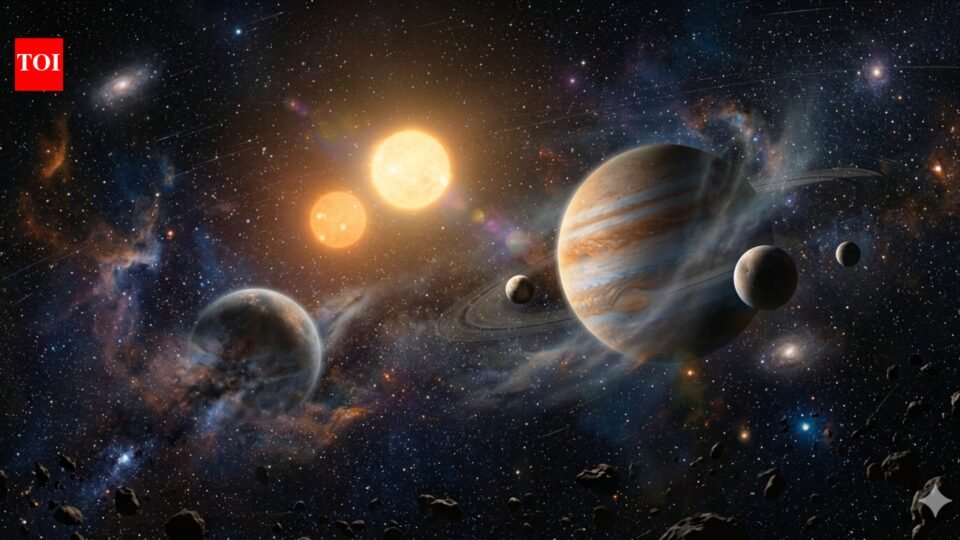

The idea of a planet orbiting two suns has long captured both scientific curiosity and public imagination. Popularised by science fiction, such worlds, known as circumbinary planets, do exist, and astronomers have confirmed several beyond our solar system. Yet, a puzzling pattern has emerged: many of these planets seem to vanish from observation. They are not destroyed, nor do they drift away into space. Instead, they become temporarily invisible to our instruments. Now, scientists believe the explanation may lie in the complex orbital mechanics predicted by Albert Einstein, reshaping how we understand these elusive systems.
The mystery of disappearing two-sun planets
While most planets orbit around one single star, circumbinary planets revolve around two stars simultaneously, thus having an extremely active gravity system compared to our solar system. The discovery of circumbinary planets was made by NASA’s Kepler Space Telescope; one of those is the famous Kepler-16b. Nevertheless, scientists observed a phenomenon where those planets disappear from their observations after a certain period.They do not vanish literally, but according to recent studies, ‘Capture into Apsidal Resonance and the Decimation of Planets around Inspiraling Binaries’, planets’ disappearances can be explained by the following phenomenon: the change in their orbits makes them invisible as they can no longer transit across their parent stars. As stated in the study, “transits may cease for extended periods due to orbital precession.”
Einstein’s role in orbital precession
The secret behind all this is orbital precession, a slow rotation of the orbit of any object with time. Although this process could be explained within the context of classical mechanics, Einstein’s relativity explains in much greater detail how any massive body affects space-time.In binaries with two stars, gravity becomes even more complicated than that. As described during explanations of relativity, “massive bodies can ‘curve’ space-time, thus altering the motions of other bodies moving in their vicinity.” This curving causes some minor yet important transformations in the motion of planets.In circumbinary planetary systems, these transformations lead to the oscillations of a planet’s orbital plane. As a result of such oscillation, a different inclination of a planet’s orbit to Earth occurs over time, making transits less frequent. Eventually, the planet disappears from sight due to misalignment.
A temporary vanishing act, not a cosmic loss
It is important to note that the planets have not been permanently lost. The orbits of the planets are dynamic in nature and, with time, will be aligned in such a manner that the planets become visible again to our telescopes and other observation tools. This may take several years or decades to happen.The behaviour of these planets has been noted by scientists who conduct studies in circumbinary systems. The transit visibility windows are limited and can recur over time.” The practical application of this knowledge in the field of exoplanet research indicates that there could be many more twin sun planets that have not yet been detected.Rethinking planetary systemsTwo-sun planets’ ability to disappear from view serves as a testament to the ever-evolving and intricate nature of the universe. While something seems to vanish into thin air, it may only be that we aren’t looking at it in the right light at the right time. Thankfully, due to advances in Einstein’s theories and our current technology, scientists are now able to figure out the mystery behind such events.As more studies are conducted on the matter, experts are also learning how to forecast the next appearance of these two-sun planets, ensuring that they won’t miss it.
